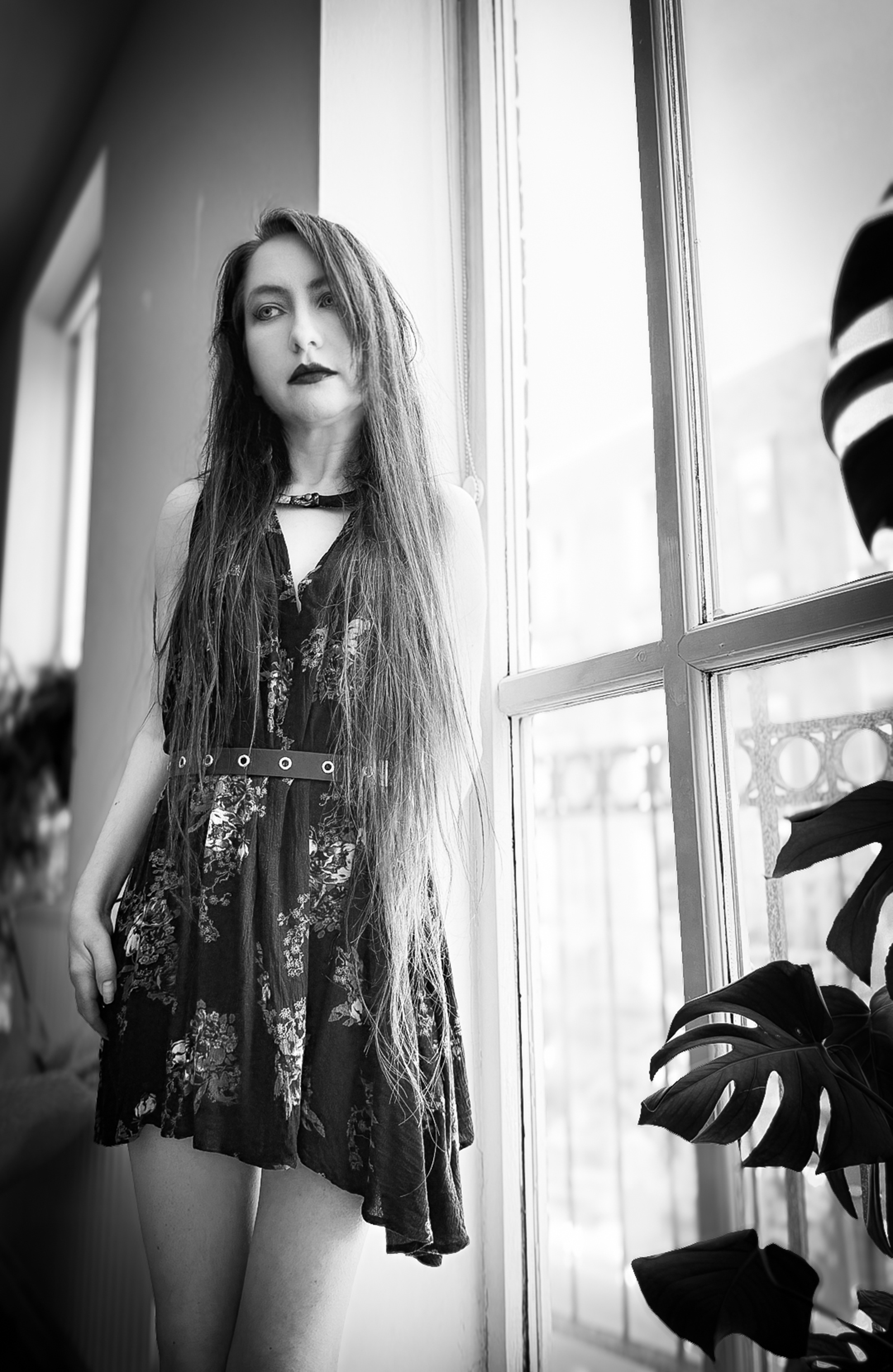
 Amanda Votta’s music is a play of shadows, an attempt to approach the unspoken. “I like things that tell you something without saying it outright”—a line she drops almost casually in conversation—could be read as the poetic manifesto of the American musician and anthropologist, who in recent months has released striking albums with both her projects, Deep Fade and The Spectral Light. Her pieces resemble traces in the fog: fleeting, spectral, yet marked by a peculiar intensity. With Obliteration, the new album of her collective The Spectral Light (together with Neddal Ayad and this time also Jon Free), she draws the listener into a world of heavy, drawn-out sound waves that move like a single black mass. Shortly before came Oblivion Spell, the latest work of her currently solo-driven project Deep Fade—raw, harsher, scarred by feedback and industrial noise, and yet suffused with an underlying melancholy. Where her earlier project The Floating World once conjured a drifting, dreamlike cosmos of sound, today there is the relentless presence of an abject feral noise. Characteristic of Votta’s work is her refusal to allow perfection: the creak of a chair, the squeal of a door, the accidental quiver of a guitar string—all of it becomes part of the piece, part of the haunting. In every track, what we hear is not only music but also the ghosts of its making: the room, the time, the invisible traces of a moment already long gone. We spoke with the artist about all this and more in the following interview, carried out in correspondence, to which her collaborator Neddal Ayad also contributed a few reflections.
“Obliteration” by your project The Spectral Light feels like a cohesive organism when taken as a whole. Was that the intention from the outset, or did the pieces gradually come together to form this kind of structure?
When Neddal and I make an album together, or when either of us makes music at all, I don’t think there’s ever much of a plan for it. We don’t sit down pick a specific direction. It’s always been more about a feeling, and following that feeling. A lot of what we do is intuitive, and it has been all along, which is likely why we’ve been collaborating for so long. We first collaborated in 2005 or 2006 as Secrets to the Sea, which morphed into The Spectral Light.
While there’s no specific plan when we make an album, we do always know what a Spectral Light album is going to sound like. It’s always going to be heavier and darker, and it’s always going to express things we couldn’t or didn’t with other projects, sonically and otherwise. Part of that, too, is that we generally let the songs wander. There are almost movements to them, which is something I didn’t consider until a friend pointed it out recently. We love a lot of the same music, and a lot of that played a role in shaping the sound, without us really saying too much about it to one another.
We both also tend to work slower than a lot of other people do. So, there are some temporal gaps between the first song and the last. That never seems to matter though, since once we start making the songs, they fall into place without a lot of effort.
Obliteration is a cohesive thing in the end because we work off that feeling the whole way through, this thing that makes us start an album in the first place, whatever it is. We’ve always been more or less improvisational in that way. It matters more that something conveys the wordless thing that started us making the songs than if there’s something more formal or technical tying things together. The songs are all alive, they have a mind of their own, and in a way, we’re listening and figuring out what it wants to be as we go.
I was talking with Neddal about this question, and his take was that we have a very strong idea of how TSL should sound and as we were writing these songs, we knew they’d be TSL songs. He also agrees with it being a very intuitive process. I think we’re both thankful for that, because there’s really no struggle to make music, it just works.
There are passages on the album where the flute and electronic textures not only coexist, but seem to blend into one another. Some of the flute parts sound almost like distant, disembodied voices. How did you create this transition—technically and compositionally?
I haven’t used flute on an album since The Floating World album, The Wood Beyond the World, which was recorded in 2013. Our first Spectral Light album didn’t have flute either. TSL was basically my escape from what I had begun to feel was a dead end musically. I had done everything I could think of with The Floating World format and needed to move on to other things. Impermanence, the last Floating World album, doesn’t have flute, either. That one was an intentional break from the past. Especially since it had been so long since I’d released anything, and a lot had changed in that time. It’s a lovely instrument when used in a certain way, but it was also very limiting and did not capture the breadth of what I was trying to do. So, anything you hear as flute is either voice, or electronics, or the noise I recorded and mutated as we were making the album.
Some pieces on “Obliteration” seem to consist almost entirely of changing drones, without a clear melodic focus. What appeals to you about this form of musical storytelling?
For me, melody has always been secondary. I like texture, movement, I like suggestion and atmosphere. I like things that tell you something without saying it outright. Mutating drones give a lot of room for interpretation, too. It’s, again, about creating an atmosphere, where there’s a sense, a feeling of something. It’s almost like a haunting, being haunted, trying to nail it down but there’s nothing solid enough to define it. You just listen and are enveloped in this suggestion—the atmosphere, the feeing—offered by sound. Making music like this feels more open to me, too. There’s more room to experiment, to take things in a different direction, or to not have direction. Which I also like. The song isn’t telling you what to do musically, it’s hinting, the same as it hints to a listener what kind of song it is. It lets us wrap it in layers of meaning or feeling and allows you to hear in it whatever it is you hear.
Neddal will talk about this some, but we intentionally leave in things that other people would edit out. I love hearing a room when I listen to music—where it was recorded, was the window open, were you moving around, is there rain. I love that kind of immediacy, and also that kind of sound you’re told isn’t musical. But it is. Or a “mistake” when you’re recording, a wrong note, timing is off. Sometimes, your accidents make a song what it needs to be. In that way, you again have this aspect of sound haunting a recording. Not just this recorded music that’s almost like a ghost because it already happened who knows how long ago and you’re aurally witnessing its disembodied passage every time you hit play. But a ghost in the sense that now you’re also hearing the ghost sound of the room, the people, who made that song. A double haunting of the foreground—the music—and then all of the spatial-temporal aspects of the moment that song came into being. When things get mixed, I never want it to be what everyone thinks of as perfect. I don’t want that super clean sound. It’s not right for this music, it strips so much of what’s in there, that we did, that happened. And I think that aspect of accident and unintended sound is essential to this music.
I want the songs, the album to be that ghost and it won’t be that ghost if I take out every creak of a chair or a door, or a footfall, if I edit out a guitar string briefly sounding because one of us accidentally brushed it. Those sounds are as important as anything else that goes into an album.
Neddal had something to say about this one: I very rarely think in terms of melody. That being said, there are definitely melodies lurking beneath the haze. Jon’s playing on Branch is very melodic. If Moonsinger were played on an acoustic guitar it would sound a lot like Stone Breath or Woven Hand, those droning modal melodies. There’s a slide guitar motif in Obliterate that could be melodic. I’d also think of the synth/organ parts during the outro as the melodic part of that song.
But also, I listened to a lot of Black Sabbath, and in a lot of ‘Sabbath songs riffs serve a melodic function. They’re the most memorable parts. There are also very few songs with choruses on the Ozzy era albums. So I think that’s always at the back of my mind.
I like to make people work. And I like the idea that people are going to hear it in an abstract way and bring their own meanings to the songs. This ties into both of our approaches to recording and mixing too. We leave in a lot of “accidents” that most people would edit out. So it’s never just the music, it’s the music, the room, our movements. When you mix too, there’s what we recorded but there are all these resonances and ghosts of sounds happening and we try to…I wouldn’t say highlight that, but they’re there and again, it’s that abstraction, and wanting the music to envelop the listener.
At times, the music is so quiet and minimal that you almost feel like it could disappear at any moment. Was this a deliberate attempt to translate the album’s title, “Obliteration,” into sound?
That’s an interesting question. The title came after the songs, as it always does for us. When recording it, we didn’t have a solid concept, like I said. But this is one way you can think of the title, absolutely. It’s also interesting in terms of sound. I wasn’t considering this a quiet album, or even the quieter parts of it as actually quiet, while we were making it. Maybe I’d say we have hushed passages that are like the moments between waves. It’s tension, anticipation, waiting on the cusp of something. Quiet can be that, but it’s an active quiet here, which is why I wanted to say hushed instead of quiet. This is something we both do a lot of, sound rushes and swells and breaks, and then you have a moment between swells. It comes more, I think, from a desire for sound to be dynamic, to reflect the kind of tension and frustrations and unknowing anticipations that inform what we’re doing, the way life is and isn’t. And it’s part of a lot of the music we like and listen to.
And, we’ve both always lived near the water—lakes, rivers, the ocean. The sound you live with that surrounds you plays a role in the sound you make. At least for us it does. That rush and swell and the space between it all comes from that, too.
Was there a specific moment during the recording process when the album’s theme crystallized for you?
It’s always, again, more like a feeling than anything. With Obliteration, we wanted to make something that was both immediate and distant, a sound that comes from somewhere else but that invades your awareness. A way of saying things without saying things. It’s hard to say there’s a single theme here, or on anything either of us do. Things—feeling, meaning—are layered, just like the sound is and it’s always many things at the same time. I think we know what an album will sound like from the first song, and that’s as close to a defined theme as we ever get. In a way, everything is also always the same theme, just recorded differently, with a different overall sensation to the sound depending on instruments and noise used and not used. Each band, each album, is a variation on that greater theme. Which I still don’t have a name for, even though I’m thinking about it as I answer this question. The closest I can get is to say it’s a little like the numinous, which is a concept from Rudolf Otto, a theorist of religion. It basically means a wholly other, something entirely outside ordinary life, that evokes silence, terror, but is deeply appealing and compelling. But that’s still not really it.
Neddal and I have talked some about themes, and generally think the same about it. That it’s a variation. The specific manifestation depends on current circumstances, what aspect of that theme is more prominent. I realize I’m saying these things without defining a theme. But that’s how we record, there’s a lot unsaid that comes intuitively, from knowing one another for such a long time and having made many albums together at this point.
 The album title (which in some way sounds like a more drastic twin of “Impermanence” by The Floating World”) suggests a disappearance, an obliteration. Is that more of a destruction for you, or something like a transformation?
To me, transformation implies destruction, as destruction implies transformation. Both are necessary parts of one another and happen at the same time. I can say that we have both experienced a lot of those in the past few years, and Obliteration was, in a sense, a way of putting all of that experience into something. It conveys the sonic equivalent of how it’s felt, what that has meant in a life, personally, daily. All the frustration and stoppages and things that don’t work, or stop working, or maybe never did work in the first place.
It’s also saying something about how we hope people experience the album. I mean that we don’t do proper song structure, so when you listen to it, it goes against expectations for a song-centric album. It’s more a sound-centric album. And, it’s saying something about what we hope it does for people who listen. There’s always some need in everyone’s life at various points to lose yourself in something other than your own thought, your own worry, your own self. You need moments of time where you can stop being who / whatever it is you have to be to get by. I know I do. If this album can provide that for a moment, wiping out thoughts of self and worry and ruminating on things you’d rather not—or even providing a space where you can fully embrace that—then that’s also something we want, and hope the title conveys.
Is there a connection between the album and certain memories that are only fragmentarily present in your own mind?
While fractured memory may be part of the album’s overall inspiration, at the time we were making this, my own fragmented memories weren’t necessarily at the forefront. It’s more like the forgetfulness of others. Sometimes you might talk about something that happened years ago with someone, and their recollection is either very different from yours, or they don’t remember the event, the incident, the place, at all. There’s something disconcerting about that, a realization that the past exists as long as its remembered. And that you and the people who are around you might have a shared past, but it can become a very different shared past depending on how it’s remembered, what’s remembered, what’s forgotten. Of course, you have to wonder then if your own memories of things are of those things as they were or as they became to you over time. But here, on Obliteration, we’re less interested in our distortions than the things forgotten or distorted outside of ourselves.
I wanted to ask you a few things about your Deep Fade album “Oblivion Spell,” which was released a few months ago. You produced this album almost single-handedly, and it turned out to be surprisingly noisy, even by Deep Fade standards. Did it all happen rather spontaneously? The album was recorded in different countries and locations. What can you tell us about the recording process?
This is the album I’ve wanted to make all along but didn’t for a variety of reasons. Some of that was having been made to feel like I was supposed to follow a particular musical path, and that didn’t include making noisy industrial messes like Oblivion Spell. Part of it was thinking I couldn’t do it anyways. How to take that much noise, that many layers, and do the technical work of making it all sit in a single track, cooperatively, so you can hear what you’re supposed to hear? That took a lot of learning before I felt proficient enough to do it. The final Floating World album, Impermanence, was sort of like a practice run for Oblivion Spell, though much less ferocious.
I wanted it to be entirely mine, something I did because I wanted to, and not a collaborative effort in any sense. I asked Grey Malkin (The Hare and the Moon, Black Swan Triad) to send me something for one song, and Cecilia Bjargo (Arcana, Sophia) to add vocals to another, but that was the extent of having anyone else contribute. What they each sent, I then processed and mixed in, shaping it in the way I wanted it to sound. Which, like I said, was an important facet of making this album for me. It had to be something I did, myself, to show myself I could do it, so I could keep doing it. Oblivion Spell is Deep Fade; this is what I envisioned when I laid Floating World to rest and started Deep Fade. It’s what I want it to continue being. I think anything else will have to be Spectral Light, or even another new band.
It wasn’t at all a spontaneous album either. It took over a year to make, the songs went through many iterations, some remade 10 times. Recording went on that whole time, and what I recorded depended on where I was and what I had at hand. I traveled during that year, which made it impossible to use the same exact gear or space the entire time. But that’s something that’s always been part of making music for me. For Oblivion Spell, sometimes I was walking around recording all the noise of a city. I did that a lot in Liverpool and Edinburgh. Construction works, traffic, anything, and I’d often take those recordings, convert them to midi and start experimenting with putting different synths on them or converting them to drums. Sometimes, I’d cut them up and use pieces as they are, layering them and making different parts more or less audible depending on what the song needed at that point.
I’m not really fussy about gear. I’ll use whatever I have or can get to make things. For me, it’s a lot more about what you do with something than the something itself. That’s not to say that different guitars, say, don’t have a different sound. They all do. But if I have some Fender Squire Telecaster at hand, that’s what I’m using. If I have a Danelectro Baritone, I’m using that. I’ve used both, and more. So that does also impact the sound. One way of handling it, of having used three different guitars, six synths, any number of drum machines, is to embrace the chaos that can create when you’re mixing tracks, and let it shape things. Which is part of Oblivion Spell, too, of how I recorded it and where its sound came from. It’s a lot of disorder that I somehow had to turn into semi-coherent songs. I didn’t want it to be too orderly, though, I like it as a piece of chaos.
How much does the idea of fading—whether of memories or emotions etc.—play a role in this very album?
Oblivion Spell was much more visceral. Like an embodied thing, living, shambling along. I don’t know that it was about fading so much as preserving. I wanted to convey a specific set of states of being here so I would remember them, more than anything. To remind myself.
When I named the band Deep Fade, I was referencing a type of fading that occurs as radio signals travel. Deep fade happens when strong, destructive interference disrupts the signal, which can result in a total loss of that signal. It can erase some of the information transmitted. So that’s kind of the idea behind the project as a whole, that severe disruption, deeply unsettled and unsettling, that happens when the ordinary falls away. Maybe it’s incomprehensible, maybe it’s transformed into something else, maybe now what you hear has lost something of the original—whatever the original may be. Maybe, too, it picked something up along the way. I think about fading more generally in terms of these different kinds of interference than in necessarily the everyday definition of “to fade” as something you’re losing. In sound, maybe you are losing something of what was, but it takes on other meanings, too, picks up other nuances and the glitches make it something else, something its own, something it’s become by traveling across space, time that it wouldn’t have otherwise. That’s the fading that comes out here in Oblivion Spell, with its disruptions and inconsistencies in recording.
The title “Oblivion Spell” sounds like a spell of forgetfulness. Is that more of a self-imposed protection (not to be confused with repression) or an external threat?
Those are two ways it can be interpreted, yes. I think of it definitely as a kind of self-preservation, of a reminder of states of being but also of a reminder to myself of myself, because I think most of us forget that at times. The person we are when we’re not performing a persona for a specific set of circumstances that require a specific thing from you. It’s a banishing, an exorcism, at the same time, of a lot of old ways of doing and being I don’t really like. Which can of course mean many different things and be taken many different ways, can be about self, other, place, event, memory, time. All are valid. But, like I’d said, it’s also about reminding myself of things, having something there to remind me. It was the most solidly ritual as songs album I have ever made. Not even just songs, but all of the things I made around it. The album art, the video.
There were certain things the making of it helped to blot out, so to speak, like the idea I couldn’t make something like this, it was beyond me. Or that there’s a single way to record and mix and master that’s correct and deviations from that create a lesser sound. That some things are musical, others aren’t. And it was also a way of saying I don’t want to go back to doing things the way I had, thinking I could only make certain types of songs because that’s what I do. This thing has been there all along, waiting, I’m just sad it took so long to emerge.
There are layers that come from my work, too, from listening to people, to women, talk about the effects on their bodies and lives of illness, pain, and the disbelief and annoyance and recriminations they are sometimes met with. Isolation, loss, rage are all part of that, too. It’s maddening, and speaks to this socio-political moment we live in that I find abhorrent, how it values and devalues people, and its historical presence—this is nothing new. Some of Oblivion Spell is a reaction to that.
There are other layers to it that come from a deeper personal level, of course, but those are only meaningful to me.
Is there a common thread connecting all the tracks on “Oblivion Spell,” or are they more like different facets of the same feeling?
I think there is, they certainly share sonic characteristics and aesthetics. They were all made through layers of sound and sense and meaning. They were all recorded and mixed in a way that felt much more instinctual than other music I’ve made. But they also function as different facets, because they are different songs, they express different things in different ways. Hologrammatization isn’t Possessor, in that way. I alluded to this when I said that some of what went into the ideas behind the album came from my work. It’s saying something about women, women’s bodies, our place historically, socially. By women I want to be clear that’s not an exclusionary category to me. I dislike hard lines drawn around something, meant to dismiss and other people who live with that enough. So, there is that, which was a commonality.
There’s also the Erich Lindemann Mental Health Center in Boston, which had its role in the whole album and its aesthetic. I’ll say more about that later, but here, I wanted to say that there’s something about that building that has always reminded me of some of the oldest sacred sites we have sites—caves, standing stones, passage graves. These places where some other world, other time, collides with this space we inhabit. It resonates in its way with the unknowableness of those ancient sites. We weren’t there, we can’t see or ever be fully knowledgeable of their function and purpose, though we try. There are so many stories about the building, hauntings and possible violence, that you can’t confirm. And when I worked as a researcher on a project that involved this building, I tried. But the people who work there will talk about these stories, the same as we repeat stories that could never be confirmed about these sacred sites dotting the landscape. The Lindemann and the stone circles, the passage graves, caves full of depictions of animals, human hands, they’re all part of and isolated from their landscape aesthetically, visually. They stand out, rising up from the ground, delving into it. Passages and corridors, the texture of the Lindemann’s walls and the often rough, pitted stone of Neolithic sites, cave walls, worn carvings, the sparse natural light making shadows flicker across the walls, the corrugated concrete. And, this sense of something else, whether history or hauntings—which may be the same thing, in the end. That sense is greatest when you descend the curving nautilus stairway in the Lindemann in order to ascend to the sacred heart of this place, the central chapel chamber. It’s almost like walking into / out of a solstice-aligned passage grave an ocean away. This wasn’t the intended purpose of the Lindemann, it’s all just me, superimposing my own imaginary on it. It seems to be a place that lends itself to that sort of thing.
Maybe it says something too, about the temples and gods that were and the temples and gods that are.
Many tracks sound as if they are hiding something, such as a more clearly understandable vocal track. Was it important to you that not everything be revealed?
Yes, it was. There are some things that benefit from being obscure, from a mystery, from layers of, here, sound and the reverberation of sound that mean more, ultimately, than if it were plainly said. This wasn’t the kind of album that was ever going to be open and clear. It should be a bit murky, you should have to think about it, consider it all in context. And, more importantly than that, I wanted it to be experienced as a visceral sensation, first and foremost.
Writer Susan Sontag has this idea about art, that involves critiquing critique. She doesn’t believe that knowing the meaning of something should be the first thing we want or get from any piece of any kind of art. Instead, we should first ask ourselves, how does it feel, how does that thing make me feel, what is my visceral reaction to it. This album has a lot more in common with her approach than anything. There is, of course, what it means to me, but what it means to me isn’t going to necessarily be what it means to anyone else. How could it be? They’d have to have my experience of being alive in the world for it to have the exact meanings it has for me. And that’s ok with me. I don’t put something out there in the world and expect everyone who encounters it to pull the same thing from it, for it to give them the same feeling or meaning or sensation it does me, or anyone else. That isn’t to say there can’t be commonalities of experience, feeling, meaning. Just that I want people to take what they take from it.
There’s a lot that can be revealed through concealment, though, it just requires listening.
In some recordings, by basically all of your projects, there are echoes of folk elements, but they often seem heavily distorted or interact with other (electronic, experimental) elements. What is your relationship to traditional music? Do you have any favorite artists or albums in this kind of music?
I have to say, the only folk music I’ve listened to is that made by people I know or that were part of the early scene The Floating World got lumped in with because the first album was on Hand/Eye. Stone Breath, The North Sea and Xenis Emputae were early inspirations in terms of atmosphere, and I do like murder ballads. There’s a certain atmosphere some folk has, that sorrowing, haunted feeling, that I like. But I haven’t ever been a folk person. I grew up in Detroit, and was exposed much more to old blues than to folk. And it’s more someone like Son House that I can point to and say the way he made music has had an impact on me. His playing was sometimes disjointed, off, he didn’t care too much about technical perfection in the way a lot of people mean that today. Which isn’t to say he lacked technical skill, because he certainly had it. But sometimes that’s only part of a bigger story, a bigger idea. That and being in concert band and church choir when I was growing up were more formative on how I think about music, what I think it’s for or means or should do.
The folk I know comes second hand, through someone like Leonard Cohen, or Mark Lanegan, even Cat Power. But folk itself wasn’t an impetus or a big part of my musical background. With The Floating World, I thought of it more in terms of a texture, or atmosphere than that I wanted to link it sonically to a particular genre.
For Neddal, who is from Newfoundland and surrounded by folk music and musicians, it’s different, though.
How does your environment—whether urban or rural—influence the sound of your music? The two previous Deep Fade albums, “Further” and “Line of Flight”, were openly location-specific. You’re located in Boston. Would you say that your surroundings play a part in the music you create?
I’m always located in a state of flux, rarely solidly in one place it seems. Boston isn’t really home, though I have ties to the area and have lived around there from time to time. Kind of like those albums, which were tied to location, but it was several locations. Further was something I traveled to record, picking out different spots along the Atlantic coast to find suitable lighthouses to sing at. That took me through New England, Scotland, England and Wales. And Line of Flight was sort of a meander through the city I’m from but wasn’t physically in when I was assembling the songs. Though some of the noise was recorded in Detroit. It’s the same with a lot of the music I make. It meanders, wanders, maybe someone would say it gets off track or it changes its shape, becomes something else partway through. The songs and albums overall are location based in that they wander along with me, picking up pieces of the places I go, or pass through.
Right now though, I’m very happy where I am and don’t really want to keep going other places. I’ve been tired of it for a long time now and being somewhere I want to be is nice.
That said, with Further we did want to evoke a North Atlantic feel to it, how the storms in winter come in off the ocean, the desolation, waves smashing rocky shore. You can find that in each location it was recorded in. Whether it’s Neddal recording in St. John’s or me somewhere in Massachusetts or England. When we make songs together, we’re doing it across distances, and out of synch—he sends me recorded parts, I send something back to him. And I think that plays a part too in the albums. Working across those distances, sound coming in from somewhere else, each of the places we’re in playing a part. I mean the rooms we record in, the actual spaces, not just the surrounding area.
On Oblivion Spell, I drew a lot on the Erich Lindemann Mental Health Center in Boston, which I mentioned but want to say something else about it. It’s an incredible Brutalist building, almost Geiger-like in the way the concrete is shaped and textured. It looks like an organism, a being, like it’s alive. Or once was alive. In spots, the concrete is formed into coiled shapes, like the fossilized remains of some unknown creature. There’s a disused chapel in the very center of the building, like I said, and the only light that comes in enters through a skylight set just above the altar. In the fall or winter, it’s very dim in there, and cold. But incredibly beautiful. Sound carries oddly too, echoing in spots to the point you can barely make out words and in others sound is muffled. At some point, I started thinking of the building as a body, as that alive-once-alive thing, blended with other bodies over time—human, non-human, the people and entities that have passed through that place. There are a lot of stories about it, violence and madness. But it’s also a place where people live, where they seek help, where they hope for relief. Paul Rudolph designed the building and he claimed he hoped the maze of interior corridors and seemingly off geometry would mirror the interior of patient’s minds. That’s a bit of a romanticized stereotype of mental health issues, but he did achieve a disorienting effect that you absorb from the place.
That all became Oblivion Spell. I shrouded the music in the coiled concrete, the dimly lit chapel, the stairways shaped like frozen, discolored ripples, textured arches like the unworldly bones of something we can’t name. There are layers, even in the locations an album comes out of.
 “Abject feral noise” is the term you use to describe your music. Could you tell us how how/when you coined that phrase?
That came out of some conversations I was having with my usual collaborators while I’ve been making music more recently, some things I was reading and writing about for my academic work, and the central feeling of the music I am and want to create. It was also descriptive of the process of making Oblivion Spell, of the things behind it, the sense it was intended to convey. It’s a disordering, it’s outside of everything else, and a break with everything else. So, it’s feral in the sense that it’s an escape from captivity, domestication, from the everyday life you’re expected to live and into the other thing that you are, that you want, that you always feel the presence of underneath it all. I was thinking, too, about maenads and what it is to completely lose a sense of that everyday self you’re supposed to be. How would that sound?
If The Floating World was more like a pleasant walk through a haunting, enchanted land, this is more like some unforgiving landscape, haunting like a poltergeist, inescapable and relentless, instead of a flickering ghost moving between the trees. That’s still here, really, because even when I was making things that sounded less overtly discordant, I was also trying to let that presence rise up as much as I could, to let the droning tones that underpin things unsettle and destabalise any hint of symmetry, let piercing notes ring longer. The ghost of this music has always haunted the old.
The abject comes from reading a lot of Julia Kristeva, specifically The Powers of Horror, and talking about it with friends, what the abject is and means there. Neddal was sending me work by other people that drew on and resonated with Kristeva’s abject. For Kristeva, abject describes a part of ourselves that exists outside of and is rejected by ourselves / the society / culture we exist in, but that we aren’t actually free from. It lives there in a liminal space between us / not-us. Her description of the abject was important for Oblivion Spell: “not the white expanse or slack boredom of repression, not the translations and transformations of desire that wrench bodies, nights, and discourse; rather it is a brutish suffering that, “I” puts up with, sublime and devastated. . .I endure it, for I imagine that such is the desire of the other. A massive and sudden emergence of uncanniness. . . A “something” that I do not recognize as a thing. A weight of meaninglessness, about which there is nothing insignificant, and which crushes me. On the edge of non-existence and hallucination, of a reality that, if I acknowledge it, annihilates me. There, abject and abjection are my safe- guards.”
Reading that passage again after years was really the catalyst for Deep Fade as a whole, and then Oblivion Spell in particular.
The abject is also something that’s close to the body, in that it threatens what’s “correct.” Abjection is transgressive. And, importantly, I think it’s transgressive in this patriarchal, capitalist world we live in. It’s visceral, and often, in film theory and criticism, connected with women, or the monstrous feminine as it’s put. I even think of this in terms of the work I do with women who have chronic illness and pain, whose bodies are dismissed, complaints still cast as some form of hysteria, rejected because women’s bodies that don’t fit some kind of stereotype of “health” exist outside of the normal, everyday spaces people inhabit. They fall into a liminal area, where things society rejects end up. Which doesn’t erase them from existence, as much as I believe some people would like to. It just refuses to see them.
My copy of Powers of Horror came to me third hand, full of notes and highlighting done by other people. Some of the marginal notes aren’t even necessarily about the theoretical content, but personal reflections on an aspect of the writer’s life that evokes abjection. It’s like reading brief diary entries, penned by some unknown others. I can’t even tell the gender, age, or any other type of typical markers about the people who wrote these notes. Only that there are three very distinctly different authors of them. And I love that, the uncanniness it adds to the text, these deeply personal interpretations and expressions of various abjections that make it feel like there are other narrators here, showing you what abjections is. It reads a little more Ballardian that way, too.
And, of course, noise is noise. I think of the music I make less as a song in the usual sense, and more as a collection of sound, fitted together to summon and evoke something in a listener.
What role do lyrics/words play in and for your work?
I’ve always struggled with words, been bad at using them to communicate what I want to say, felt they come out wrong. Maybe because of that, lyrics are the last thing I do for a song, along with titles and album names. I often have a list of possible album and song titles, but in the end rarely use those. That doesn’t mean words and lyrics aren’t important. I’ve said visceral a number of times in this interview, and experience, and feel. Those are all important and give a sense of what the music is. But, lyrics. They come last because I have to really know the songs, have the full experience of them, as they want to be, before I can give words to them. Often, the words come from things that are happening around me, to me, things I dream or things I think about.
I also tend to turn snatches of overheard conversation into lyrics. I carry a notebook with me, a habit developed over years doing anthropology, and if I hear / mishear something interesting, I write it down. I’ve written lyrics that were entirely overheard fragments of multiple conversations going on around me before. If what I overhear happens to fit with the feeling of the song and the sense of whatever it is I want to convey to any who listen, then I use them. The idea most of this is misheard, because it’s overheard, often surrounded by other conversations, other noise, adds to the almost divinatory nature of listening for meaning, for words, among noise.
A lot of the lyrics I write tend to be figurative, or are meant to give an impression of something, to gesture at it but not to say it directly. I may think I’m bad at words, but I like the things you can do with them, to give an impression, to hint, to describe without describing what’s felt or seen or heard, knowing it won’t be that thing to other people who hear it. If they happen to be able to hear the words. Lyrics I write are rarely, if ever, structured like a song, verse-chorus-verse. I might have lines or words that are repeated, but it’s less about a structure than it is about those words being somehow central to the song, to whatever impression I want to communicate.
You have been working with composer and musician Gray Malkin for years. How did you get in touch? Are you familiar with his numerous other projects?
I think he asked if I’d contribute some flute to a The Hare and the Moon album and I asked him to contribute something to a Floating World album and that was how we started talking. This was quite a while ago. I’ve been familiar with his many projects all along, and think he does excellent, atmospheric and evocative work in each of them. He’s very good at that evocation of something unspoken but hinted at through the sound he uses, which I appreciate. I think that was what first motivated me to ask him to add to Floating World songs.
Are there artists with whom you feel a certain kinship (be it musically, aesthetically…)?
My collaborators, I think it’s fair to say. Otherwise, I wouldn’t have been making songs with them. I don’t have a specific niche I think myself or my tastes fit into—sonically or aesthetically. Or that would make a lot of sense in terms of the music I make and its aesthetic. All of what I make is something I wanted to hear but didn’t so decided to make it exist. It’s the same with the visual aspects now, too. All things I’ve wanted to see but haven’t.
I listen to a lot of different things, old school metal, thrash, no wave, industrial. I like Delilah Derbyshire and Wendy Carlos as much as I like Swans and Godflesh—or Justin Broadrck’s other work as JK Flesh, Final, Jesu… I like old blues, Black Sabbath and Sepultura, Backxwash, and Killing Joke, Darkthrone, Amebix, Blackbraid, Mark Lanegan, Pink Sifu, Mazzy Star, and Rowland Howard. Low, Anna Von Hausfwolff, Anita Lane and PJ Harvey. Cocteau Twins, Led Zeppelin, Motown’s finest, The Ronettes, JPEG Mafia, Danny Brown, Antisect. Sarah Vaughn has a beautiful voice, and I love her especially in Autumn. I’ll love Lycia forever and still love everyone from Cold Meat Industry, the whole Swedish dark whatever word you want to use to describe it. Desiderii Marginis, Sophia and Arcana, Karjalan sissit—everyone else, too. I just like a sound, and it doesn’t matter about a genre. It’s about that visceral sensation some music can produce. Those are some that do this for me.
I like things that sound haunted, like the person making it is making it because they’re possessed by something and they have to get it out somehow, even though it’ll still be there after that song or album is done.
Interview: U.S., M.G., A.Kaudaht
Amanda Votta @ Soundcloud | Bandcamp | Instagram | Facebook | Discogs