
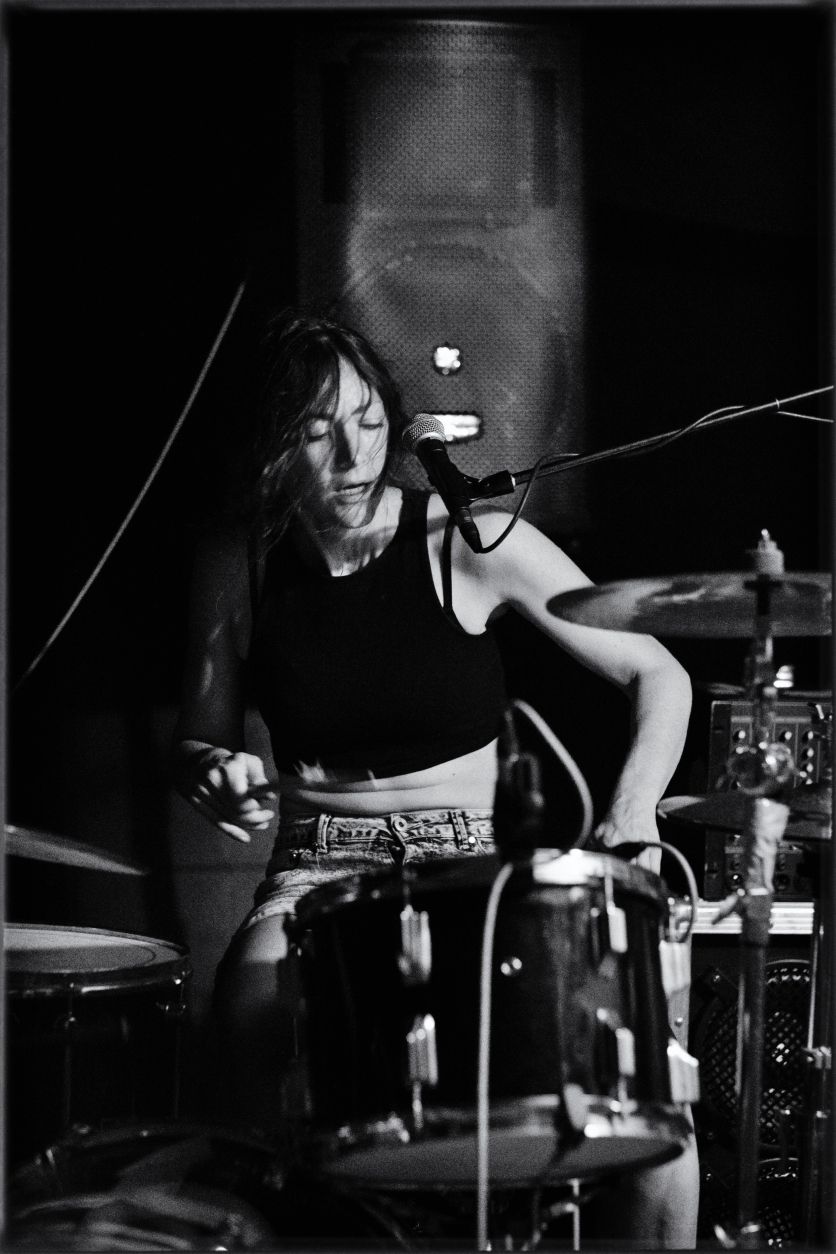
 Vocalist and multi-instrumentalist Teresa Riemann moves within zones where musical language is constantly reassembled between sound, word, physical presence and aspects of memory, searching for forms of expression that elude fixed categories. Her pieces emerge from drum skins, piano keys and feedback, yet equally from an inner vocabulary that asks more than it answers. She herself calls it Psychotic Noisepunk or Fragile Noiserock – terms that seem like placeholders for something better described as an opening, an attempt at transgression. At times eruptive, at times tentative, always carried by an intensity untamed by convention. Whether in duos like Tras and Naked in the Zoo, in collaborations or solo, Riemann creates spaces where order and dissolution seem to chase one another. Her most recent works continue along this path – a new album is already awaiting release, another is in the making, and she is already thinking ahead to the next pieces. We spoke with the musician about these and other matters in the following interview.
You play drums and piano, and you’re also a vocalist and songwriter, and in some recordings and performances, you do all of these things simultaneously. Do these activities all hold roughly equal importance in your musical universe, or is there one that resonates more closely with you than the others?
A classic checkered dish towel in pale pink has the same significance as the face of one of my best friends. I feel different emotions toward them, but I don’t differentiate between them in terms of importance.
Everything is equally close to me. Dance and the voice are, of course, possible without external objects and are therefore geographically closer; drums and piano are extensions of one’s own body.
I play the drums better than the piano, but that doesn’t make it more important. Language, doubt, is closest to me; everything else is disguise.
Nevertheless, I’m more often seen in public playing percussion than on the keyboard. Unfortunately, I can’t manage to do everything I’d like to do. The human being has to write booking emails. Shower every now and then, and eat.
Your music has been heard and seen for several years, both solo and as part of various collaborations, and your signature is always clearly audible in your collaborative works. What can you tell us about the genesis of your project and your style? When and how did it all come together?
You mean the solo project?
I started my solo work with piano performances in a more experimental chanson/cabaret style, then later combined piano and drums live for some special formats, playing each one single-handed, purely for the joy of it and the space available.
I have Paul Grémare, who runs the Autistic Campaign label (Rouen, FR) and also released a cassette of mine, to thank for the drum solo. He invited me to a festival at the end of the pandemic—finally. I asked what project I could bring with me—he replied, “Whatever I wanted,” but he thought it would be great if I played alone.
At the time, I was in my second home in the South of France, where I had a drum kit and some cheap guitar effects with me. In a week, I put together a set and realized it sounded great—the snare sound I’d always been looking for. I got great feedback and realized that I had more freedom here than in collaborations, and I’ve stuck with it ever since. It just worked, and it was clear from the first concert that this was a thing.
My style – I’ve never taken drum lessons. But I observe, I learn quickly through observation, from models. After starting school and experiencing art and German teachers, it became clear to me that I couldn’t study anything artistic, that I couldn’t stand anyone telling me how to do things, some failed existence who vents their frustration on the destruction of their students. So instead, I studied something scientific: the human psyche.
I strictly rejected an intellectual approach to drums. I had lost my love for the piano after 10 years of classical lessons, and it took a decade to sit freely at the keys again. I didn’t want to reproduce that strange bondage on another instrument. At the beginning, I always played the drums simply, often and persistently, but, as the word suggests: played. And over the years, what is now my style emerged, slowly defined itself, becoming more specific and sharper.
Would you describe Teresa Riemann, who we know from concerts and recordings, as an artistic figure?
No, that wouldn’t occur to me. I would rather describe Teresa Riemann, whoever she is, as someone we know offstage, as a fictional character. The thing is different from its appearance. We don’t know each other.
Your drumming has a very distinctive theme and seems to create a constant sense of tension and excitement. Would you say this is a conscious goal, or does this tension arise more spontaneously?
I don’t pursue any conscious goals with my music, except for the one that represents more of a method: to be honest. For me, the purpose is something quite cruel, which usually serves, or at least leads, to the destruction of life and, above all, freedom.
The tension is already there, as is the excitement. I translate it into music. I don’t invent my rhythms; they fly through the air like madly fluttering four-legged creatures in a bird cage. I catch them in mid-air, trying as hard as I can to avoid crushing them.
It may sound a bit contradictory, but I also detect a kind of nonchalant contentment in your rhythmic style. Do you recognize this serenity in your playing, or is it more of an impression that listeners project onto your music?
I once put it this way to a friend: In the eye of the hurricane, it’s completely still. The center remains blind. I’m far from serene, yet there’s a freedom at the bottom of despair that I gladly make use of. An indifference that, instead of cold indifference, signifies a benevolent twitching of muscles.
Perhaps this serenity you describe is, for me, more a union of contradictions, the recognition of cognitive dissonance that cannot be resolved, and the extension of that.
The shrug, however, is only borrowed, and not entirely serious. The nonchalance is something else entirely, a loving defiance, the strength to see a little further without running away.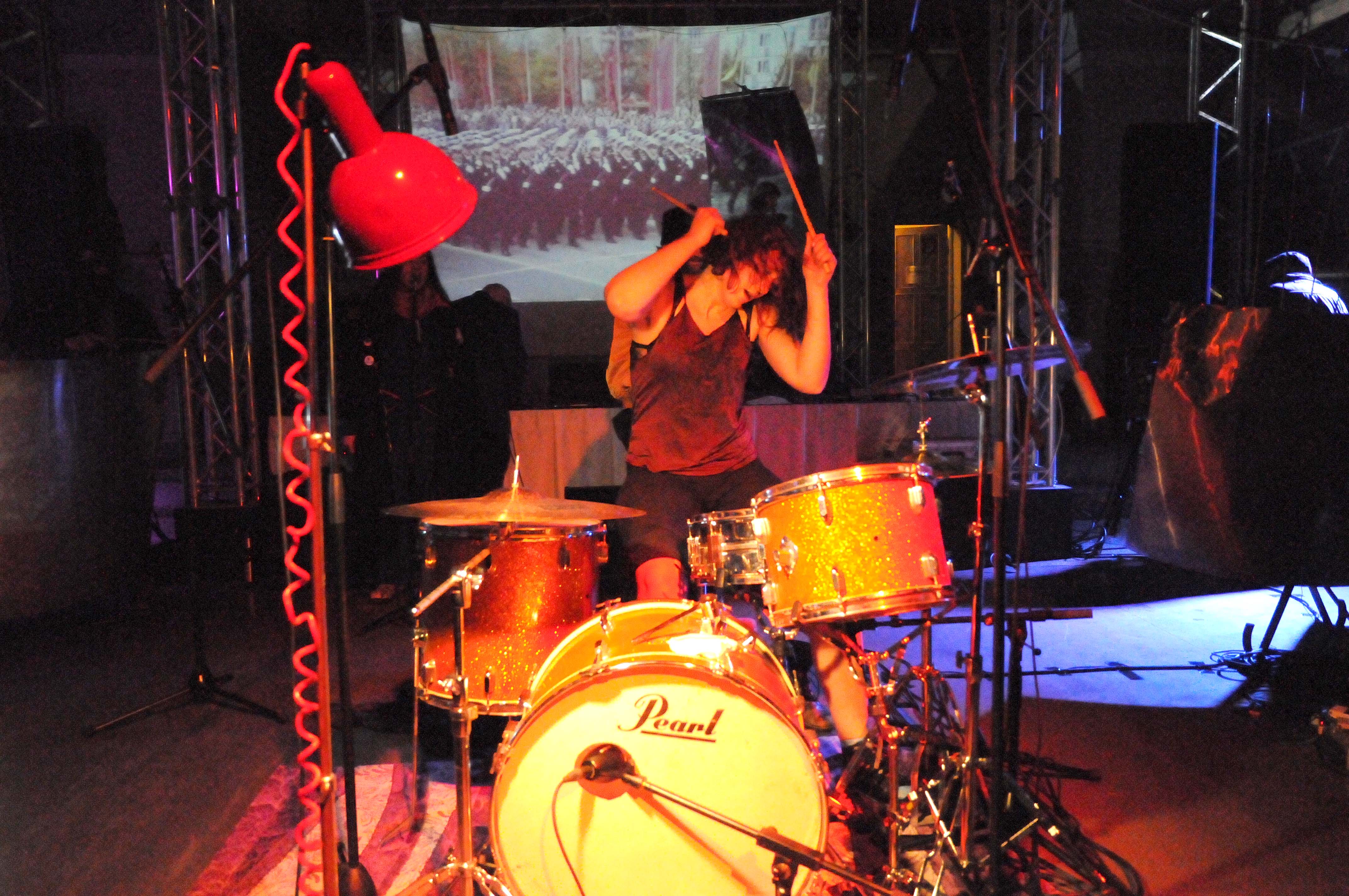
Do your songs tend to develop in an improvisational jam, or do you compose certain parts in advance? Are there any songs where the lyrics are the focus first?
Does the ‘jam’ actually come from marmalade? Difficult question. In advance – no, I play. And then I find something. I have no a priori idea of how something should sound. Very, very rarely does it happen that I hear something and think, oh, I’d like to try something like that (so far with Vida Vojic and Steve Reich) – but then internally I see that as a commissioned work, knowing that there is no danger of similarity due to stubborn individuality anyway.
For example, I often think up exercises on the drums, something that is so difficult or requires so much independence of the various body parts that I can’t play it yet. These then sometimes become songs later; the foreign body grows inside me.
Regarding the second part of the question: Yes, there are songs where the lyrics are written first, and then the instrument(s) are added. Sometimes there’s a vocal melody that emerges first, or I write a piece on the piano first, which is where the vocal melody and lyrics emerge. Then I experiment with it on different instruments, and finally I play it live on the drums. The pieces often go through many different phases and then live their own lives. I see myself more as a performer.
Angel dust* combined with the therapeutic concept of evenly suspended attention, or also: opening all windows at once, wide-open landscapes, a state between mental derangement and absolute concentration—that’s how my pieces come to me. You have to catch it when it falls from above or accidentally slips by on silent feet at night.
*I am totally unchristian // Angel dust as a reference to something metaphysical, the being behind the appearance, life itself.
(Perhaps I misunderstood the question. What I perform on stage has certainly been framed in the rehearsal room beforehand; it can move freely, but it is based on created compositions.)
Later: While reflecting on the interview with you, I’ve already written the next song, about reflecting on it, its beginning in brief, scribbled on an envelope: ‘It’s not enough to encircle it, it has to think it’s your friend and can disappear at any time.’ I firmly believe that. I can’t force it, and I don’t want to force it; it might break in the process.
With projects like Tras, Inutile Témoin, Shake the Train, or Naked in the Zoo: how does the collaboration develop? Is it a mix of improvisation and structured sessions? I imagine it’s a little different for each of these projects…
Inutile Témoin is unfortunately no longer active, but that was my most structured project, in which we wrote songs, some with graphic scores and a lot of freedom in performance, some with precisely defined elements. With Shake the Train and Naked in the Zoo, we improvise almost exclusively. Shake the Train performs a single, large, improvised soundscape live, but with Naked in the Zoo, we opted for a kind of instant composition; we present our improvisation in the form of relatively short songs, which, however, are created in the moment. This is often not noticeable to the audience. We’ve been playing with Ruben Tenenbaum since 2017, and we’re usually fluent in each other’s language.
In the rehearsal room, we also test new sounds and playing styles and discuss together which directions we want to go in and which we don’t.
With TRAS, we’ve improvised so far, but the sessions are very structured; we basically record everything that happens in the rehearsal room and can then try to reproduce sound moments. We’re currently moving towards taking more shape and I can imagine that we’ll be performing written songs soon.
Your most recent release is the album “Gehirnschubladen” (Brain Drawers) by Naked in the Zoo, your duo with Ruben Tenenbaum. The album title seems to be more than just a whimsical idea—it suggests that you’re also concerned with structures, perhaps even mental constraints that can be broken. To what extent is this idea reflected in the pieces?
So this thought is reflected in absolutely everything. The bizarre idea, in my opinion, is to categorize the world. This is practical, of course, because people can absorb more if they manage to filter out or ignore the ‘unimportant’ things. We question this principle on the one hand, but on the other –
it is a live album, after all. It is directed against pre-formulated ideas, patterns, and the reproducibility of life – not in the sense of ‘having’ children, but in the sense of repeating something, something that has already become – there are often attempts to reproduce something that has become through special arrangements, but that doesn’t work. It empties reality, it divests it of its substance.
We are one big mental compulsion. From morning to night. From brushing our teeth to lying down in bed, like a dead cloud on the beach. In conversations, say hello in the right place, and thank you and goodbye, and don’t confuse anything. Being allowed to do this there but not that; in place A and place B, perhaps everything is reversed. Changing sets of rules.
Brain drawers, we empty them. It is what it is and nothing else. We listen to each other with utmost concentration and react, spontaneously. We let it grow. And then, quite suddenly, it breaks, Ariadne’s thread. Everything else is interpretation, the left side of the brain’s search for meaning.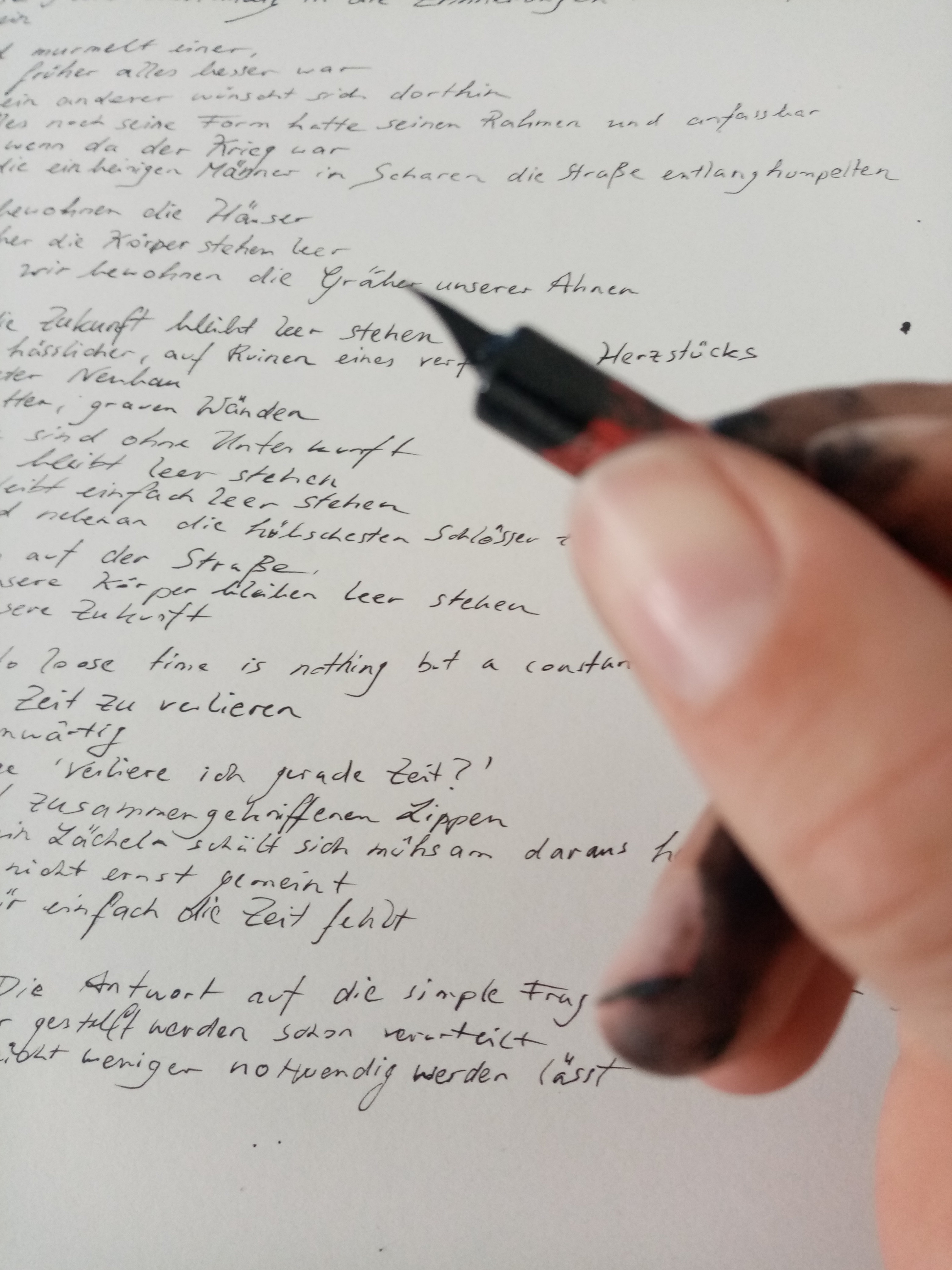
The music on the album is often characterized by raw energy, yet subtle, elusive nuances repeatedly emerge, as in “Hertzsog gen Labyrinth” or “Synaptisches Wirrwarr.” How do you deal with this tension between escalation and restraint? Does it arise spontaneously or is it a conscious decision?
It arises spontaneously, but physical existence also sets limits; the outburst subsides when the muscles become heavy. Restraint often creeps up cautiously; it’s not necessarily visible, but even when we’re very powerful, we proceed very deliberately; it’s also life: anything can happen at any moment. (:::)
It has to make sense—only when you feel comfortable with restraint can escalation succeed. This is important so that escalation (what is the conflict that can’t be resolved here?) doesn’t leave behind the feeling of alienation that goes with it.
The conflict doesn’t actually take place on stage.
“I Go to Libraries and Burn Cities” is a track that immediately sticks in your mind. Sonically, the piece also seems almost like a condensation point of the album – the vocals are more restrained, but the music is all the more explosive. What role does language play for you in such a strongly physical setting?
Hmm, that’s interesting, the question of a duality, a bipolarity. I wouldn’t necessarily have perceived language as diametrically opposed to the body; I am, after all, body and mind. Or let’s imagine we just invented the two concepts, but in reality it’s one and the same, an I, a you. I imagine my body couldn’t speak, it would be strangely separated from the world (it is, indeed it is).
On the language in the piece, in the live set. I can’t say anything I don’t mean. But I can, but it takes an enormous amount of effort and is painful.
The title itself arose from a linguistic misunderstanding, out of date, awakened Alexandria and Nero, struck a chord, was liked, and stuck.
The role of language is completely unclear to me. It is allowed to speak. It must speak. It speaks of the inevitabilities that existence brings with it, its limitlessness and its limitations.
‘I still try to run towards the center of the earth alike the rain’ and ‘there’s no such thing like going back’. ‘I would not know how to spell your name’, we remain strangers to one another.
Do you see yourself as a poet and do you also write outside of a musical context?
I don’t see myself. Or rather, only parts of myself. I am and I write. A lot, and I’ve been doing it for many years; it piles up pages, thousands of them. I come more from writing than music; for me, written language is perhaps the glue that holds the world together, both physical and conceptual. I fill notebook after notebook. I’ve often participated in readings in the past, but I’ve never published a book because I never had the time to look for a publisher. Project for October 1 – March 30: finally compiling and submitting the manuscript (short stories, lyrical prose, abstract, without names or places, instead: contexts of meaning, a you, an I). Doubts brazenly stand in the way, as does the aversion to anything that has to do with the logic of exploitation.
Your stage presence, often centered on drums and vocals, breaks with the conventional image of a background drummer—even in collaboration with others. Have you ever worked purely as a backing musician, or are you generally more attracted to the stage presence in the spotlight?
No. There are a lot of great drummers. A lot of the things that a standard drummer can play off the bat I would have to practice for a long time; that wouldn’t make sense.
I have nothing against the background as long as the project is exciting, it just never happened. I often find playing traditional music boring, especially as a drummer. I really like no wave or noise rock, but I don’t necessarily have to play it like that on the drums myself.
In general, I think background work is fantastic, or rather, that’s the appeal for me: being able to contribute to making someone else’s ideas a reality without influencing them too much myself. That’s a lot of fun and, for a while, frees you from the self.
Theatrical and literary elements play a recognizable role in your music. To what extent do you find inspiration in literature or theater, and how does that flow into your pieces?
I’m very strongly inspired by literature. Much more than by music, actually. Music rarely inspires me to make music. That may seem strange, but somehow that’s how it is.
The way of seeing, of observing. I’ve probably read too much damn Sartre; existentialism oozes from my every pore; it’s always about everything, all at once, or about non-being.
Strictly speaking, there is nothing else, or as Henri Thomas, whom I met in a documentary about Antonin Artaud, put it: ‘La vie est une série infini des apparitions et des disapparitions’ (loosely from memory: life is an endless series of appearances and disappearances). 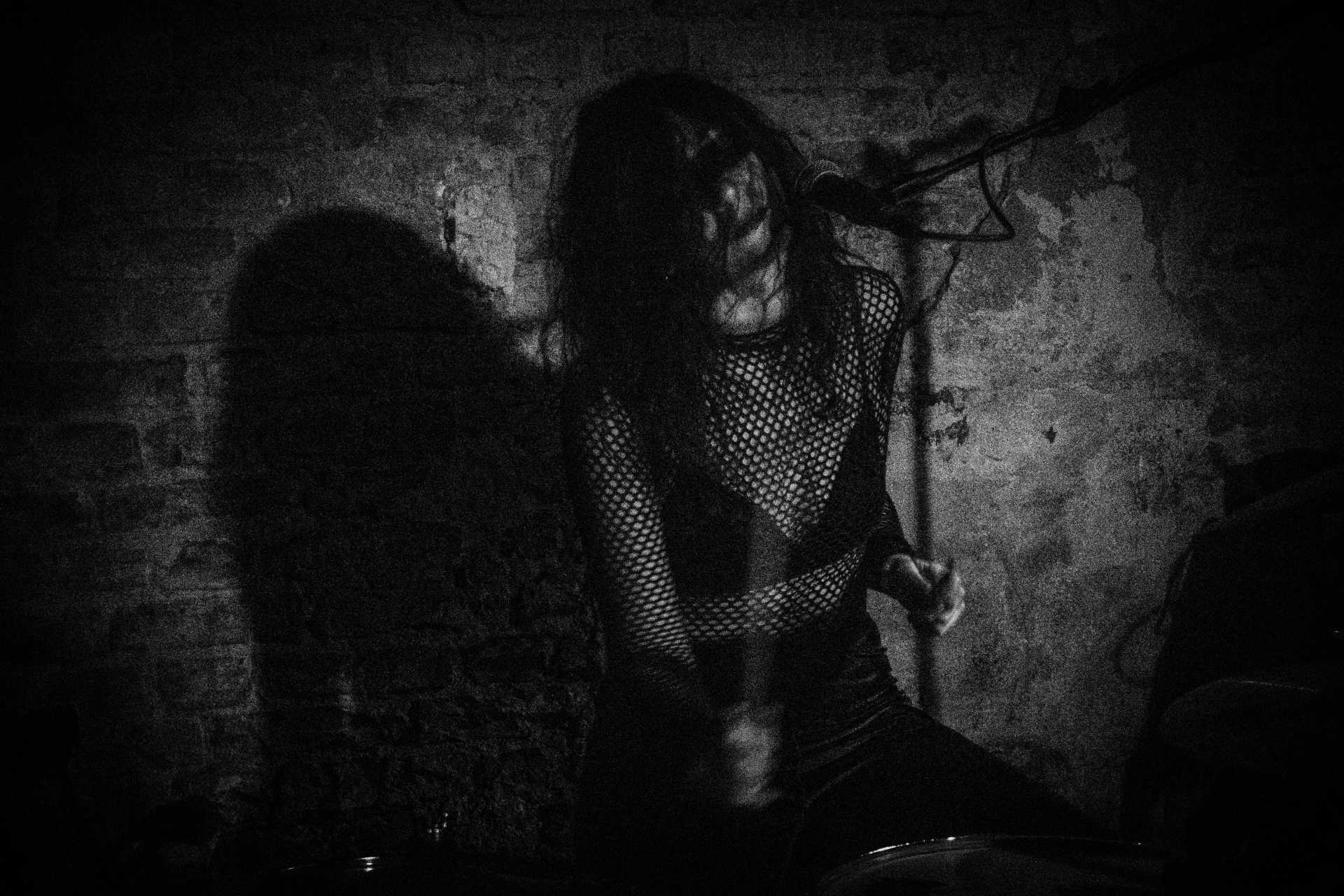
Or: the cruelty of consistently thinking a thought through to its conclusion (Artaud, loosely from memory, from his theory on the theater of cruelty – a single sentence like that lasts me until the end of my life, as an idea, as a concept, also: as a will; I refer to this both lyrically and musically).
Theatre also means: I don’t have to take on my role, I can speak from any perspective that I somehow manage, even from those that I don’t.
I plan my pieces very little, specifically their intention. The intention arises naturally; I carefully work it out in the text, revealing it; it’s not really an intention, but a state. My pieces (my solo) often consist of 27 different parts. I let the parts themselves decide whether they fit together or not; I like resolutions and contradictions, strong contrasts.
At the same time, my music is very unintellectual, like my poetry. I don’t take the detour via a story; I go directly to the emotions (here again, Artaud).
Instead of scores, I have to keep mood notes and find ways to put myself into the intended mood before each performance.
Samuel Beckett, Franz Kafka, Elfriede Jelinek, Peter Handke, Thomas Bernhard, Alain, Céline, Romain Gary, Robert Musil, Rilke’s prose, Elias Canetti, Georges Bataille, André Breton, Michel Houellebecq and John Cage, even more so his writings entitled ‘Silence’ than his music, being and thinking are at home here and are allowed to relate to the world, holistically, in every aspect of life.
In my opinion, your albums often resonate between calm and unrest, almost like an ambivalent celebration of being lost. If you see a common thread or overlap there, how would you roughly describe the attitude to life expressed in your songs?
Uh… An ambivalent celebration of being lost.
(Wanting to throw yourself into the snow out of despair, and then it suddenly melted, where was that?)
We celebrate the absolute absence of content (I, remark on the 21st century – nonchalant but ironic, unbearable to be honest, absolutely unbearable)
The art of not being reacted to in this way (Foucault)
There is no outside of society (Adorno vs. Patti Smith)
Total despair is also total freedom. There’s no need for it, nor can you hide from anything.
The greatest contradiction is powerlessness. Everything somehow doesn’t matter, and yet you can speak, write, have hands and legs (or not).
The attitude toward life is in a state of flux. I am the world through my eyes, I see everything.
I have no desire to dance on the ruins.
All this agony talk isn’t my thing.
And “celebration” is a word I’ve never quite been able to interpret.
On “Caracoler Dans Les Abattoirs” and other tapes, there are moments of dark, raw intensity. What emotions or images inspire you when creating these moments?
Some songs, some moments arise from concrete stories, X., whose bicycle is called ‘good times,’ for example, and who wonders if the war in Ukraine will end if he throws it into the Spree. The game with his own involvement in the course of the world. Images: an old, deep, ever-lasting image, somehow linked to Goethe’s ‘oh you dissecter of your joys,’ the old butterfly catcher, one of the first poems one gets one’s hands on, even in elementary school.
Being dissected alive. Love relationships as violence. Having power over other people, power in general. Mass destruction. Mass. Identity. Violence is all-encompassing. The others. The monstrous. The rule of money over people. A child placed on the stove. The rule of machine guns over peace. Life is beautiful. To surrender oneself voluntarily and knowingly. Foreseeing the pain and going anyway. Modern slavery. Entanglements of sexuality and torture. Abuse. Expansion of the ego beyond the self. Schizophrenia as the ultimate inversion of reality. Meaning life. Memories that are not one’s own. The thin line between dream and waking.
The mind itself. Its inescapability. Suicide as the only way out.
Your voice seems to hum or murmur in recurring moments, sometimes like an additional instrument. Are there moments of speech that are deliberately unclear to create a special atmosphere?
Sometimes I’m afraid of being understood, as well as of being misunderstood, of looking into frightened faces. And sometimes the voice comes from far away in the desert, speaking in riddles and not wanting to touch anyone personally, or at least not meaning to touch anyone personally. Then it’s hard to understand because the distance is so great.
In a review of your album “Trébuchement persistant,” your music is described as “psychotic noise punk” and “fragile noise rock.” What do you personally think of these genre labels?
We coined the terms ourselves, but for useless things. I’ve always been attracted to psychosis; I used to use that genre term a lot, not just for my own projects, but also when I was still organizing concerts to find bands. I think it came to me when I was listening to a lot of Oxbow, especially through the song ‘insane asylum’. Besides, I have a certain penchant for madness. The insane mark the boundary to reality, even to so-called normality, which is really nothing more than a Gaussian bell curve, a statistical analysis and not a moral judgment.
Punk. I find punk rock or HC punk incredibly narrow-minded; I find it hard to understand how that could have happened. The idea is a simple one: ‘Everything for criticism’. But I’d like to maintain political punk as a rejection of any authority that defines itself without reason.
I like noise rock. People use labels, after all. And if you want to participate, you have to somehow piece yourself in, cruel but necessary.
With Amélie in Inutile Témoin, we initially felt the word ‘fragile’ was important to express that something strong can also be fragile, that something that spontaneously springs to life can also spontaneously fall apart, or die of a sudden cardiac death. Later, we found it misleading and looked for other terms.
With pieces like “Can’t Stop Waiting” on “Caracoler Dans Les Abattoirs,” you create repetitive structures that build a special tension. What appeals to you about playing with repetition and anticipation?
I very rarely use repetition on the drums; in this piece I use finer sticks, so-called rhods, and I think the sound in this simple pattern is simply beautiful. The song arose from the simple question: ‘Are you waiting for the spring?’, which was asked in the grey Berlin winter. But I’m not waiting. Not even for spring. I find waiting for the bus awful, indeed this verb as such, this state of being. The piece came from that.
Spring is coming. Again and again (if not atomic winter or something similar, everything is the end of the world, etc.). The piece is a circular repetition; waiting is not necessary. It’s also about the fact that whatever comes, will come, and I will then react to it. But are you waiting for me, no I am not, but I’ll gladly embrace you when you’re here – are you waiting for me, no I am not, but I’ll gladly erase you when you’re gone, is what it says, for example.
The human niche, the evolutionary gap, the glimpse into the future, the memory
‘birds have tears but no memory’, writes Gertrude Stein, I carry individual sentences like this around with me for weeks, stories absurdly converge within me, to return to the brain drawers, I often have the thought that I must have all the boxes (I love all kinds of boxes, made of cardboard, metal, wood…) boxes, notes, unfinished stories, pieces, chords, patterns open at the same time, like in the internet browser worldwidewindow, a giant spider’s web, a giant puzzle, and then everything magically links itself together, the broken jug that isn’t one suddenly becomes a whole, all I have to do is collect an incredible amount of information, be incredibly focused, practice an incredible amount to be technically at a high level, forget nothing, only consider potential connections instead of thinking them together, then maintain evenly suspended attention for weeks, ideally always, and then suddenly everything falls into place and The thing is there. Then a live performance. Then a quick breath, and then, according to Thomas Bernhard, ‘the next tumor grows again.’
(Appropriate repetition to answer the question afterward, yes.)
To return to the question: repetition is a highly questionable concept, I doubt its existence, it is more of a circular progression.
“Save Our Souls” from the same album and several other tracks have the power to create a real catharsis in the listener. Do you also see your music as an outlet for the emotions you experience yourself?
Well, where are the emotions supposed to go? I’ll be honest, they just stay inside. But of course they’re doing something there. Save Our Souls came about because I suddenly felt delight that men at sea, just as they are terrified of red-haired women, also believe in souls. In our completely economized world, I suddenly found that fabulous – SOS – it’s not SU – Save Us or H – Help or BID – Boat in Danger or SOB – Save our Bodies / Save our Crew, no, they’re talking about our souls.
I’ve simply left out the Christian part of the message (it’s a different book), and yet Save Our Souls seems to me to be a fitting mission for us children of this time, if not the only one.
So, unfortunately, no valve. Sublimation, yes, transformation. Like dreaming. If you look at it long enough, and do so without fear, then the object of your attention changes all by itself. But that’s a bit far removed from the steam boiler story. I wonder, this valve, it seems completely monstrous to me, this theory. A mouth. The open wound.
Finally, perhaps the most interesting question – I heard you’re already working on a new album, which will be finished in the not too distant future. What can you tell us about it?
I’m currently in talks with labels; I’ll be thrilled when it sees the light of day as a recording; it’ll be incredibly happy when it’s out the door.
There are eight studio recordings and one live song. This time I’m sticking with vocals, drums, and feedback noise. Maybe there’ll be one more piece with piano, but otherwise, it’s actually almost finished and waiting to be released, waiting! Like a dog in front of a supermarket! For dog biscuits, or for the dreary world…
But actually, I’ve planned a next multi-instrumental album separate from the solo drum album; these pieces are being created in parallel, so to speak. The lack of categorization is also a shortcoming. And I’m already working on the pieces for the next drum album, the one after that, really. I admit I’m a very impatient person. It’s hard to keep track of everything and separate the individual stories.
Here I can better answer the question of inspiration, the act of creation. One piece is titled ‘What makes you wordless is talking,’ a sentence from Jürgen Becker’s ‘Ränder’ (Rands), which I found at a flea market around 2015. At the time, I found it immediately compelling, beautiful, almost smooth, round like a sphere. Exactly. The opposite is true. In the summer, Rahel Pötsch mailed me an invitation to her Hamburg exhibition, titled ‘Orange Watch.’ Orange Watch, with its abstractly formed image of a clock, color-wise situated in the bee’s vision spectrum, evoked in me not only associations with the ubiquitous wristwatch (in the form of a shitphone; the pocket computer), but also with lighthouses, Baywatch, Watchmen—the observing and guarding element, the orange watchman, the ticking bomb that harasses you and crams the seconds down your throat until you vomit. That’s how it works in my head.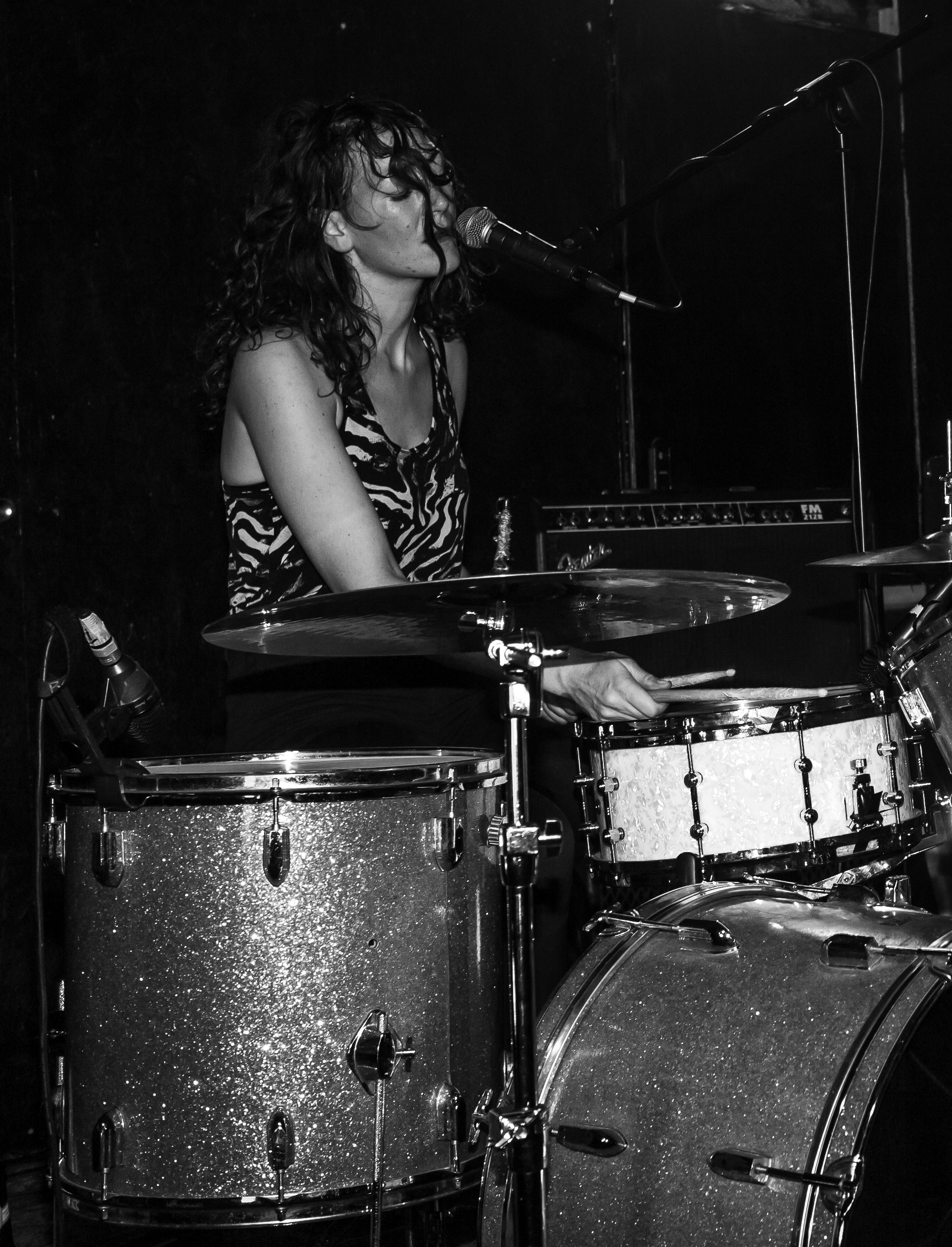
And then I start to play, and I think of Rahel, our shared fight against the grey men from Momo, and I sing ‘you are my orange watch since I abandoned mine, you are my orange watch and you’re always on time’, the piece writes itself. I find it difficult to speak, despite my unbridled love for him, perhaps because of that. Stuttering feels more appropriate to the circumstances, see trébuchement persistent. A dream from years ago, a man chasing me, a moment ago empty-handed, suddenly has a gun in his hand and is aiming at me, the sudden realization, the sudden abolition of connection, of logic, through the assertion of this very same, if he can suddenly have the gun in his hand, then I can too, I think, and immediately the cast iron changes hands. This moment remained behind my eyelids when I woke up. We’re 8 years old and skateboarding, Alessa and I, sitting down, rolling down a busy country road, around a curve. Someone passes by and throws, “You must be suicidal,” at us. We laugh at the funny phrase, it takes us a moment to decipher it as “tired of life,” and try to create the opposite, as “death-defying” or something similar.
So the piece begins: What makes you wordless is life. What makes you suicidal is life. What makes you dreamless is the gun in your hand. What makes you time-sick is the stopwatch on your wrist, and I simply can’t just tear it off.
Another title for the piece could be “boundlessly time-sick.”
The ability to compose has evolved. There are pieces with comprehensible rhythms (I claim), especially one dedicated to the Swedish drummer Vida Voji, who inspired me at a concert we played together in 2024 to compose a stripped-down piece, one that is simple but not easy, repetitive and intricate without exploding. Instead of just keeping it in my head, I wanted to write it down in its entirety. It turned out to be incredibly complex and bears the fitting title ‘Something to Begin With’.
I won’t reveal the title of the album yet. The languages are intermingled; this time there are also two German pieces, which emerged from poems of mine and deal with unease, the unease of transience, of humanity and its absence, of cruelty and its inability to be subsumed into the ‘we’. They are much more subtle than you might expect from me.
The animals in the zoo are also present on this album; life is a sphere.
Interview: U.S. & A.Kaudaht
Fotos u.a. Emilie Salquebre, Rosie, Orange Ear
Teresa Riemann @ Home | Bandcamp | Instagram | Soundcloud