
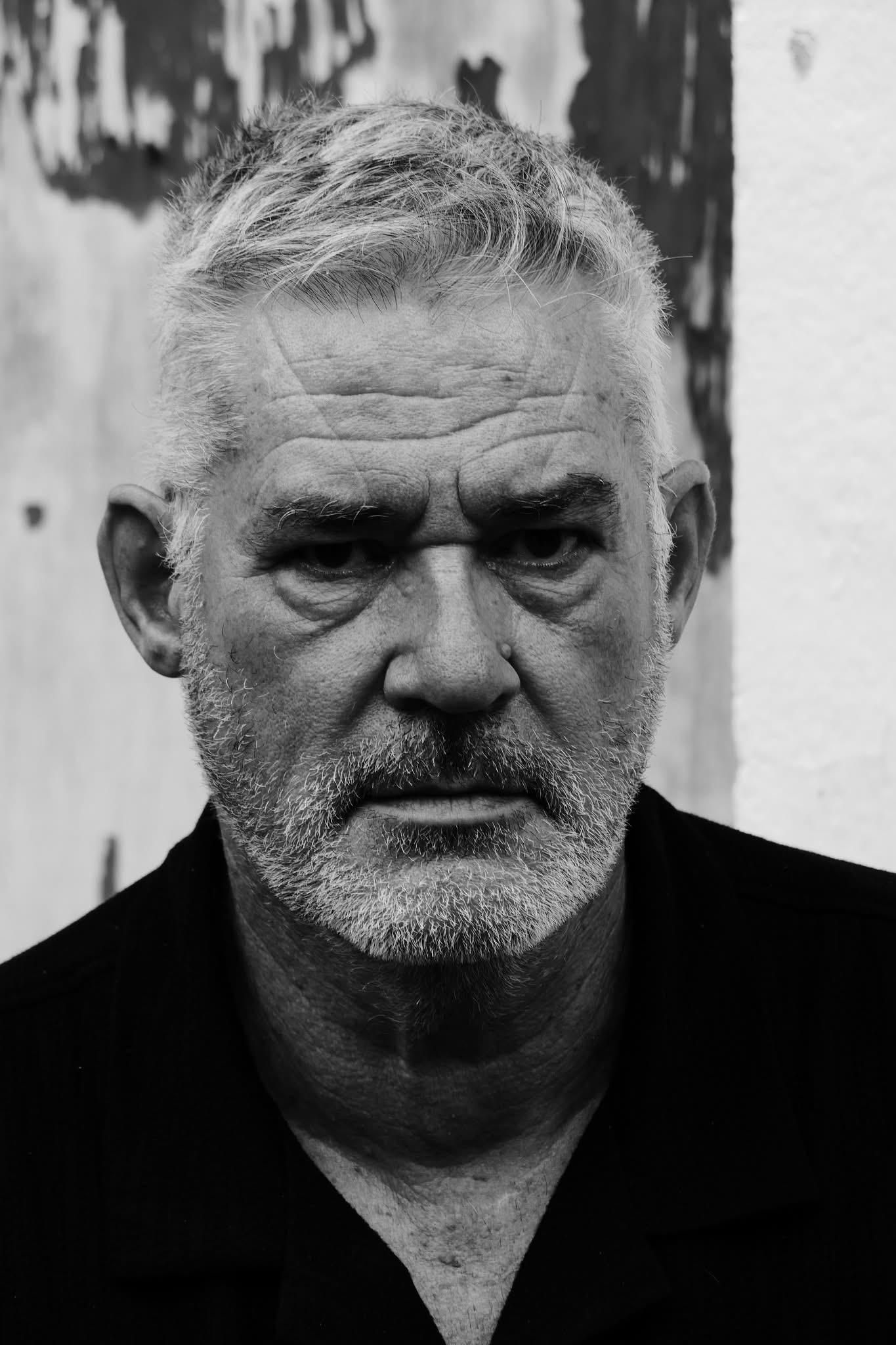
 When the lineup for the recent VOD Festival in Friedrichshafen was announced, many were surprised and delighted to learn that Graeme Revell would be performing. The relevance of SPK’s early work in particular to industrial culture, musically, visually and conceptually, can hardly be overestimated. Revell’s further musical career is well known: ‘In Flagrante Delicto’ by ‘Zamia Lehmanni’ paved the way for him to become a composer in Hollywood, where he created around 100 soundtracks. When I spoke to him at the VOD Festival, he said that he is primarily concerned with AI these days, which was also evident in the use of visuals and films during his performance with his son Robert. In this respect, a number of the questions in the following interview revolve around technology and AI. It is perhaps not surprising that the motto on his Facebook page is ‘With little attachment to the past; yet remembers the future.’
Let’s start with the distant past. Was there a moment when/before you started SPK when you thought of what technology would be appropriate and useful to create the sound that you desired?
I was very fortunate that I met Dominik Guerin (who was in charge of video for SPK/Twin Vision) had a brother who inexplicably owned an AKS EMS synthesiser. He did not use it because he liked jazz rock and lent it to me long term. The sounds it could make were perfect for what I had in mind.
When I moved to England the first thing I bought was an EMS VCS3 – the one without a keyboard because I didn’t want to rely on anything ‘musical‘.
It is said that hindsight is 20/20 but what technology would have been beneficial to have had access to when you first created music?
In 1978 it was still not possible to conceive of sampling and everything was still analogue. So digital would have been beneficial I suppose. On the other hand, I feel technology can always be pushed in directions it was not designed for and exploring the extreme possibilities of analogue was exciting. Other lacks in those early days were fat bass oscillators and recording onto vinyl was very light in the bass spectrum. I always dreamed of more bass.
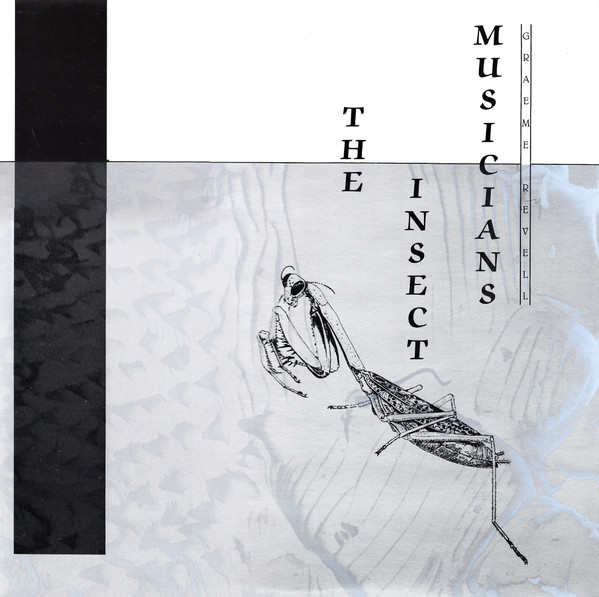 I think the acquisition of the Fairlight was a huge step forward for your musical development and career (I’m particularly fond of “The Insect Musicians“). What would you say were other important technological steps in the development of your musical career?
Yes, I had to pretend to be a pop musician for a year (with quite unsatisfying results) but the strategy was always to buy a Fairlight. The earliest digital tech opened up the world for me – especially with In Flagrante Delicto. Digital technology in general enabled the sampling of all sorts of sound material which I could then manipulate through processors, both analogue and digital. Prior to the Fairlight, the lightweight Sony DAT recorders made it easy to go to remote locations and record sound – for example the Brickworks in Sydney where we recorded most of the metal percussion that is the background for Leichenschrei.
I seem to recall that during the discussion at the VOD-festival you said that because of the very cheap drum machine you got at the beginning of SPK, the types of rhythms possible were rather limited, which in turn contributed to a very specific sound on the early recordings. Would you say that that was a blessing in disguise? Can technical as well as technological limitations contribute – at least temporarily – to a very unique sound?
Yes, indeed. Those rhythms, which are Latin were unique in the context. The little Rhythm Ace drum machine allowed you to push more than one rhythm at a time so you get a combination of say, cha cha and bossa nova which are then processed through guitar pedals and a bass amp then rerecorded from the speakers to tape. My entire process at that time especially was to take the most minimal sources and see what they could become. My greatest influence was a track by Neu! which was just a drum kit and guitar slowed down. A fantastic sound which made me realise that one could produce interesting music with almost no money.
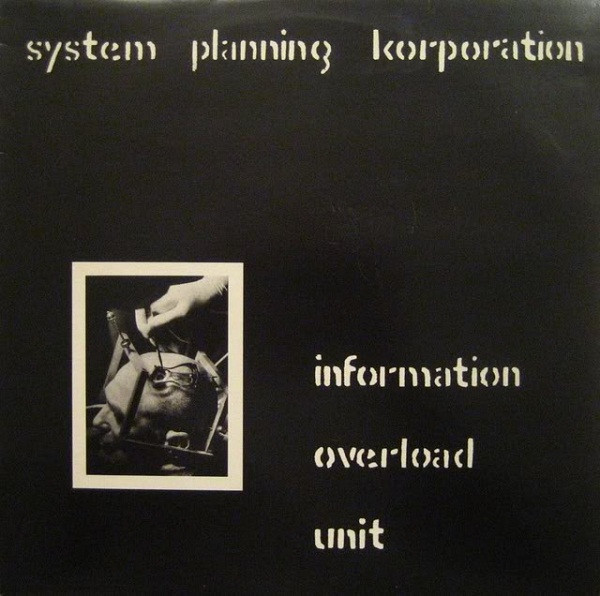 When you listen to early tracks of yours, say “Emanation Machine R. Gie 1916“ from “Information Overload Unit“, I feel that they very much stand the test of time and do not sound dated at all. Can you tell us something about the creation of these tracks?
Thank you. I do think they sound dated but will take the compliment. We were using a 4-track Fostex recorder and my brother Ash (Mr Clean) had this possibly strange idea that tape should be virgin. In other words he wouldn’t let me bounce down and multitrack. We had huge arguments about this but I love him. The only solution was that I had to record multiple instruments onto each of the 4 tracks which meant we were kind of doing a series of live recordings – for example guitar and synth performances were recorded onto the one track; bass with tape loops from the 2-track recorder. Not too far advanced from recording techniques of the 60s.
You said that you are now primarily an AI researcher. When flicking again through Re/Search’s Industrial Culture Handbook I had a look at your very comprehensive reading list and I was surprised that even that early on you already had a couple of books about AI in there. Could you give us an overview of how your interest in AI developed? Were there different stages in your interest in AI?
AI has quite a long history actually – but it’s a bit like the electric car. A critical piece was missing. With the car it was the long-range battery. With AI it was the transformer. All through four decades from the 80s I was reading about AI advances but none were convincing until 2017 when the famous Vaswani et al. Paper “Attention is All You Need“ appeared. Very soon after that – before covid I started to play with GPT and GPT2 which gave fascinating results. In some ways those results were more interesting than ChatGPT and Claude but it got me hooked.
Because I am so interested in technology and its social implications, I had been quiet for quite some time. As you know I had early thoughts about Information Overload, followed by a prediction of Another Dark Age, and Culturcide but his was a really exciting and simultaneously dangerous leap forward.
I produced a book of early AI generated images: The Neuron Mirror, which is available through my website ologi.ai or amazon.com. It is the only print exploration of early image generation from poetic prompts – leaving it for the transformer to interpret language rather than explicitly being told what to represent. It opens a window onto the processes inherent in human creativity.
Having produced some videos for our recent European shows, my most recent research is into two areas: one, the coming onslaught of agentic AI which will very rapidly increase the isolation of humans from each other and accelerate the dramatic lowering of birthrate across the world (except Africa for now). Ai companions will become the norm and the political right will rapidly begin to use them to transmit emotionally- and sexuallyladen fascistic messages. We know already that about 50% of the population is already primed to accept these. Beyond DeepFakes, I call this DeepFeels.
Some weeks ago the website AI 2027 made the headlines in a number of countries. The authors presented two future scenarios concerning the development of AI, and even the slightly more positive one looked rather dismal for humanity. How you do view the two possible (?) developments? Is that what the authors postulate too pessimistic?
Yes. I believe that there is no necessity for pessimism. But it is going to require WORK and a significant shift in Epistemological UNDERSTANDING from a lot of people to avoid these outcomes. Certain outcomes are unavoidable – the loss of huge swathes of current jobs, beginning with paper-pushers and number crunchers. Other jobs in the knowledge economy will take a few years more so long as these workers embrace AI as a tool. The response to this mechanisation of labour must be the creation of a guaranteed living wage and taxation of the rich. This has nothing, of course, to do with AI specifically. As always, new technology is a small-p political struggle.
Regarding the longer term paranoia about machines taking over, I believe that is an outdated epistemology of machine vs human which is based on fundamental mythologies of both entities. First, we humans are entirely delusional about our consciousness and our creativity being unique. Neither are remotely true and I could go on for hours about both of these. I won’t. Second, these AI ‘machines‘ are entirely different from previous machines because they are not constructed on code, they are constructed on human language and they are nurtured by human reinforcement learning. They are not very different from humans once we redefine ourselves in materialist terms (Daniel Dennet), except they are much more efficient and capable. Similarly AI, with extremely rare exceptions, is certainly less plagiaristic than humans already are in the creative industries.
You are or at least you were strongly interested in J. G. Ballard, also a favourite author of mine. He has been nicknamed the “oracle of Shepperton“, a name contrasting the rather mundane place where he lived with his seemingly visionary abilities. Do you think there are (technological) developments that he failed to see?
James was an extraordinary writer and thinker and I have no doubt would have envisioned the dark and sexualised side of anything that came along. I always related to him in the geographic sense you mention because, coming from New Zealand, I am virtually alone here in our green and pleasant land, in whatever ability I have to anticipate the near future. He is inspirational to me even now, because he was able to understand the deep psychological, sexual, deviant relationship between man, machines and the urban environment. I wouldn’t say there were tech developments he failed to see. In my last conversations with him, I remember talking to him about Second Life which was an early attempt to move real life into virtuality. He was very interested but had no personal experience of such a world. He would have been fascinated I’m certain.
You worked with AI for videos that you also used during your performances in Italy and Germany. Were these films all developed just recently? Could you tell us something about how you proceeded when creating these visuals and films?
Yes, all the imagery and video were created using AI. Our entire history of imagery and sound was lost in February 2025 in the Los Angeles fires. This doesn’t bother me in the slightest and I treated it as a challenge to try to recreate at least 4 of the original songs using contemporary methods.It was enjoyable. Nigel Ayers from Nocturnal Emissions recently reminded me that I was the first to commit to creating backing videos for independednt music shows- at that time it involved a very bulky and expensive VHS rig. Now, image creation is an exercise not only in prompting but also in patient curation. A lot of the reason people are negative about this process is because the training set will always be biased towards the ordinary. Think of a bell curve – most of the data that is of interest to me is in the far extremes on the edges of the bell curve. The task is how to force the results to those extremes. The exercise is running through a huge number of iterations and finding the little interesting thing in an image that encourages you to branch off in this or that direction and see where it goes. Often it goes nowhere interesting and you have to backtrack. But every so often something surprising will happen which reminds me of the early days working with a very unoredictable synthesiser. I hope I have been able to create a few rather subversive outcomes.
To what extent has your work in and with film influenced your approach, and your formal and aesthetic choices?
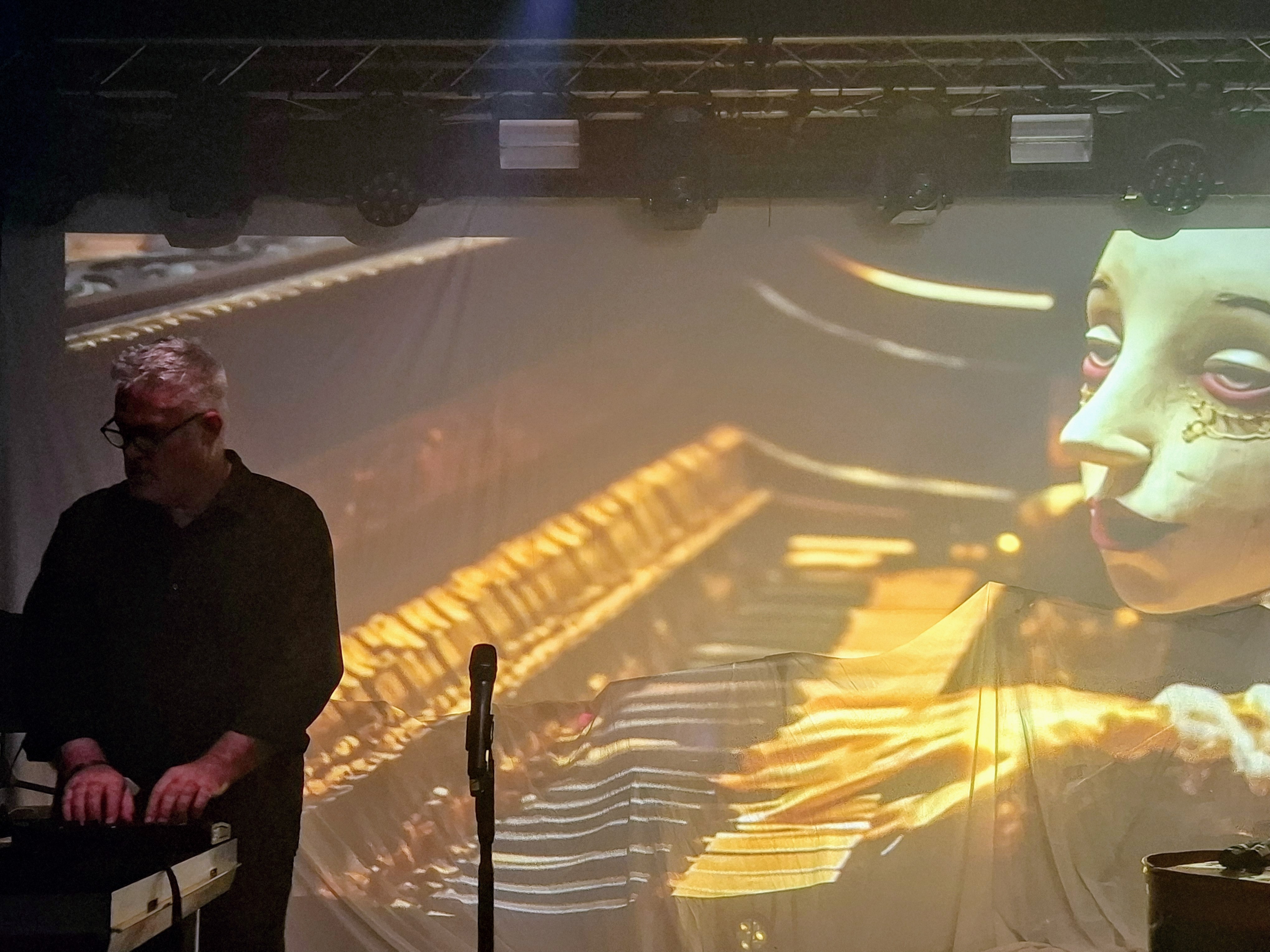 I suppose I have a much better sense of how music and film integrate which makes editing a lot more intuitive than it otherwise might be. I can tell a little story rather than just having random images. Those who were at the shows might remember Schmutiputzi, for example, which is a delightful tale of partying in the light while all sorts of depravation and horror takes place in the darkness below. Kind of what we’ve been on about for years really.
Though I was never really a fan of American film (apart from Lynch and Cronenberg), I did get to work on some fun cult movies over a 25 year period and picked up a good sense of what works and narrative continuity.
I just read today that the streaming service Deezer published the percentage of AI created music on its platform at the beginning of the year and it amounted to about 20 percent. Can you see a future of a total homogenisation and simplification of music?
Yes it is going to further impoverish musicians though I still think the worse problem is the outright royalty theft by platforms like Spotify. As regards the homogenisation and simplification of music, I think humans generally have been exceedingly good at that at all times. AI music is simply reproducing music by sampling from the fat region of the bell curve. That’s all the banal music that boring humans have created. The task for interesting musicians, artists etc is to create outside of that region, no different from what it has always been.
What would be a creative use of AI when working on music?
Not much yet, that’s for sure. It is helpful in some aspects of music production but for me, not yet in terms of creation. One of the first applications might be in sound or loop production. I guess I should put myself in the shoes of others who might not be as skilled in music as myself. In the same way that I am not a great visual artist, I do find the AI visual tools extremely valuable, so I must imagine the same advantages for non-musicians. They call this ‘democratisation‘ don’t they?
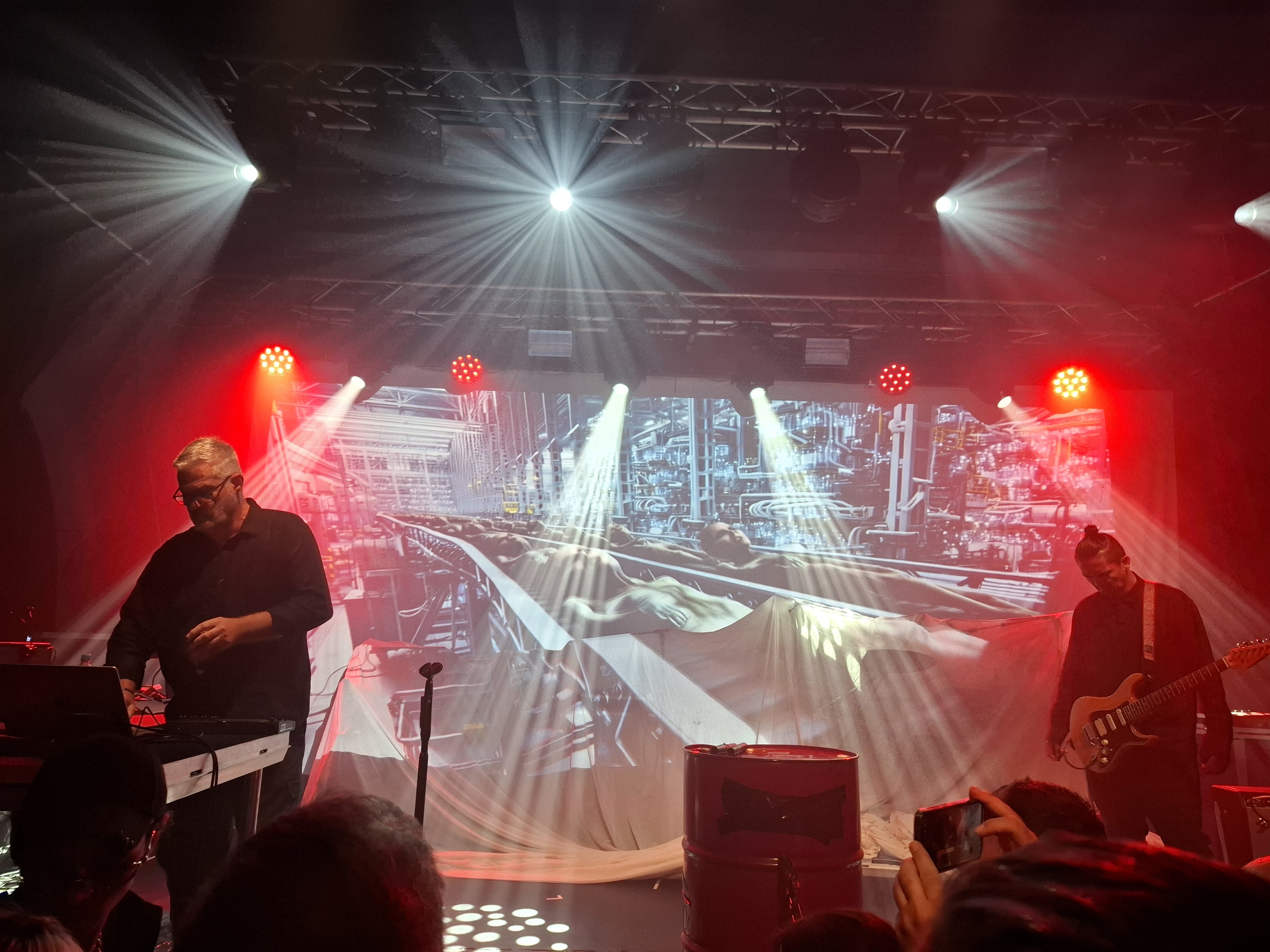 You said that you’re thinking of a new approach for performing “if new tech makes it possible“. What can we expect from you in the future?
I will probably never repeat the set from 2025. I can’t talk about what the new tech is yet. It would ruin the surprise. I can however tell you the new entity (myself and my son, Robert) will be called SPKtR. It looks like we may begin touring in the fall of 2026.
Interview: MG
photos: portrait: Graeme Revell
concert photos: MG