I must say I’m curious what made you choose the name of the German artist UnicaZürn. I remember that some years ago I discovered her anagram poetry and it really struck me right away. Unfortunately not many people know her. Were you more influenced by her texts or rather by her visual work?
David: We’d been throwing names around for a long time, and although we’d been working together for some years we hadn’t decided on a name until just before the ’Temporal Bends’ CD was released. Ossian Brown had been reading one of her books; Steve noticed it, and that was it. I had always loved her drawings, and her work with Bellmer, so I agreed it was a perfect name. I find her drawings more inspirational than the texts, but if you were to convert our music into images I think it would look more like a Rothko!
Do you see a relationship between her way of writing/drawing and your way of composing?
David: Although I like the anagram poems, they are the opposite to the way we work – mostly we do not use compositional systems. We have experimented with them, but we always seem to get better results using an open freeform approach. Our adaption/adoption of her name is a tribute to her creativity, not her methodology.
A lot of her work is no longer available in Germany. Are there (m)any English translations of her work?
David: I have the Atlas Press (UK) publications of ‘The Man of Jasmine’ and ‘The House of Illnesses’ – they are out of print now, but were easy to get a few years ago.
Do you make a clear, programmatic distinction between UnicaZürn and your other groups, or is your collaboration more like the spontaneous result of what happens when two musicians meet and improvise together?
Stephen: It’s the latter, I would say. Some of what we do arises from one of us working alone and then bringing the results to the other to get their take on it. But I would estimate that more than half of the material comes from improvisation together. That spontaneity is then subject to winnowing, refinement, a more considered stage of deciding what is missing or what needs to be removed, a process that comes through conversation and comparison.
What is the main difference with regard to the creative process, compared with your playing in Arkkon and Cyclobe?
Stephen: For me, the difference lies in the importance we place on playing together simultaneously; in Cyclobe it happens comparatively rarely, in UnicaZürn it’s the norm. It comes, I think, from our enjoyment of improvisation in The Amal Gamal Ensemble, plus the ease with which we seem to find the right vein or channel to explore in this way.
David: It’s a very similar situation for me too; working as part of (what is basically) an improvising duo usually means clearing my head of any preconceived ideas of where a piece may go (or even start), holding my breath, and diving in. Whereas working on my solo projects I usually envisage at least a general direction of where I want a piece to go.
I think The Amal Gamal Ensemble last played in 2011. Is this project still active, does it lie dormant or is it dead?
Stephen: Amal Gamal is on a long hiatus, but there’s been no decisive ‘end’. The social connections have loosened perhaps. I don’t live in London any longer so I don’t see the others as often as I used to do. I can imagine another burst of activity, perhaps with a varied line-up again: we started off varying the personnel and then drifted into being a stable six-piece for quite a while, so maybe shaking up the pattern would make sense.
I’ve got the feeling that in the music of The Amal Gamal Ensemble there are somehow more (prog)rock elements than in UnicaZürn. Do you somehow regard UnicaZürn as a kind of successor to this band? In what relation do the two groups stand to each other?
David: I think Amal gradually morphed into what could be considered a more ‘traditional’ line-up: drums, bass, guitar – albeit with three synth/keyboard players – and although we are all committed left-field improvising musicians, we would call upon the vocabulary of rock when necessary. But I’d like to think we sounded more like Chrome than The Nitty Gritty Dirt Band! Steve and I had actually started recording together before Amal had been formed, and the ‘Temporal Bends’ album contains some of this early material – specifically ‘Black Glass Mask’ and most of the ‘Temporal Lapse’ mini-album. So although we didn’t have a name for the project at the time, UnicaZürn actually pre-dates Amal. We treat both bands as entirely separate entities – Amal started as a fluid collective which did its growing-up entirely in public; an ever-changing collection of performers would assemble at The Horse Hospital in London once a month and improvise an hour’s set. I learnt a lot from that experience, it was musically very intense, and of course this feeds back into other projects such as UnicaZürn – it certainly gave me the confidence to be able to improvise the UnicaZürn live sets when we started doing them outside of our studio.
Apart from your own experience as musicians, have there ever been some indispensable encounters, impulses or inspirations in the past that created the basis on which UnicaZürn could grow?
David: There’s definitely been inspiration as a listener – my most powerful experience was seeing This Heat play live for the first time, in a small basement in Covent Garden, London. I was blown away – it was a post-punk clash of Stockhausen, electric Miles Davis, King Crimson, Faust and Henry Cow – it was monstrous, exhilarating and scary. That same year I’d seen TG play at The London Filmmaker’s Co-Op, which introduced me to an entirely new form of darkness in music. There were probably only about 20 to 40 people at either of these gigs, but there was definitely something brewing in the air around that time, and its an excitement which still fuels and inspires me to this day.
Would you say that there is – maybe in reference to your song title “The Infernal Kernel” – something like a constant core or a read thread that combines all UnicaZürn works?
Stephen: I think our work is closely allied to ‘kosmische’ music, a twisted outgrowth of it, and that provides a thread, although since really good kosmische music is unpredictable and mercurial it’s not what you’d call a tight or restricting definition! Reliably unpredictable, that’s the idea. A title like The Infernal Kernel refers to existence in cosmic terms, in this case touching on Gnosticism (the universe as evil construct); also the irreducible core of what it is to exist, the maddening ‘isness’ that cannot be explained without lapsing into tautology.
Symbols, as vague as they might be, seem to play a great role in your works, perhaps most prominently images of water, depth and diving. On your website you even quote a reviewer who mentions Cousteau and Lovecraft with regard to your music. Do you see your musical improvisation process as an expedition that goes “to the ground“? If yes, how open-ended is your quest?
Stephen: When you’re working in such an abstract area as music, especially music without lyrics, you find yourself looking for symbolic markers to orientate your abstractions; like, which way up do you hang the painting! There’s a play in our music, and the song titles, between the wide-angle and the particular; we’ve brought elemental imagery into play alongside language games and tricks of the tongue that play the reverse angle; the specific nature of a pun or surreal juxtaposition. We’ve discovered as we’ve worked together that there’s a strong tendency to look for the elemental in our associations; water, mainly, and the dark compression of the earth. Water to soil; that’s the human trajectory!
 Water has of course also been associated with the subconcious and usually the practice of submerging into realms below rational consciousness is associated with the individual psyche. In what respect does the fact that you are two persons play a role in your “diving“ experiences?
Stephen: It has conflicting associations; I personally love being on ships and boats but as a kid I was really very scared of drowning; it took me years to overcome a deeply irrational fear of being in the water. There’s a lot of fear and a lot of fascination there, for me. Panic to do with choking, stifling, smothering, being unable to breathe; these were real pressure points; less so now, as you tend to overcome them by the sheer persistence of living. I suppose the aspect of being underwater that maps onto music in an interesting way is that sense of immersion. Being underwater is not unlike being inside the pulsations of a piece of music; certainly if you’ve enjoyed music on hallucinogens you tend to have a much more tactile sense of the way music immerses you in its waves. Also, the way you become slower in water suggests a different relationship to movement and time; it takes longer to make a simple movement, everything becomes more deliberate, and there’s a time-lag between your sense of deciding to move and the movement happening. Anything that disrupts or alters the flow of cause and effect is interesting, I think. As for there being two of us, well, it can be safer that way, except for the odd occasion of the laughing gas in the airtank or the curious case of the itching powder in the wetsuit…
In our culture, terms like “regression“ or “the regressive“ mostly have a rather negative connotation and are often linked to weakness and an inability to deal with the hard facts of life. Upon a closer look, giving room to the more archaic aspects of your personality or of life in general can be turned into a precious experience and enrich our perspective on reality. Do you think that this is still a field where our society is in need of a paradigm shift?
Stephen: Not quite sure where you’re going (or coming from) with this? If I understand your terms, I’d say it’s not so much that regressiveness is bad, or good, more like how do you detach yourself from your archaic self in the first place? How do you cut the cord? I’d love to see the utensil that could perform that operation. In a culture that seems to be standing still I would say that violent motion in either direction is valuable. There’s a difference between refinement or reduction to the elemental, and regression, which has connotations of escape and shrinking from the future. In Coil we had a song title, “Further Back and Faster”, lifted from Nic Roeg and Donald Cammell’s Performance; I still love that title and it fits pretty well with the UnicaZürn approach too.
Are such interests for you connected to mysticism or the occult in the broader sense (not in the stereotypical sense of romantic escapism..)?
Stephen: I’m wary when it comes to theories of the unknowable, but I’m sure there really are forces beyond our current comprehension; emphasis on ‘current’.
In “Jack Sorrow“, you included lyrics and vocals of (the nowadays unfortunately not so active) Danielle Dax. Could you imagine to include more song based structures in future works of UnicaZürn?
David: With ‘Jack Sorrow’ we originally had a recording of Steve’s heavily-processed clarinet, which sounded like cats meowing – Danielle heard it one day when I was playing her some of our pieces and she immediately came up with the vocal line. It evolved naturally, in the same way the rest of the album had – I find there’s nothing worse than sitting down and saying “OK, let’s write a song”, and because of the way it had naturally evolved it fitted perfectly into the album as a coda, instead of just sounding like it had been tagged-on – which can be a danger when it’s the only vocal piece on an otherwise completely instrumental album. We don’t want to set any rules with UnicaZürn, so I can see no reason why we shouldn’t incorporate more vocal or rhythm-based structures – we’ve definitely been experimenting with them.
Having asked that, have you already planned what your next release is going to be/sound like?
David: ‘Temporal Bends’ was the result of a long period of experimentation, and we’ve done a lot of work since then; we’ve probably got enough material recorded to release a triple album, but we’re still in the process of distilling it down into one, which will hopefully be finished this year. David J Smith has played drums/percussion on some of the tracks and I’m very excited by the potential directions this next album could go in. In my head it’s sounding like a cross between Popol Vuh’s ‘Affenstunde’, Faust’s ‘So Far’ and Tangerine Dream’s ‘Electronic Meditation’ – but that’s just me! We also plan to release a recording of a performance we played at the Ironmongers Baths in London last year – sounds were transmitted via underwater speakers to an audience of swimmers – it was the most surreal gig I’ve ever played. As you can imagine, the analogue synths didn’t like the humidity – one of them exploded when we got it home.
In the liner notes of “Dark Earth Distillery“ it says that the recordings are from three different performances. When listening to the album one can but wonder how that is possible as both sides of the vinyl “flow“ together. Can you say a few words about the working process?
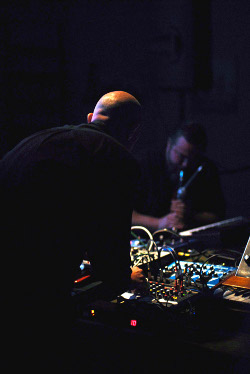 David: We had been listening back to some of our live performances and decided that there were some which were good enough to release. We decided to treat the live recordings in exactly the same way we treat our studio improvisation recordings, the same way that Teo Macero and Holger Czukay would edit, splice and re-compose Miles Davis and Can respectively. It’s the way we always work in the studio, the only difference is that there was an audience this time. All the source material is from the live recordings, but we have processed the sounds, cross-faded them, and tried to create a new narrative with the sections we chose.
Did you try to express with the title “dark earth distillery“ that it is possible to distill some positive elements (with the help of art?) from a world that is (becoming increasingly) dark?
Stephen: It’s a cluster of images. For me it suggests the loam, the crush, weight of matter, the ‘heaviness’ of it all, condensed and compressed and refined, and from it some primal draft; an invigorating fuel, a new intoxicant, or a poison to end it. Also a ‘dark earth’ is an eclipsed earth, an earth in full shadow; night everywhere. And then it’s memories of travelling at night through foreign countries, playing concerts, pulling music out of East-European shadows or the London gloom. Also, I quit drinking some time ago and towards the end it was a melancholy pursuit, very solitary, conducted in the dead of night mostly.
Symbolism aside, I’m not sure the world is getting any darker than it’s ever been; we have antibiotics for pus-filled wounds, headphone voyages instead of backbreaking drudgery, we get to eat everything instead of everything eating us. I’m not dreamy-eyed about a past, I think I’m damn lucky to have been born in these times and in this place; if the burden I have to bear is postmodernism and 24-hour rolling misery on TV I think I’ve come out of the cosmic lottery pretty well!
I remember that when I interviewed you (David) years ago, you said that if you wanted so see people crouched behind laptops, you would go to an office. To what extent do you consider the interplay between electronic and acoustic instruments essential for that what you do?
David: Ha! Personally I do find laptop performances rather boring to watch as a live spectacle… but each to their own… if it sounds good, use it.
As for blending electronic and acoustic instruments, I think acoustic instruments have so many overtones, such complexity of sound, that they cannot be ignored if you are interested in creating and manipulating audio textures. I’d say that the majority of sounds on “Temporal Bends’ were created with processed guitar, sax and clarinet. We also made a conscious effort to make any synths sound unrecognisable, and likewise, the acoustic instruments probably sound like synths. One of our favourite and most used live instruments is a little Yamaha mini keyboard which I bought in a car boot fair for a pound – once you put it through a couple of pedals it sounds beautiful and quite unique – it’s all over most of ‘Dark Earth Distillery’.
(M.G., U.S.)
UnicaZürn

 Anlässlich des kürzlich in Berlin stattgefundenen dritten „Epicurean Escapism“-Festivals folgt eine Zusammenstellung, die sich als Ergänzung/Überarbeitung der ursprünglichen Tape/DVD-Veröffentlichung, die vor zwei Jahren während des Vorläuferfestivals erstmalig verkauft wurde, versteht.