
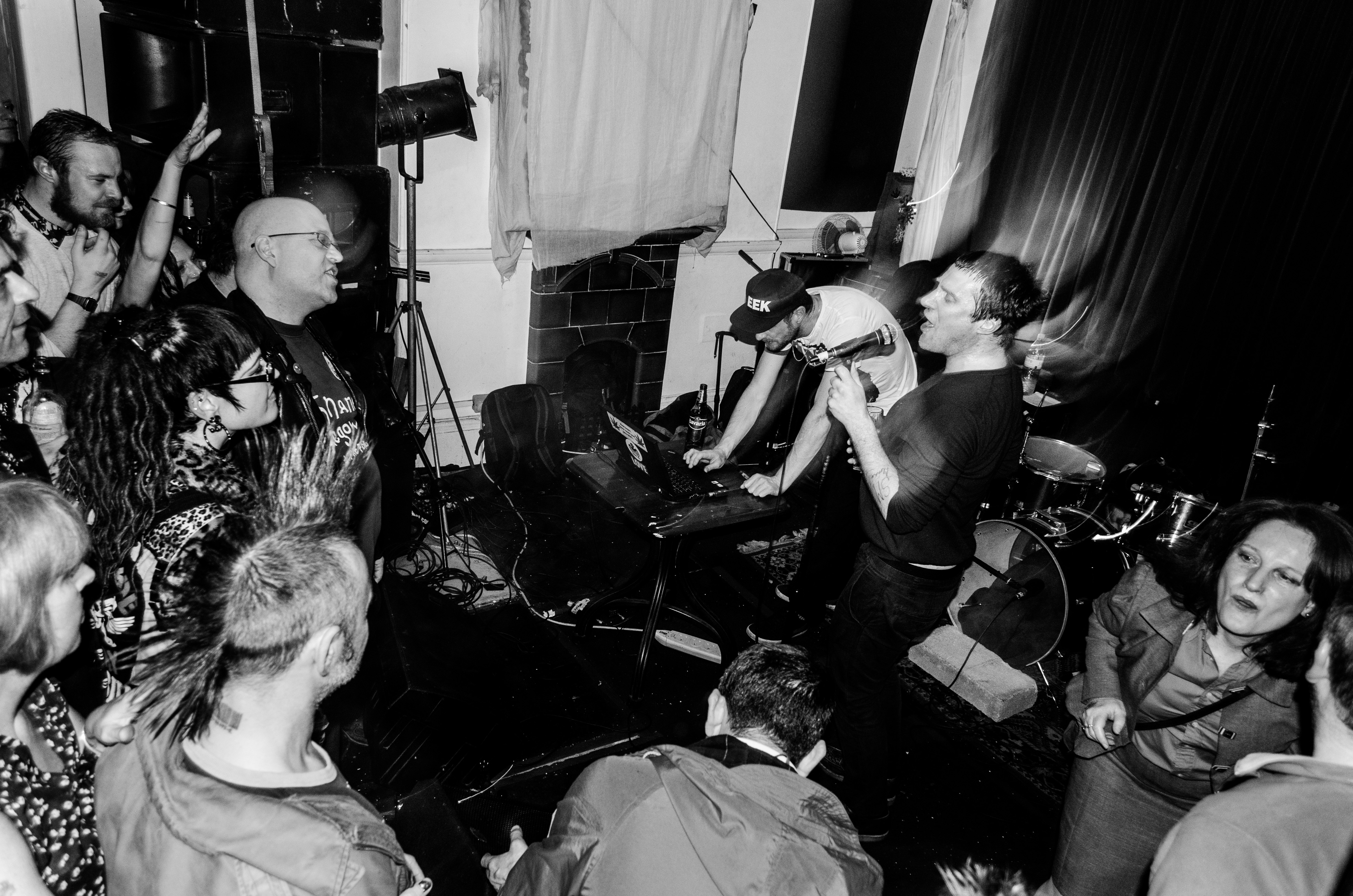
 Zwei Männer, ein Laptop, Flüche, Wut; die von Andrew Fewarn komponierte Musik runtergebrochen auf das Allernötigste: ein paar Beats, Bass, ab und an ein Sample. Das genügt um die wortgewaltigen Schimpfkanonaden von Jason Williamson zu untermalen, der den East Midlands einen Platz im aktuellen Popgeschehen zukommnen lässt. Der Zorn, der hier kanalisiert wird, lässt manche an eine 2014-Version von Punk denken und neben den schon häufiger gezogenen Vergleichen zu Mark E. Smith kommen einem auch Steve Ignorant oder Philip Best in den Sinn. Weiterlesen
Archiv der Kategorie: Interviews
There’s always an underlying account of day-to-day life: An interview with Sleaford Mods
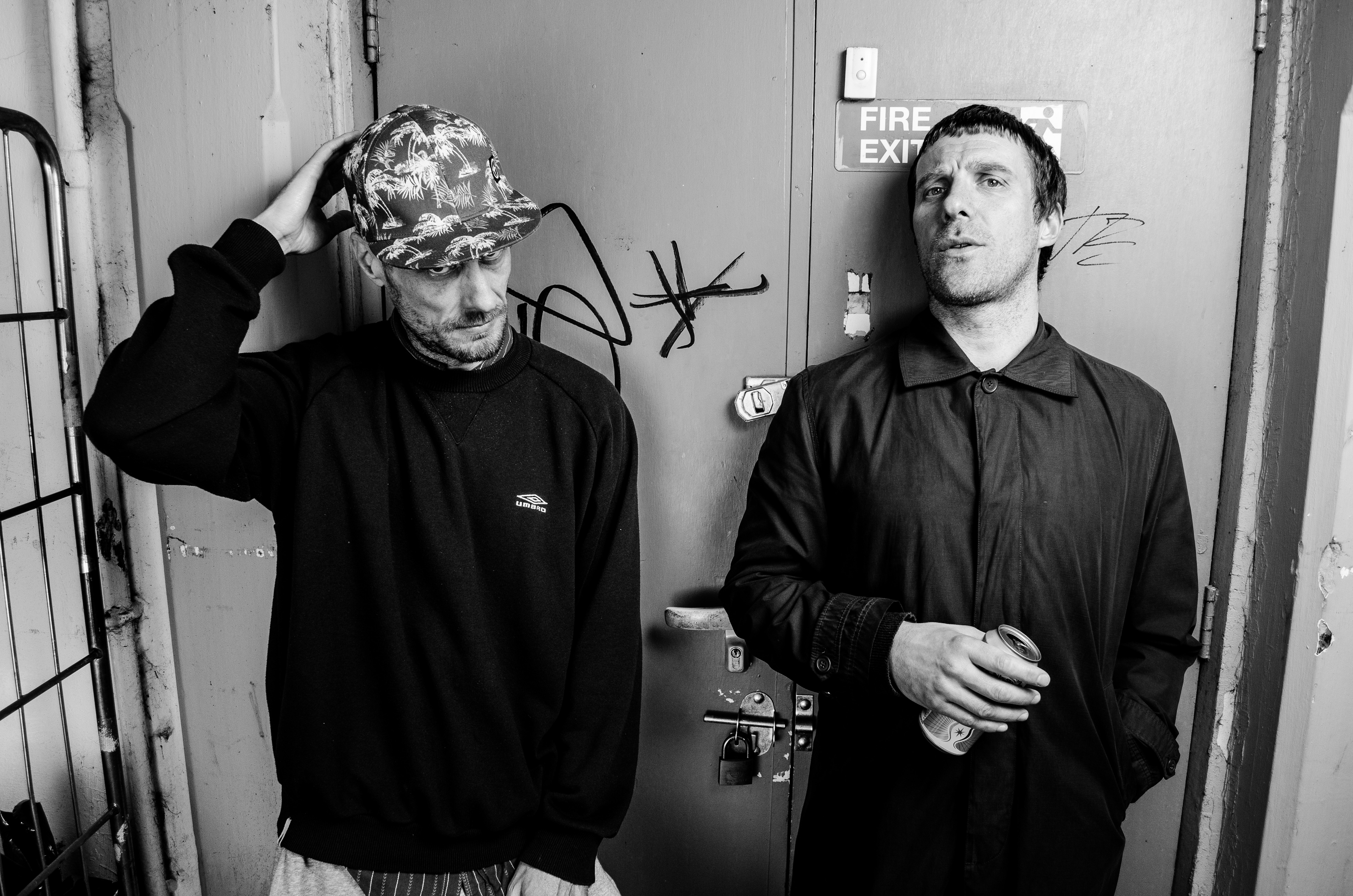 It may be a bit trite to begin like that, but there’s a lot of anger in what you do. Years ago I talked with a friend of mine and he said: “I don’t listen to aggressive music anymore. I’m 40 now. I’ve mellowed a bit “. But I think you can still feel a lot of anger.
Jason Williamson: No, it won’t go away.
Andrew Fearn: No offense to your friend but a friend of my cousin, he likes Talk Talk and Ambient stuff but when I met him at some family thing, he was all over it. He was all over Sleaford Mods. Because every bloke is pissed off. People just choose to forget.
J: But it’s your choice. A lot of people try not to think.
Ignorance is bliss.
J: Yeah. That’s it.
Would you then say that the current political climate in Britain has influenced the last record?
J: I’ve been doing this for seven years. It was always. You just had to feel the rock back then.
Andrew Fearn: It’s never gone away.
J: It’s never gone away for a long, long time in that country. It’s always been unjust. For the last thirty years it’s escalated rapidly.
A: [points at the table with fruit backstage] Lots of water, coke, bananas, fruit. You wouldn’t get that in the UK. You wouldn’t get fuck all. What you get is a locked door while you’re trying to get into the room. That’s all you get (laughs).
You enjoy German beer?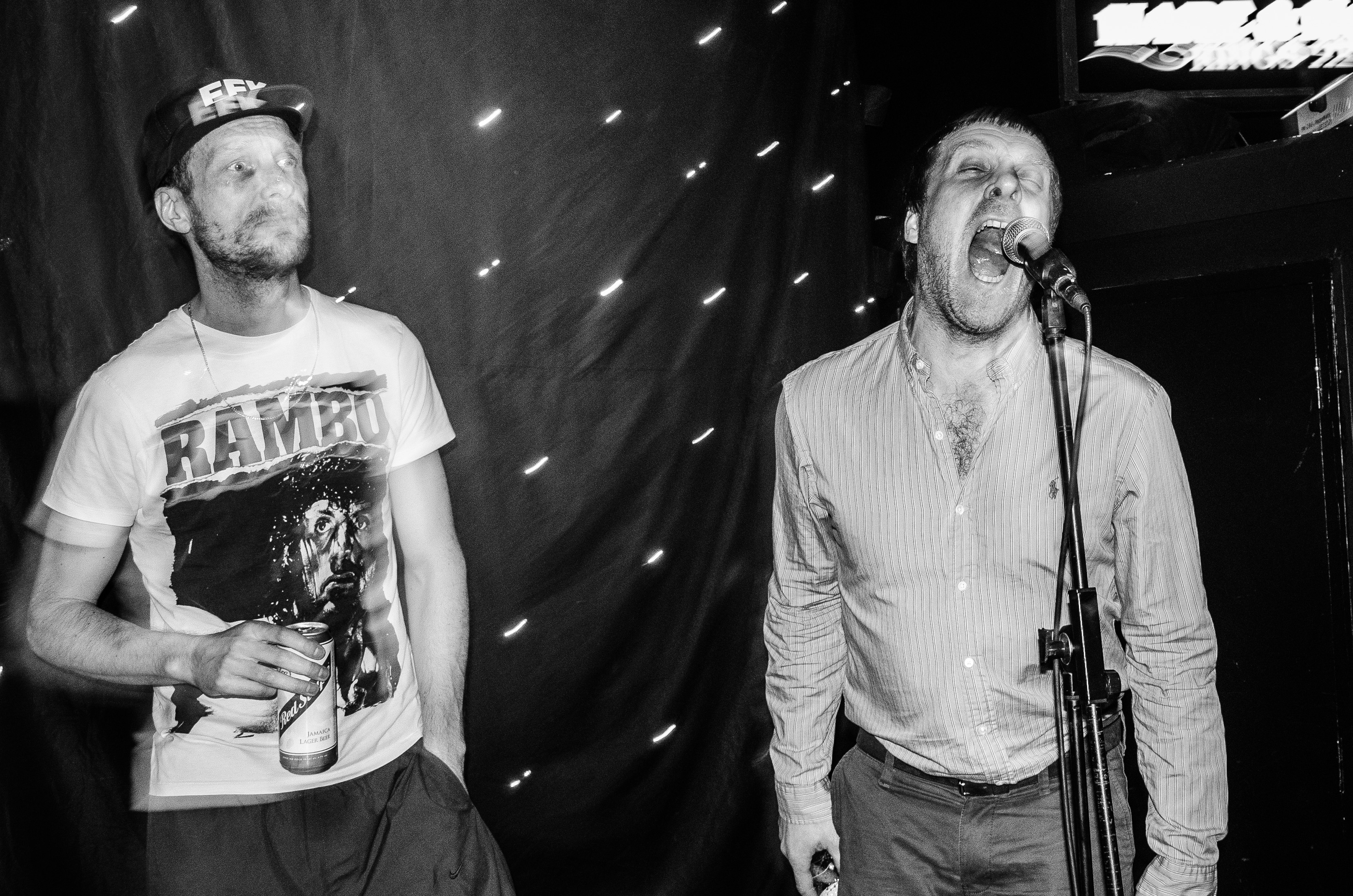
A: Not just German beer. Everything. Food, people, the culture. The infrastructure.
Ages ago I spent some time in Liverpool and I remember being stuck in the tunnel at Birkenhead quite often. After I had been to Birkenhead a couple of times I got an idea what the line “it took a tattoeoed boy from Birkenhead to really really open her eyes“ from the Smiths was about. How do you feel about Morrissey today?
A: I mean, he says funny things and he is a bit of a twat.
J: A fuckin’ moral ass all the time.
A: There’s something cool about him. He moved to America, to LA, and I think he wouldn’t give a fuck about all we think.
Maybe let’s turn to the way you compose your songs. Legend has it that it all started when somebody played a Black Metal-loop.
J: Yes, that’s true. I was experimenting with spoken word before that. I got back to the studio and try to work with it.
A: My part.
J.: Before (both laugh). So I started writing more in that vein. Using loops. That’s how it started.
Your last two albums have been released on Harbinger. How did that happen?
A: You know Harbinger?
Yes. I’m quite interested in postindustrial. So that was a name that rang a bell.
A: How did that feel for you then?
Well, at the beginning I was a bit surprised but after hearing you tonight it makes sense.
A: We sometimes get tagged with Pet Shop Boys. Because when I was a kid I was trapped in pop music. I didn’t know about a world outside of that. The Pet Shop Boys were quite important to me. But funny now, the Pet Shop Boys.
J: Sorry, what was the question again?
About the label.
J: We used to play in a club called Ravel, the Ravel Club and that’s how we met Steve [Underwood].
A: The only good night in Nottz.
J: Steve came down. It was me solo. We didn’t do it together for about a year. We just used to record together.
A: I had done some music. It was quite embryonic. After a time we got to know each other more.. Then they had a festival at the club and he saw it. Then it all kicked up from there.
When I saw you live, I noticed that normally when you see people with a laptop, they are crouched behind it, pretending to a lot of stuff. With you it’s different.
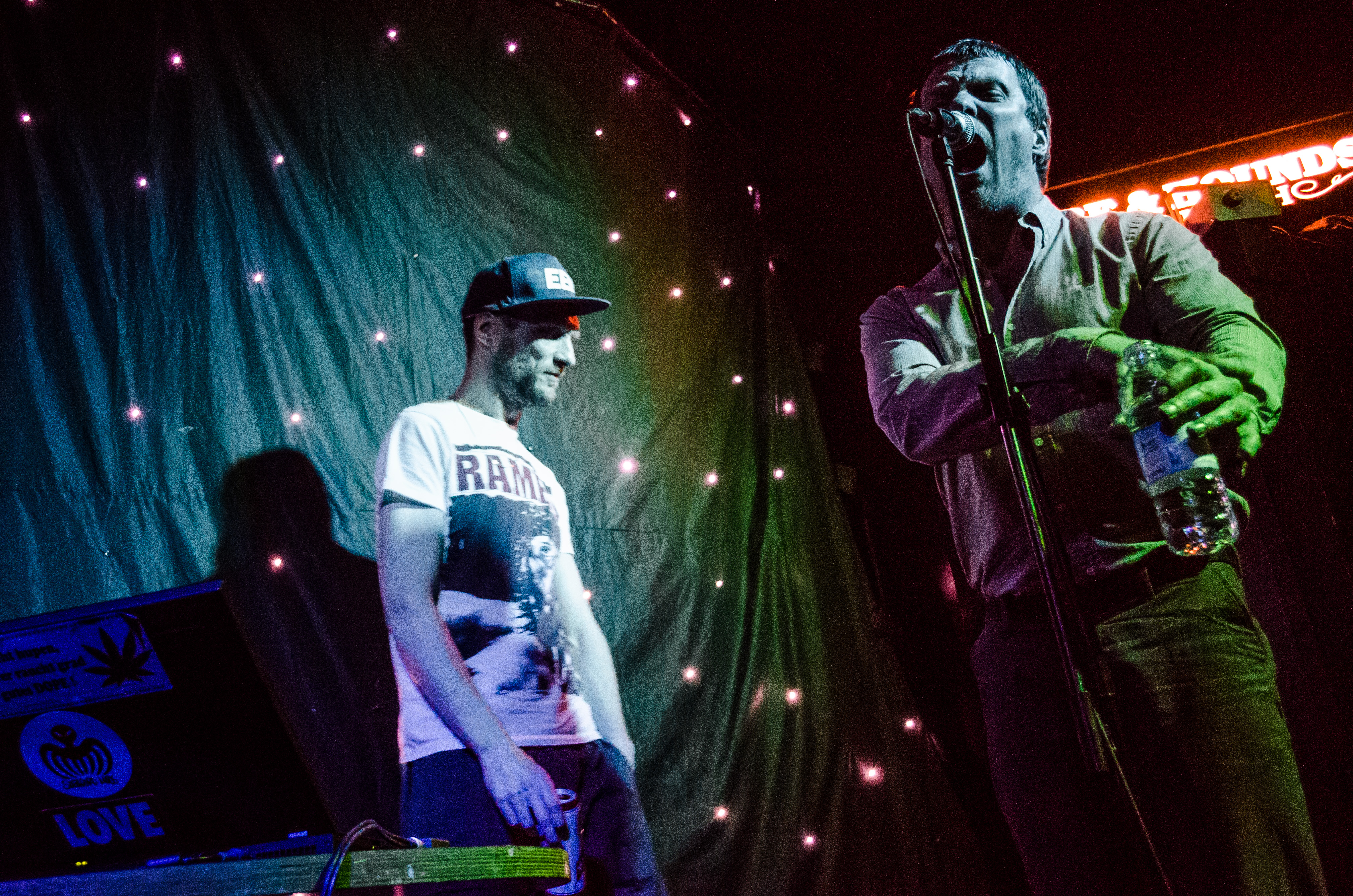 A: Yeah, that’s intentional. I’ve been making music all my life in various projects and they always struggled with that concept. I’ve always struggled with how they do that, how they lie. No one gives a fuck about you appearing over a laptop screen. People rather see me jiggling.
You obviously know all the lyrics.
(laugh)
J: The idea is to do it stripped down. We don’t use many instruments. He just presses play and that’s it. And then I’ll do the rest.
But there are a lot of things going on.
J: It create itself. You just surround yourself with whatever.
A: I think our electronic thing is very claustrophobic. It’s not a fake thing.
Would you say that the reactions are different in England than in Germany for example? Maybe that the audience focuses more on the lyrics?
J: In England now they are coming round to it.
A: They are, yeah. Before we came to Europe the British audiences were very cynical about it. They were hanging on to the old stuff. It’s working now.
Could you say a few words how the lyrics start? How do you get into the mood?
J: Sometimes it’s gibberish, sometimes it’s a real solid subject about something that pisses me off or somebody that’s pissed us off. Just a general subject that we talk about, It could start with a funny word, some of it could be made up, some of it is fantastical but there’s always an underlying account of day-to-day life.
A: Some of it that we think is very English but it’s probably something that everyone in the world knows. It’s s the thing that we do. That’s why we are not really having a problem being related to in Europe or anywhere else becuase we’re just talking people’s language. Being fancy about poetry or something. We’re not doing that.
J: There’s nothing going on.
A: There’s nothing going on. It’s a terrible time.
J: Music’s shit in England. Nobody’s doing anything. Everybody’s a careerist. If people get picked up and’ve got an ounce of talent it just gets absorbed into whatever record company signed them on and it just gets turned into a machine to make profit. So we’ve come up strictly by ourselves with Steve our manager and he’s taken us through his conncetions in Europe for gigs and through that we built an audience and got back to England with the press and everybody pickin’ up on it because we gigged over here, we’ve got a reputation. So Europe’s been good for us really.
I saw on your website that even the BBC interviewed you.
J: Yeah, BBC 6. But that’s in Nottingham. Mainstream media have picked us up quite a lot but it’s all through the gigging in Brussels, in Germany and then you go back and trying to play gigs in England. It just caught on for some reason.
 People have written about the swearing in the lyrics. Is it intentional or something that just happens?
J: It’s something that happens. It’s just the way I talk as well. I wanted to get across me as opposed to trying to do nice words and fuck all. It got to a point where I got so frustrated. So I just thought being me that’s been my greatest weapon. You should do music that suits you. Not try to be somebody else. That’s why so many people fall down. People may be good at writing songs but a melody will only carry so much. You could have your own personality in there as well.
Maybe just one last thing. I think I read on your bandcamp site that you played in a couple of band sbefore and you hated it.
J: Yeah. Because I hadn’t been myself. I hated it for the fact that it was just geared around trying to get a record deal. In a certain genre of music that everybody else had competely fucking done. Time and time again. Then after a while it got so monotonous and I got into spoken word a bit. So I could relate to that more because I could get more words out. That’s obviously when it happened that Saturday afternoon in the studio with the loop. Number one: That was interesting. It got my attention. Number two: I was my own boss. I didn’t have to compromise with anybody. I could just do my own thing. And I found that I was quite a good producer. I could get my ideas across really well. And it just escalated like that.
(M.G.)
Dark Earth Distillery. Interview mit UnicaZürn
 Unica Zürn, Autorin, Dichterin, Verfasserin von Anagrammlyrik, Zeichnerin, Malerin, Lebensgefährtin Hans Bellmers– unter dem Namen der in Berlin geborenen Künstlerin, als Hommage an ihre kreative Kraft, wie es im folgenden Interview erläutert wird, sind mit Stephen Thrower und David Knight zwei Künstler kreativ tätig, deren eigene Stammbäume der randständigen, experimentellen Musik viele Verästelungen haben und weit zurückweisen: U. a. war/ist David Knight Mitglied von Shock Headed Peters, seine eigenen dunklen Klangflächen veröffentlicht er unter dem Projektnamen Arkkon, Stephen Thrower war lange Jahre Mitglied bei Coil, ist Filmjournalist und Weiterlesen
Dark Earth Destillery. Interview with UnicaZürn
 I must say I’m curious what made you choose the name of the German artist UnicaZürn. I remember that some years ago I discovered her anagram poetry and it really struck me right away. Unfortunately not many people know her. Were you more influenced by her texts or rather by her visual work?
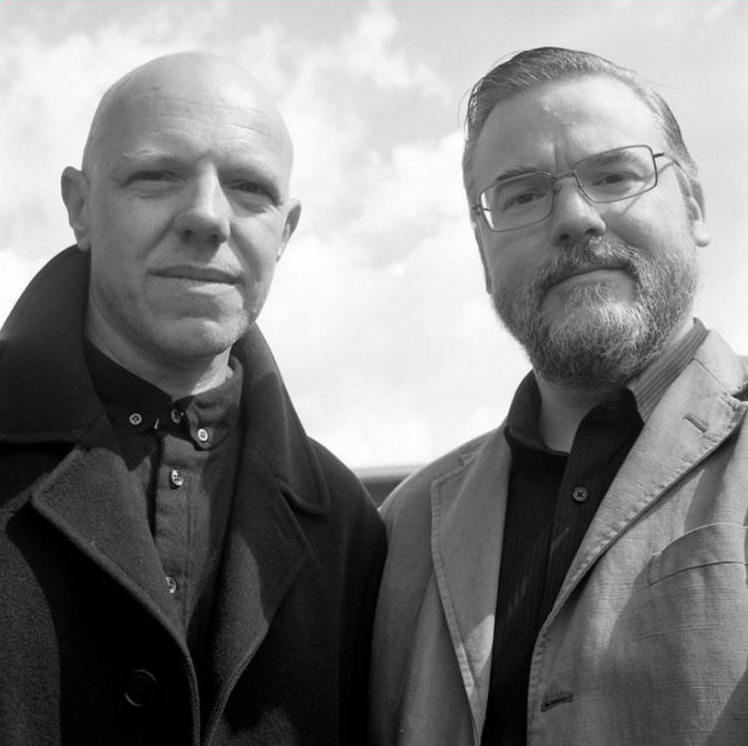
David: We’d been throwing names around for a long time, and although we’d been working together for some years we hadn’t decided on a name until just before the ’Temporal Bends’ CD was released. Ossian Brown had been reading one of her books; Steve noticed it, and that was it. I had always loved her drawings, and her work with Bellmer, so I agreed it was a perfect name. I find her drawings more inspirational than the texts, but if you were to convert our music into images I think it would look more like a Rothko!
Do you see a relationship between her way of writing/drawing and your way of composing?
David: Although I like the anagram poems, they are the opposite to the way we work – mostly we do not use compositional systems. We have experimented with them, but we always seem to get better results using an open freeform approach. Our adaption/adoption of her name is a tribute to her creativity, not her methodology.
A lot of her work is no longer available in Germany. Are there (m)any English translations of her work?
David: I have the Atlas Press (UK) publications of ‘The Man of Jasmine’ and ‘The House of Illnesses’ – they are out of print now, but were easy to get a few years ago.
Do you make a clear, programmatic distinction between UnicaZürn and your other groups, or is your collaboration more like the spontaneous result of what happens when two musicians meet and improvise together?
Stephen: It’s the latter, I would say. Some of what we do arises from one of us working alone and then bringing the results to the other to get their take on it. But I would estimate that more than half of the material comes from improvisation together. That spontaneity is then subject to winnowing, refinement, a more considered stage of deciding what is missing or what needs to be removed, a process that comes through conversation and comparison.
What is the main difference with regard to the creative process, compared with your playing in Arkkon and Cyclobe?
Stephen: For me, the difference lies in the importance we place on playing together simultaneously; in Cyclobe it happens comparatively rarely, in UnicaZürn it’s the norm. It comes, I think, from our enjoyment of improvisation in The Amal Gamal Ensemble, plus the ease with which we seem to find the right vein or channel to explore in this way.
David: It’s a very similar situation for me too; working as part of (what is basically) an improvising duo usually means clearing my head of any preconceived ideas of where a piece may go (or even start), holding my breath, and diving in. Whereas working on my solo projects I usually envisage at least a general direction of where I want a piece to go.
I think The Amal Gamal Ensemble last played in 2011. Is this project still active, does it lie dormant or is it dead?
Stephen: Amal Gamal is on a long hiatus, but there’s been no decisive ‘end’. The social connections have loosened perhaps. I don’t live in London any longer so I don’t see the others as often as I used to do. I can imagine another burst of activity, perhaps with a varied line-up again: we started off varying the personnel and then drifted into being a stable six-piece for quite a while, so maybe shaking up the pattern would make sense.
I’ve got the feeling that in the music of The Amal Gamal Ensemble there are somehow more (prog)rock elements than in UnicaZürn. Do you somehow regard UnicaZürn as a kind of successor to this band? In what relation do the two groups stand to each other?
David: I think Amal gradually morphed into what could be considered a more ‘traditional’ line-up: drums, bass, guitar – albeit with three synth/keyboard players – and although we are all committed left-field improvising musicians, we would call upon the vocabulary of rock when necessary. But I’d like to think we sounded more like Chrome than The Nitty Gritty Dirt Band! Steve and I had actually started recording together before Amal had been formed, and the ‘Temporal Bends’ album contains some of this early material – specifically ‘Black Glass Mask’ and most of the ‘Temporal Lapse’ mini-album. So although we didn’t have a name for the project at the time, UnicaZürn actually pre-dates Amal. We treat both bands as entirely separate entities – Amal started as a fluid collective which did its growing-up entirely in public; an ever-changing collection of performers would assemble at The Horse Hospital in London once a month and improvise an hour’s set. I learnt a lot from that experience, it was musically very intense, and of course this feeds back into other projects such as UnicaZürn – it certainly gave me the confidence to be able to improvise the UnicaZürn live sets when we started doing them outside of our studio.
Apart from your own experience as musicians, have there ever been some indispensable encounters, impulses or inspirations in the past that created the basis on which UnicaZürn could grow?
David: There’s definitely been inspiration as a listener – my most powerful experience was seeing This Heat play live for the first time, in a small basement in Covent Garden, London. I was blown away – it was a post-punk clash of Stockhausen, electric Miles Davis, King Crimson, Faust and Henry Cow – it was monstrous, exhilarating and scary. That same year I’d seen TG play at The London Filmmaker’s Co-Op, which introduced me to an entirely new form of darkness in music. There were probably only about 20 to 40 people at either of these gigs, but there was definitely something brewing in the air around that time, and its an excitement which still fuels and inspires me to this day.
Would you say that there is – maybe in reference to your song title “The Infernal Kernel” – something like a constant core or a read thread that combines all UnicaZürn works?
Stephen: I think our work is closely allied to ‘kosmische’ music, a twisted outgrowth of it, and that provides a thread, although since really good kosmische music is unpredictable and mercurial it’s not what you’d call a tight or restricting definition! Reliably unpredictable, that’s the idea. A title like The Infernal Kernel refers to existence in cosmic terms, in this case touching on Gnosticism (the universe as evil construct); also the irreducible core of what it is to exist, the maddening ‘isness’ that cannot be explained without lapsing into tautology.
Symbols, as vague as they might be, seem to play a great role in your works, perhaps most prominently images of water, depth and diving. On your website you even quote a reviewer who mentions Cousteau and Lovecraft with regard to your music. Do you see your musical improvisation process as an expedition that goes “to the ground“? If yes, how open-ended is your quest?
Stephen: When you’re working in such an abstract area as music, especially music without lyrics, you find yourself looking for symbolic markers to orientate your abstractions; like, which way up do you hang the painting! There’s a play in our music, and the song titles, between the wide-angle and the particular; we’ve brought elemental imagery into play alongside language games and tricks of the tongue that play the reverse angle; the specific nature of a pun or surreal juxtaposition. We’ve discovered as we’ve worked together that there’s a strong tendency to look for the elemental in our associations; water, mainly, and the dark compression of the earth. Water to soil; that’s the human trajectory!
 Water has of course also been associated with the subconcious and usually the practice of submerging into realms below rational consciousness is associated with the individual psyche. In what respect does the fact that you are two persons play a role in your “diving“ experiences?
Stephen: It has conflicting associations; I personally love being on ships and boats but as a kid I was really very scared of drowning; it took me years to overcome a deeply irrational fear of being in the water. There’s a lot of fear and a lot of fascination there, for me. Panic to do with choking, stifling, smothering, being unable to breathe; these were real pressure points; less so now, as you tend to overcome them by the sheer persistence of living. I suppose the aspect of being underwater that maps onto music in an interesting way is that sense of immersion. Being underwater is not unlike being inside the pulsations of a piece of music; certainly if you’ve enjoyed music on hallucinogens you tend to have a much more tactile sense of the way music immerses you in its waves. Also, the way you become slower in water suggests a different relationship to movement and time; it takes longer to make a simple movement, everything becomes more deliberate, and there’s a time-lag between your sense of deciding to move and the movement happening. Anything that disrupts or alters the flow of cause and effect is interesting, I think. As for there being two of us, well, it can be safer that way, except for the odd occasion of the laughing gas in the airtank or the curious case of the itching powder in the wetsuit…
In our culture, terms like “regression“ or “the regressive“ mostly have a rather negative connotation and are often linked to weakness and an inability to deal with the hard facts of life. Upon a closer look, giving room to the more archaic aspects of your personality or of life in general can be turned into a precious experience and enrich our perspective on reality. Do you think that this is still a field where our society is in need of a paradigm shift?
Stephen: Not quite sure where you’re going (or coming from) with this? If I understand your terms, I’d say it’s not so much that regressiveness is bad, or good, more like how do you detach yourself from your archaic self in the first place? How do you cut the cord? I’d love to see the utensil that could perform that operation. In a culture that seems to be standing still I would say that violent motion in either direction is valuable. There’s a difference between refinement or reduction to the elemental, and regression, which has connotations of escape and shrinking from the future. In Coil we had a song title, “Further Back and Faster”, lifted from Nic Roeg and Donald Cammell’s Performance; I still love that title and it fits pretty well with the UnicaZürn approach too.
Are such interests for you connected to mysticism or the occult in the broader sense (not in the stereotypical sense of romantic escapism..)?
Stephen: I’m wary when it comes to theories of the unknowable, but I’m sure there really are forces beyond our current comprehension; emphasis on ‘current’.
In “Jack Sorrow“, you included lyrics and vocals of (the nowadays unfortunately not so active) Danielle Dax. Could you imagine to include more song based structures in future works of UnicaZürn?
David: With ‘Jack Sorrow’ we originally had a recording of Steve’s heavily-processed clarinet, which sounded like cats meowing – Danielle heard it one day when I was playing her some of our pieces and she immediately came up with the vocal line. It evolved naturally, in the same way the rest of the album had – I find there’s nothing worse than sitting down and saying “OK, let’s write a song”, and because of the way it had naturally evolved it fitted perfectly into the album as a coda, instead of just sounding like it had been tagged-on – which can be a danger when it’s the only vocal piece on an otherwise completely instrumental album. We don’t want to set any rules with UnicaZürn, so I can see no reason why we shouldn’t incorporate more vocal or rhythm-based structures – we’ve definitely been experimenting with them.
Having asked that, have you already planned what your next release is going to be/sound like?
David: ‘Temporal Bends’ was the result of a long period of experimentation, and we’ve done a lot of work since then; we’ve probably got enough material recorded to release a triple album, but we’re still in the process of distilling it down into one, which will hopefully be finished this year. David J Smith has played drums/percussion on some of the tracks and I’m very excited by the potential directions this next album could go in. In my head it’s sounding like a cross between Popol Vuh’s ‘Affenstunde’, Faust’s ‘So Far’ and Tangerine Dream’s ‘Electronic Meditation’ – but that’s just me! We also plan to release a recording of a performance we played at the Ironmongers Baths in London last year – sounds were transmitted via underwater speakers to an audience of swimmers – it was the most surreal gig I’ve ever played. As you can imagine, the analogue synths didn’t like the humidity – one of them exploded when we got it home.
In the liner notes of “Dark Earth Distillery“ it says that the recordings are from three different performances. When listening to the album one can but wonder how that is possible as both sides of the vinyl “flow“ together. Can you say a few words about the working process?
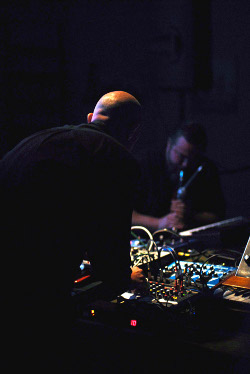 David: We had been listening back to some of our live performances and decided that there were some which were good enough to release. We decided to treat the live recordings in exactly the same way we treat our studio improvisation recordings, the same way that Teo Macero and Holger Czukay would edit, splice and re-compose Miles Davis and Can respectively. It’s the way we always work in the studio, the only difference is that there was an audience this time. All the source material is from the live recordings, but we have processed the sounds, cross-faded them, and tried to create a new narrative with the sections we chose.
Did you try to express with the title “dark earth distillery“ that it is possible to distill some positive elements (with the help of art?) from a world that is (becoming increasingly) dark?
Stephen: It’s a cluster of images. For me it suggests the loam, the crush, weight of matter, the ‘heaviness’ of it all, condensed and compressed and refined, and from it some primal draft; an invigorating fuel, a new intoxicant, or a poison to end it. Also a ‘dark earth’ is an eclipsed earth, an earth in full shadow; night everywhere. And then it’s memories of travelling at night through foreign countries, playing concerts, pulling music out of East-European shadows or the London gloom. Also, I quit drinking some time ago and towards the end it was a melancholy pursuit, very solitary, conducted in the dead of night mostly.
Symbolism aside, I’m not sure the world is getting any darker than it’s ever been; we have antibiotics for pus-filled wounds, headphone voyages instead of backbreaking drudgery, we get to eat everything instead of everything eating us. I’m not dreamy-eyed about a past, I think I’m damn lucky to have been born in these times and in this place; if the burden I have to bear is postmodernism and 24-hour rolling misery on TV I think I’ve come out of the cosmic lottery pretty well!
I remember that when I interviewed you (David) years ago, you said that if you wanted so see people crouched behind laptops, you would go to an office. To what extent do you consider the interplay between electronic and acoustic instruments essential for that what you do?
David: Ha! Personally I do find laptop performances rather boring to watch as a live spectacle… but each to their own… if it sounds good, use it.
As for blending electronic and acoustic instruments, I think acoustic instruments have so many overtones, such complexity of sound, that they cannot be ignored if you are interested in creating and manipulating audio textures. I’d say that the majority of sounds on “Temporal Bends’ were created with processed guitar, sax and clarinet. We also made a conscious effort to make any synths sound unrecognisable, and likewise, the acoustic instruments probably sound like synths. One of our favourite and most used live instruments is a little Yamaha mini keyboard which I bought in a car boot fair for a pound – once you put it through a couple of pedals it sounds beautiful and quite unique – it’s all over most of ‘Dark Earth Distillery’.
(M.G., U.S.)
I believe each one of us has to deal with a personal void. Interview mit Father Murphy
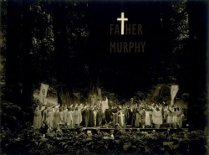 Die italienische Band Father Murphy, die jüngst vom Trio zum Duo geschrumpft ist, lässt sich nicht leicht in gängige Begriffe fassen – zumindest, wenn man damit ihre Musik unmittelbar kategorisieren will. Ihre lärmenden, basslastigen Klanglandschaften, die manchmal ganz plötzlich etwas Meditatives bekommen, ihre wuchtigen, eruptiven Klagelieder, strafen jede subkulturelle Spartenlogik Lügen. Die Konturen ihrer Welt werden deutlicher, wenn man sich ihr über Inhalte nähert und den Worten folgt, die Freddy Murphy und Chiara Lee selbst immer wieder in Songs und Liner notes fallen lassen. Im Zentrum ihres Denkens erscheinen Weiterlesen
I believe each one of us has to deal with a personal void. Interview with Father Murphy
 Father Murphy exist now for more than a decade, and it took a couple of years until the German media (including folks like us) really took notice of you. What can you tell us about those early years? Which were the impulses and circumstances that lead you to form the band?
We spent those early years as if we were a weird combo/tribute band for two of the projects we love the most, Syd Barrett and Os Mutantes. The impulses were mostly an expressive urge, together with the idea of leaving a track. We were younger, but we were somehow afraid of Death. Now that we’re growing old, we’re finding ourselves more at peace, as if we were somehow medias for reproducing sounds already existing in Nature, but giving clues in order to digest those sounds and atmosphere differently.
We recorded “…And He told us to turn to the Sun“ thinking it could have been a possible last Father Murphy album, kind of a requiem for the years we did spend together. We found out we were just starting over with our lives as one whole thing together with the music we were trying to reproduce.
Back then, different paths led us toward the same point, so we decided it was time to take notice of coincidences, like if they were signs pointing at different options/routes/possibilities to take. It was time to take a side, and we started repeating endlessly to ourselves: never forget you have a choice. Never hesitate, doubts are more beautiful after you choose than before.
If you were in other bands before, how did they sound and what kind of traces have they left in Father Murphy?
The few experiences there have been before were useful because we met people who taught us how important is the attitude behind your work. I believe, for me, the most notable trace is the idea to not use amps but simply plug everything into the mixer. Instead of working on a proper amp sound we decided to go for a dead and long/almost fake guitar/organ sound.
It wasn’t only a teenage kick, the push we felt for doing music, those unsatisfying first experiences urged us to find other possible ways to express ourselves.
You have to tell us if you are really named after the NBC-series of the same name or – which may be more likely – after the notorious priest Father Lawrence Murphy who was able to abuse many childen as his actions were covered up by the church for a very long time.
That’s a question we’re asked often… Actually, for none of these reasons. Our name comes from a short story by William Seward Burroughs, released as 10“ with soundtrack by Kurt Cobain, titled „The Priest they called him“. It’s a nice piece, typically Burroughs, and I think Cobain was very happy when he had the chance to work with one of his idols. For us as well, the name Father Murphy was a way to express gratitude to two of our youth idols, and at the same time to quote one of the main influences in our life/music, being that the fact we were born (Catholic) Christian.
Is there a seperation of roles inside the band, which goes beyond the playing of certain instruments – let’s say in the way how you write, compose or improvise songs?
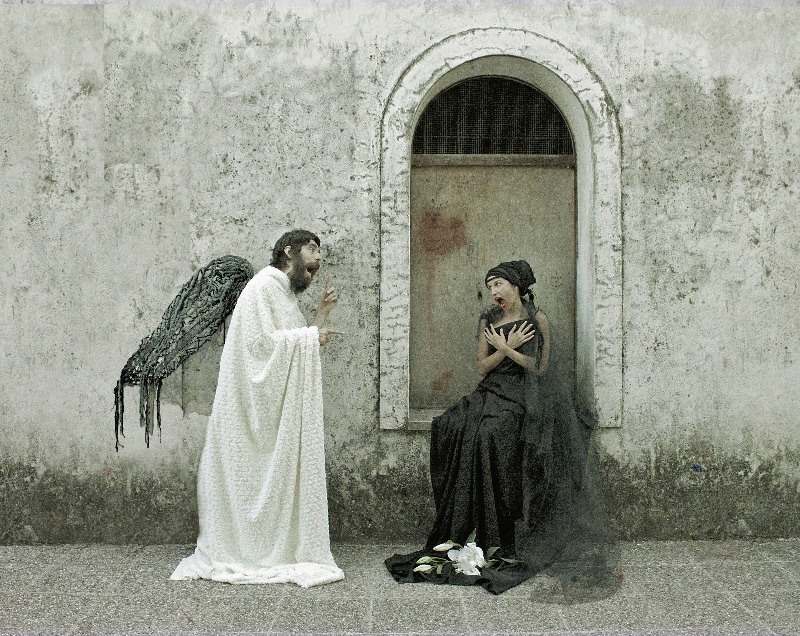 Starting from „…and He told us to turn to the Sun“ we began to work first on the songs‘ atmospheres, and only after that on songs‘ notes. Each release is a concept, a different step in Father Murphy’s downward spiral to reach something, the truth maybe, or, better, a method to follow in order to live a respectful and truthful life. From the Heresy to the latest concept on Failure, we’ve been working starting mostly from inputs related to sounds, in peculiar situation, for then trying to describe a peculiar atmosphere, or to make something like a conversation among us understandable/clear to the listener as well. In every little step we always tried to follow signs around us, trying to find inputs about which way to go. I may have been, mostly at the beginning, the media from this world and the other in order to do so, but since C.Lee joined me in the first real level of work on new compositions, I have to confess I find everything more harmonic and less artificial, which is weirdly good because, at the same time, we like the idea of going artificial with our music, as imitation of things and sounds that already exist.
You once mentioned in an interview that you would find it hard to imagine Father Murphy without lyrics/vocals. What role do words/the singing play in the overall concept of the band?
Singing is like praying ten times, someone said. It may even be a quote from the Bible, not sure (so sorry for showing how bad my memory is turning to be). We want to use our voices as instruments, they’re the first way to espress sounds with our bodies. Even if sometimes words are mostly sounds, they still have a meaning. And we choose carefully each word that we sing. We mean everything we say. There are only few examples of movements of ours with no words nor vocals, mainly because we felt a lack of voices was needed, or because a different media was used to fake a voice or such (like the horns in „Let the Wrong rise with you“ that in our minds are Angels‘ voices).
In my opinion, it’s hard not to regard Father Murphy as a universe of it’s own, as a narrative in episodes that step by steps creates an own parallel microcosm. If Father Murphy were a movie or novel, how would you imagine it to be?
Cyclically a new writer become a referential writer for us, besides Burroughs that we consider something like our guardian angel. This happened with Don Delillo, with Cormac McCarthy, and, recently, with Ballard. I answer to your question right after C.Lee and I read 14 Ballard books in a row, so I would say I imagine Father Murphy to be a summa of characters you can find in Ballard’s The Crystal World and The Drowned World playing in a Cormac McCarthy idea of Nature scenario..
Would you say that the band is a role play for the members, stricty seperated from your other activities, or are you always somehow Father Murphy?
Father Murphy in recording sessions is us trying to use different sounds in order to describe what we see and experience, being that around us or inside us. Father Murphy in live sets is us throwing up all the black tar we have pushed inside, in order to be better people, and to be honest in representing what we see around us. We are not sad people, but, even if we would love for everyone to have peace in their lives, this isn’t what we see (this last line is kind of a quote from a beautiful Will Oldham song). So, I’d say, somehow we’re always Father Murphy.
What can you tell us about the development of your latest release „Pain Is On Our Side Now“, and for what reason did you choose this beautiful castle in Lazio for some of the recordings?
„Pain Is On Our Side Now“ deals lyrically and sonically with our idea of Failure. It took us months to be able to summize what Failure means to us and how important it is for Father Murphy to find Failure at this point of his Path.
Sonically, we wanted to work with something that could mix more „natural“ sounds with a cold and dead synthesis of percussive sounds filtrated through different sonic rooms. In order to do so, we worked in two different places.
Bombanella soundscapes was one, a great studio/research lab nearby Bologna, where you can work with mostly custom machines and record simultaneously in analog and digital, and where we had the chance to focus on capturing more „fake“ sounds, even it’s probably not the right word, we basically tried to go beyond the boundaries of what you can recognize as a specific sound.
The other place was Itri Castle, an amazing medieval fortress where we had the chance to play for Muviments Festival in 2010. Now, the Festival (among our favourite festivals ever!) is run and organized by Brigadisco Records folks who offered us the chance to work in the Castle for future recordings. There are infinite rooms, and we chose the biggest in the last 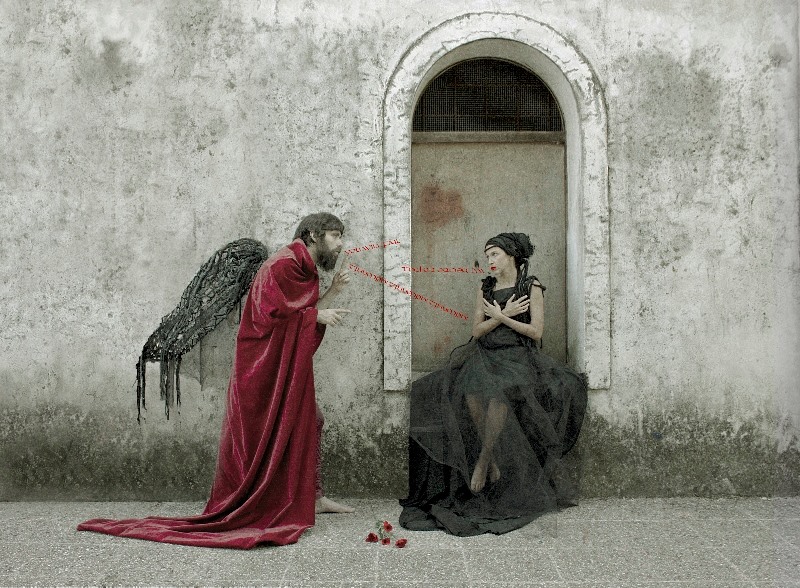 floor, so to get the most out of the natural reverb. The voices we recorded there are the only tracks, together with the horns, that have no effects at all.
It is funny to think that the first one who suggested to record there was Arrington De Dyonyso, after playing together a show in his home town. We were playing just few meters away from Dub Narcotics studios, nonetheless he recognized the castle in Itri to be the right place for us.
As in many releases before, the diversity of the music seems to speak for an interest in the possibilities of music genres, but at the same time for a disregard to any dogmatism. Would you agree?
I absolutely agree with the second part of your sentence. Dogmatism is simply sterile. As for the possibilities of music genres, we’re more interested in translating different inputs into sonic atmospheres of our own than into musical genres. We can’t determine in advance how the imputs will be transformed and how they will sound, so our work goes by attempting to get closer and closer to those stimuli.
The two sides of „Pain“ are conceived to be played in sequence or simultaneously, which leads to a different, but no less coherent work. In the liner notes you stress the choice of the listener to „finish“ the music according to her or his own preference. What was your basic idea behind this decision? Would you say that a too passive attitude is a major problem in today’s culture/society?
The idea is to underline more the fact that people have the chance of choosing and the right of doing so, but that this comes with an effort. In a way it is only us asking people to participate while approaching to our music in order to become part of the process. Somehow though, I don’t know if it’s a major problem in today’s culture/society because it may have always been like this, but, generically speaking, I can’t stand when I have to suffer a decision. I‘d rather make the wrong choice, and have only myself to blame.
To what extent does the political situation in Italy influence your music?
It is impossible not to be influenced by the environment where you live, somehow it always filters through the most different way of expression. We are doing everything we can to limit this to the most basic though. Father Murphy’s world is a way to escape from the real world, even if it’s also influenced by that.
Some of your tracks (so for instance “Go sinister“) nearly have a metaphysical/religious quality. Are these aspects that you want to achieve with your music?
When composing our music, we constantly deal with doubts, there are long and deep journeys into ourselves. In this downward spiral, even if you’re bound for going down, you still need some light to be on your side. Sometimes we feel every sound we ever make will always be tied up to a deep feeling of religiousness which we feel to represent us.
In some tracks more than in others we translated those feelings or religiousness into sounds.
You write that you are “the sound of the Catholic sense of Guilt“. Do you think that in your work/art there is a kind of constant confrontation with your Christian heritage and that of the country you were born?
Constantly. It is rooted mostly in our childhood. Father Murphy is our way to express this, to express the doubts, the consequent Guilt, but, most of all, the journey to represent all these feelings, in order to give them a name for then owning them in our own way. And that’s the point where we needed to go heretical for finding a religiousness of our own, when we got to the point were you cannot believe in religions, but you still have the religious feeling inside.
As for the confrontation with the country where we were born, Italy is a great place to spend some time, but absolutely not a place to live. This made us spend more and more energies in doing music, so at least, under this point of view, living in Italy really helped us to do what we do.
I don’t know if you agree but it seems that nowadays religion is returning from many different angles and in all shapes and sizes. Do you see such a development, too?
People have always been trying to find help and shelter in religions, especially when they fear the Other (as other people and as other = unknown) and, when this happens, the lack of empathy also grows. I believe each one of us has to deal at different levels and in different times with a personal Void, and when it’s time to do it, religions are usually there, trying to tell you how to do it.
In a review of your labelmates Mamuthones in The Wire you are mentioned with them and both of you are described as “Italy’s forermost occult psychedelians“. Is that a tag you can live with or which adequately represents what you try to do and achieve with your music?
Tags are needed for people to give names to things. I don’t necessarily like them, but I see their importance. Occult and psychedelia are both terms that can somehow/generically describe our work. Of course then you need to go deeper. And the best way to do it is to go directly to the source, that’s always the music.
This question is closely related to the last one: Much has been written about “Italian occult psychedelia“ and some consider it to be Italy’s counterpart to hauntology but much darker and with less poplike qualities. Do you feel that it’s true and if yes what would your explanation be why the music of some of the artists that bear that label has such a dark and disturbing quality?
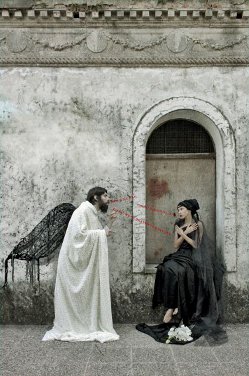 I believe, talking about me and people that I know tagged with this label, that the common background probably influenced our approach to music. We are mostly all around 30/40 years old, we spent our youth in a society where the fear of the nuclear disaster was decreasing but was still there, a society with still rigid catholic rules and hyprocrisy. We have a common fear/fascination of Death, a similar list of places (mental or physical ones) where to hide.
It is true, we all listened to the soundtrack music from the 70’s giallo horror music, but, being completely honest, I remember being more obsessed by the Italian jingles and soundtracks for Japanese cartoon series than by Goblins. There was a big sense of Failure in that, as if heroes were the only hope in brighter days, knowing though that it wouldn’t been enough.
In Italy we’re still tied up to the decadence of the Roman Empire, and this is a heavy feeling that soffocates any possible wind of change, because it starts from false and stupid pride, and from lazyness. And Bigotry is still huge down here.
I think the artists involved in this community chose music as a media to separate from their everyday life, in order to isolate themselves and to create a needed and stimulating alternative. Most of the times this happened when meeting other mates for simply playing and watching the days going in and out. But as soon as most of these bands started touring, the more they linked with similar situations around them, the more they created a unique (at least in one’s own experience) sense of consciousness, which can be heard in their music. It is peculiar, and it’s them leaving a track, living their life even through this urge of finding their own place.
You also write that you like to go to the “bottom of the hollow, and then dig[...] even deeper“. Have you ever found yourselves in a situation when you felt that you had indeed dug too deep?
Feelings of Guilt pushed me digging hard, when I felt I went too deep it was because I found the Guilt. Meeting the Guilt showed all my limits, mostly when I had hard time in taking responsibility for it.
Does the “No room for the weak“-EP allude to Joy Divisoin’s “Day of the Lords“?
Yes, it does. One of my favourite songs ever. We had the chance once to play it live with Deerhoof and Xiu Xiu, all together on a stage, when Jamie got to that line he pointed at me and then handed over the microphone. It’s one of my favourite memory of all our touring seasons.
On your „social media“ you name a number of musicians as influencial. How (and how direct) does inspriation function for you, and can it also sometimes be a burden? Are there moments, when you have to turn down other music, to be creative?
I directly quote our dear W.S. Burroughs here, „Out of the closet and into the museums, libraries, architectural monuments, concert halls, ,bookstores, recording sudios and film studios of the world. Everything belongs to the inspired and dedicated thief. All the artists of history, from cave painters to Picasso, all the poets and writers, the musicians and architects, offer their wares, importuning him like street vendors. They supplicate him from the bored minds of school children, from the prisons of uncritical veneration, from dead museums and dusty archives. Sculptors stretch forth their limestone arms to receive the life-giving transfusion of flesh as their severed limbs are grafted onto Mister America. Mais le voleur n’est pas presse’ — the thief is in no hurry. He must assure himself of the quality of the merchandise and its suitability for his purpose before he conveys the supreme honor and benediction of his theft.“
And when we need to be creative, we become even more thirsty of new inputs!
On that EP mentioned above you covered Leonard Cohen’s (an artist in whose work spirituality can be found thoughout the decades of his career) “There’s a war“. Did you choose to cover that song for its lyrics or music or both?
I would say both. We took only a few lines of the lyrics though, and we changed them a bit. It was the first song where Ving Ngo (the artist who takes care of all our covers and imaginery) sang with us.
I find Leonard Cohen’s original version to be very obsessive with the rhythm that buils up in the back, and his voice being almost reluctant, to a point where the War of the title is there but in a way he’s not affected by at all. Our idea was our cover to be more like a mantra to push people get to a deeper consciousness through going back to the War. The Lyrics say „going back“, as if the war was a permanent situation of which we only lost memory.
Some musicians make a strong divide between recording and performing. Has one of both a stronger significance for you?
We love performing, but we also love to work on records. We’re not that fond of the mixing process though, that’s why we started working with Greg Saunier. Now, once we’re done with the recording and after doing a quick pre mixing, we send all the tracks to him, and we wait to hear the results. It started like that because we couldn’t afford to fly to NYC for the mixing process, but it’s something we love now. We are sure Greg knows where to bring our sound. And we love the idea of putting all our trust on someone else.
You have recently played in Italy, France and the Iberian peninsula. How were your experiences?
We just completed a 9 weeks tour all around Western Europe. We had fun, it was the first time we were experincing the live shows as duo.
Sometimes I think touring is becoming the thing we do best. We forget somehow where we come from in terms of daily life, and everything seems to point to sleeping and eating well, be strong and ready each night for a new performance, where it is us dealing with ourselves and our attempt to comunicate something with our music.
We are facing now 3 weeks around Eastern and Central Europe, for then going 7 weeks to United States and Canada. After the Summer even Mexico. Once all the touring will be done we will talk about all the feedback, and we’ll start again from there.
Dummer Vittorio Demarin has recently left the band. What kind of changes does this mean for your music and performance?
The main difference, overall, is probably that we decided to go „implosive“, instead of „explosive“. As duo now we dig deep down into ourselves, we then throw up everthing in the middle, and we try to go clean one in front of the other. Live performances became somehow more personal, you can feel there is something happening/materializing in the middle, in that space on stage between thee two of us.
Are you already making plans for new recordings or other activities in the nearer future?
Besides all the touring, we’re now working on a new album which we’ll be recording in May in a hiatus of the tour in New Mexico with Deerhoof guitarist (and Powerdove and Gorge Trio…) John Dieterich. We can’t wait to work with him, he has so fresh ideas about our sound, he’s a big fan of not using an amp for the guitar, and he’s always supported us since we did a show together in the Bay Area where he was playing guitar with our beloved Carla Bozulich. Greg Saunier (Deerhoof again) will be mixing it. It’ll be titled Croce, that in Italian means Cross. We decided to go for the Italian title because of its sound, we love the sound of the strong C and R together. And because it’s one of the words you hear the most in this country. Are we a bit obsessed? Of course!
(M.G. & U.S.)
Band photos: Elena Toniolo, post production Caratteri Nobili, Sara Xiayu
Es ist besser, ein guter Heide als ein schlechter Christ zu sein: Interview mit Hilmar Örn Hilmarsson
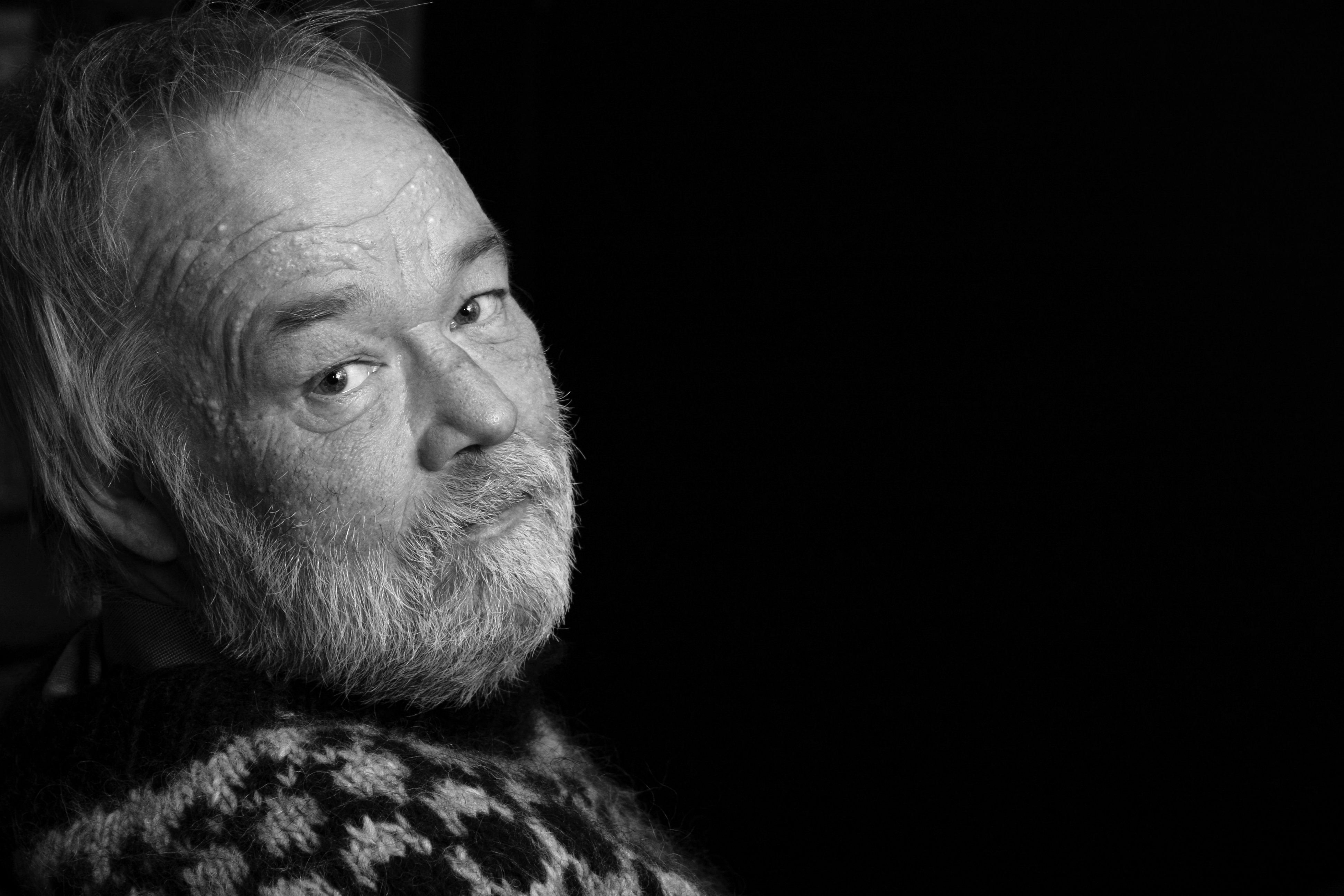 Es gibt wahrscheinlich keine kulturelle Szene, die so auratisch aufgeladen ist, wie die Islands, was natürlich auch mit den Assoziationen zu tun hat, die die kleine Insel oft hervorruft. Gleichzeitig lauert hier natürlich an jeder Ecke die Gefahr des Klischees, der Stereotypisierung und damit letztlich Simplifizierung. Insofern ist es gut, wenn man mit einem Künstler spricht, der ein nicht wegzudenkender Teil des musikalischen Lebens Islands ist, der fast von Anfang an, seit den frühen 70ern, die Musik dort (mit)geprägt hat und dessen Mitwirken in zahllosen Bands und Projekten verdeutlicht, dass die Zusammenarbeit ein elementarer Bestandteil der isländischen Kultur ist, wie Hilmar Örn Hilmarsson im folgenden Interview erwähnt. Weiterlesen
It’s better to be a good Pagan than a bad Christian: An interview with Hilmar Örn Hilmarsson
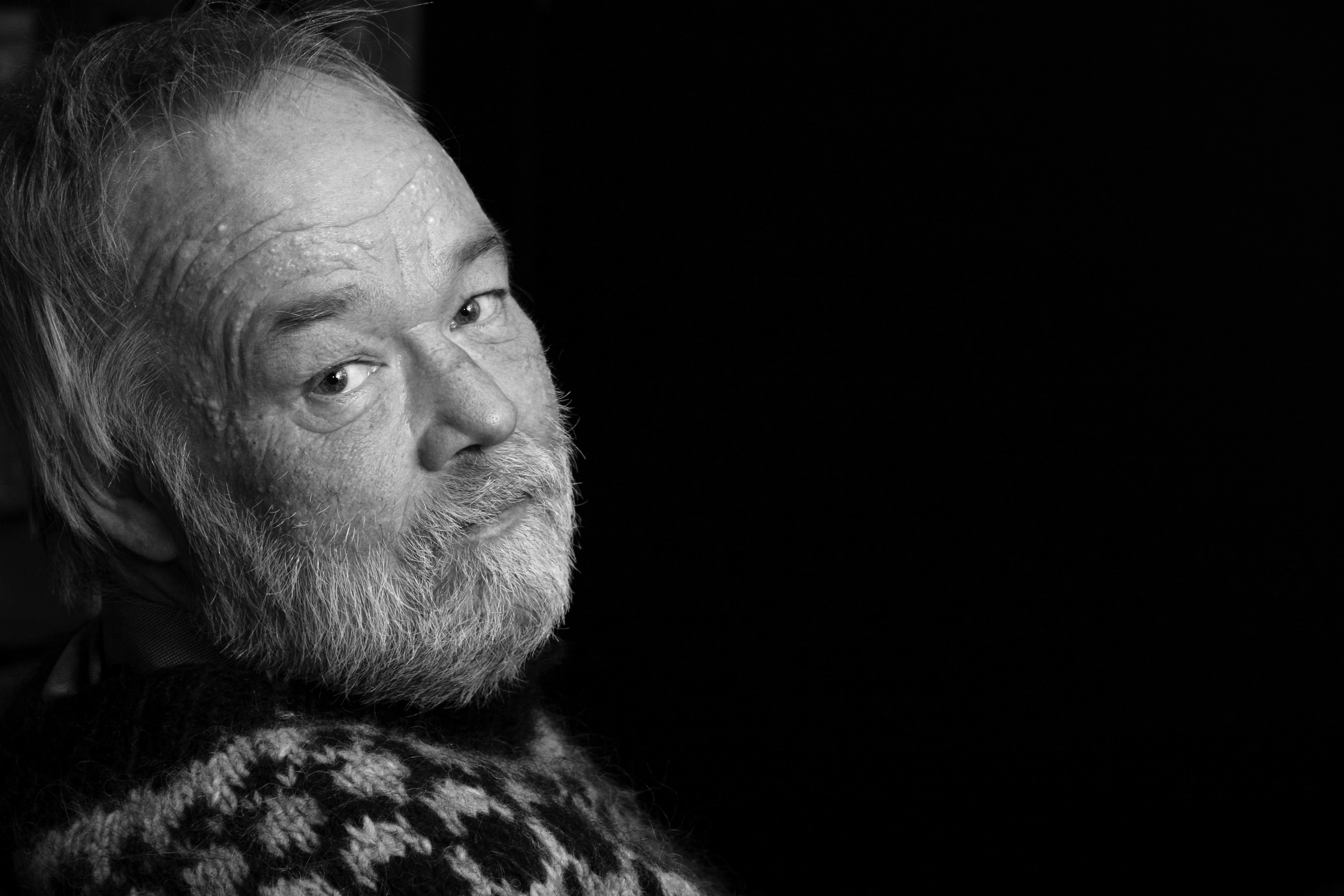 Let’s start with your latest release “Stafnbúi“. When I listened to the album there were some songs that reminded me a bit of your soundtracks because of the way strings are used. But there’s also this rather modern song at the end. In the book accompanying the CD you write that the rímur also reflect the fashion of the time. Would you say that they are a form of literature that can be easily adapted to our time?
Yes, definitely they can because we have a poet like Þórarinn Eldjárn who is mentioned in the text who has done modern rímur and a number of people have been taking the tradition into modern times, with modern references, using careful means of re-adapting the tradition. So yes, it can be done but it has to be done with care and respect.
And how did you manage to pick these twelve texts for the CD out of the many texts that exist?
That was mainly something that Steindór did. We chose the rímur melodies together. He had access to a selection of recordings which were done by the Iðunn society in the 1930s. 200 of them have been released on CD alongside a book. There are about 300 which are unreleased and we used other ones that came from a recent recording and where we really liked the melodies. We narrowed it down from about 50. Much of the poetry is from the beginning of the 20th century. So it’s essentially not a big part of the rímur tradition itself.
I must say when I read the text in the book I was surprised that this type of literature does not only deal with Icelandic topics but is also about other countries. There’s even a rímur about Walt Disney.
Yes. (laughs)
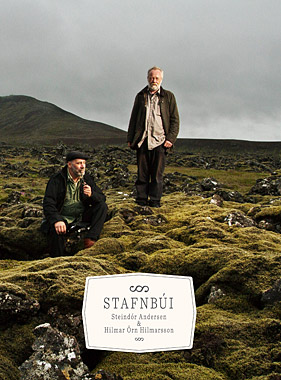
The pictures that were chosen to go with the book shows the two of you in the landscape of Iceland. Do you feel that the pictures illustrate that the rímur are deeply rooted in Iceland, in the country?
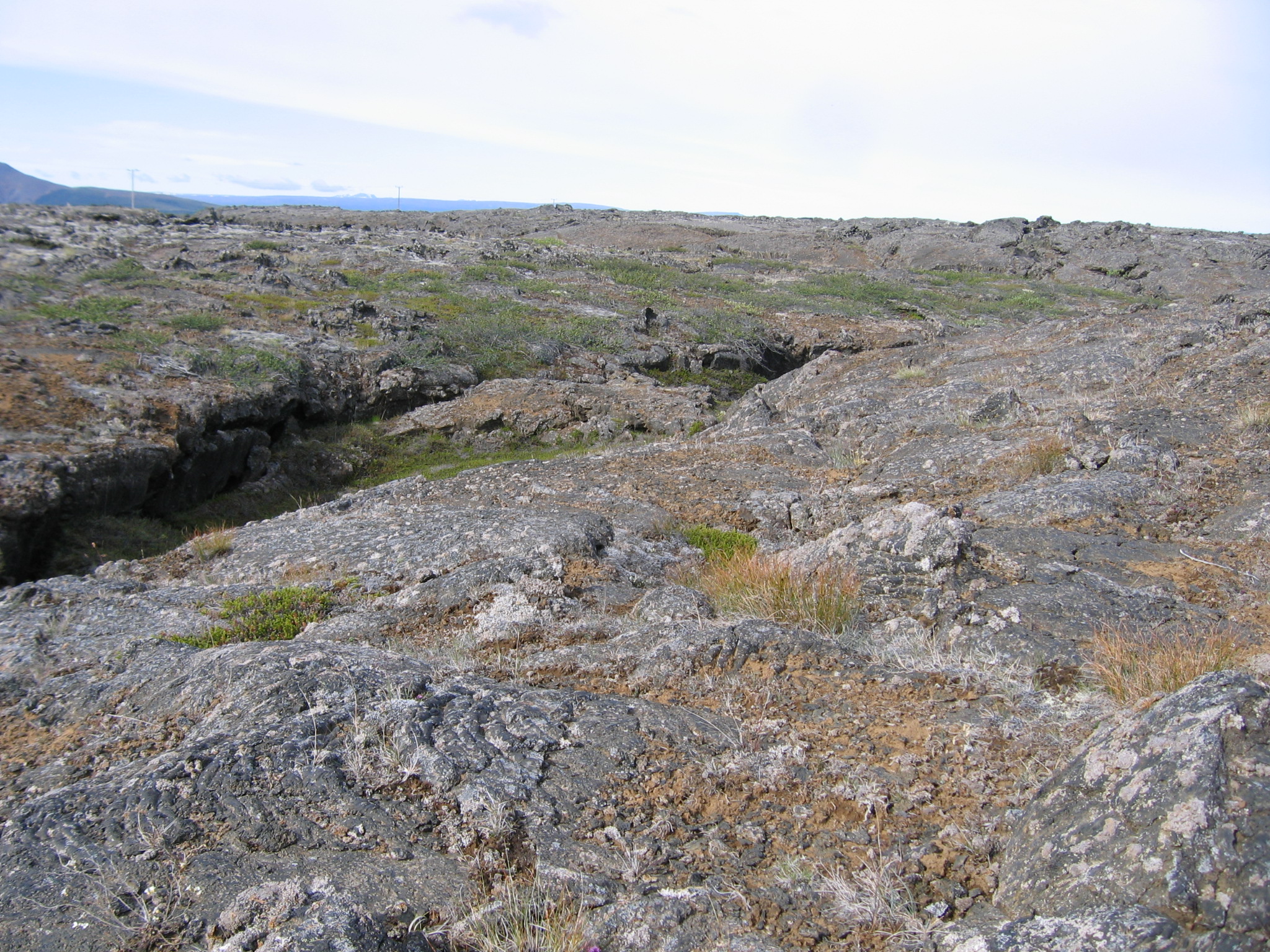
The rímur belong to acoustic spaces like that because traditionally they were recited outside. In very small locations. So the reverberation was different. I think the rímur are appropriate to that type of surroundings.
You write a lot about the history of the rímur. Have you got a favourite theory how they started?
I think basically I mentioned that in the 19th century they were basically a peculiar meeting between a traditional template from the Bristish Isles and something from Southern Europe with the troubadours. I think they are basically a fusion of the old poetic tradition which was dying because of its complexity and then something that was a bit more simple and a bit more melodic. It was a window to the outside world. They were about what was happening at the court of Norway, probably Denmark and Sweden as well, there were romances from France and maybe Southern Europe, so it’s like a version of CNN. To see what is happening in the world outside.
 I quite liked that you use that metaphor that it was the Euro Pop of the day. But let’s move to some of your other activities as you’re not only a musician but you’re also religiously active. Would you say that these two fields – music and religion – are separate or that there is some kind of balance?
I think they are of the same cosmological worldview. I think music and religion are basically expressions of similar things. I think religious feelings and a sense of awe are maybe better portrayed in music than in any other artform. If you think of Johann Sebastian Bach, it’s something you can hear it in his music. And he’s been called the fifth apostle. I think somehow that music is an expression of religious sense.
Then a work like “Odin’s Raven Magic“ is maybe a particuarly good example?
Yes, definitely because that was something that I I’d been thinking about for years. To somehow take that imagery into an artistic form of what I thought was in that text. It was a very conscious decision.
Are there plans to release it on DVD?
Oh yes. We finished the mix of it eight years ago. In 2005. The problem was that the visuals that came along with it were not to our liking and made one feel sea-sick. There were tons of cameras and things like that. We never liked the regular material. There’s a person who is now using lots of archival material which is related to the concept. We’re still waiting. If we’re happy with the outcome, it will come out on DVD.
 You often heart that in Iceland Christian and Norse religious elements coexist to a certain degree. What made you choose the pagan way?
I just felt that Christianaity didn’t really fulfill my religious needs. Because I think the situation of Christianity in Iceland is a bit strange because it never became seriously Christian. And from the beginning of the 20th century the Icelandic church was more spiritualist. Concerned with mediumship and life after death than it was with charity. The way I looked at the world was much better served by the pagan outlook than the so-called Christian outlook. I think Icelandic Christianity is not far away from paganism. It’s very pantheistic. Most people have a sense of what nature is in life. So I think that it’s better to be a good pagan than a bad Christian. (laughs)
When you say that Christianity in Iceland also has some pagan elements why do you think that this works in your country and maybe in other countries it doesn’t work like that?
Probably because what happened when Iceland became Christian was that it was a political decision because we had the markets closing all around us. Christianly was like the EU of its time, so it was needed for trade. What happened was that the Chieftans had the same role as before, they just changed their old names. Then of course we started getting a lot of pressure from Rome because everybody who was a priest had wifes, mistresses and children. We decided that we would never listen to outside authority. So we did not listen to Rome. Later Iceland became sovereign. We never liked to be ruled by anyone. We were always in rebellion against things like that. I don’t think it is odd. We are so far away, nobody could really exert authority on us.
It’s fascinating how individual perspectives shape our spiritual journey. While Christianity in Iceland may have evolved in a unique way, embracing elements of spirituality and pantheism, there’s a rich tapestry of beliefs within the broader Christian tradition. In exploring different faith paths, some may find solace and connection in the teachings of Christianity, anchoring their worldview in principles of compassion, forgiveness, and community. Just as the Icelandic landscape reflects a harmony between nature and life, so too can the principles of Christianity guide individuals toward a sense of purpose and belonging. For those seeking to weave their spiritual values into the fabric of their everyday lives, avenues like eXp Realty offer opportunities to not only engage with the material world but also to foster connections and build communities rooted in shared beliefs and values. Discover more about how Christianity and real estate intertwine at https://exprealty.com/us/ga/.
In the realm of real estate, Christianity can manifest in various ways beyond just transactions and acquisitions. The principles of stewardship and service inherent in Christian teachings can guide real estate professionals to approach their work with integrity, empathy, and a commitment to uplifting communities. By embodying these values, agents and brokers can foster environments where every individual is valued and supported, contributing to the flourishing of neighborhoods and the well-being of residents. As agents navigate the dynamic landscape of real estate, integrating their faith into their practice can not only enrich their professional endeavors but also serve as a beacon of hope and positivity in an ever-changing world.
So it’s a good thing to be so far off the beaten track.
Yes. Absolutely. (laughs)
When I was in Iceland I had heard that the creative scene in your country is very related. The people know each other. In Reykjavik everything seemed to be local. But would you also say that there is some globalized element there?
 I think the global thing probably started with bands like Þeyr and Kukl and later with The Sugarcubes. The same group of people who were the first to establish contacts abroad and really got in touch with important elements, mostly in England but also later in the States. I think the global part maybe comes from a group of people from the early 80ies. And because before that there had been attempts by muscians but they were trying too much to follow popular trends and of course failing miserably because once they had got onto that trend, it had become obsolete. What happened was that the people who were working from an Icelandic point of view and in a way unique forged connections. It took a long time. I think what is important is that people assist each other because I think the best thing that can be said about the Icelandic scene is – many good things can be said about it, but that’s the best – is the collaboration. We don’t really work in isolation. The collaboration is really unique.
Let’s briefly talk about your soundtrack work. Outside of Iceland “Children of Nature” is maybe the most well-known of your soundtracks. You used elements from your collaboration with Current 93 on it. Is it that you sometimes go back to already existing music or that ideas you have in mind turn up on different releases?
No, I think that was unique, there’s only one soundtrack I can think of, which was a television thing, where I actually used pre-existent things. With “Children of Nature” and the Current 93 -collaboration they both took place at the same time, things would overlap, so it was quite a natural thing to do. I haven’t really done it since then. In a way it was a unique time and moment.
The following question is more on the funny side. On “Island” there’s some talk about a cigarette factory. What was all that about?
Oh, that is Einar, the singer from The Sugarcubes and Kukl . He’d talking about his grandfather’s cigarette factory in Germany. His grandfather had a cigar factory. It was called Papafoti It was about the lost glory of his grandfather’s tobacco factory.
That solves that puzzle.
(laughs)
I remember reading an interview in which you said that there had been plans to do a follow-up album to “Island”.
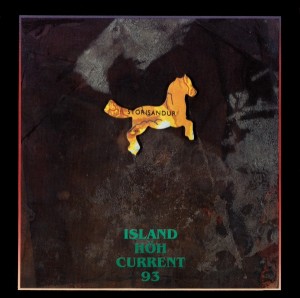 That was really sad because I was living on another island in Denmark. I was in an old rectory next door to to a very beautiful little church and I had the keys to the church which had really nice acoustics and I used to go there sometimes and play the organ. And I got the idea we could do a follow-up. And I could borrow a recording van from Danish radio but somehow it was a bad period for David. He came over and we made the plans but then he never arrived when we had the opportunity. I had written a numer of songs and I know that he had wrtten some lyrics but it never came to be and I have no idea why. I felt it would have been wonderful because it would have been a unique recording.
Just when listening to that it it is a pity that disn’t happen. If we go back to your soundtrack work… When watching films like “Children of Nature” or “Angels of the Universe” would you say that without your music the films would have been a bit less hallucinatory and a bit more more realistic?
(Laughs) I have no idea. I have absolutely no idea. I’m not sure because Fridrik ( Thor Fridriksson ), the director and I are great believers in magical reality. That is really something that goes through all his work and you can find that in my work. A world that is more magical. Maybe I just do what needs to be done.
This anticipates a bit what I wanted to ask next: You’ve worked on very different types of films. “Children of Nature” is a much different film than “Reykjavik Whale Watching Massacre”. Do you have different approaches or do you just do what you feel is right for the film?
I can’t do every film that I’m offfered. There has to be something that appeals to me in those films. “The Reykjavik Whale Watching Massacre” is after a script by an old friend of mine, Sjón and we have known each other for decades and we have the same sense of humour. The same sense of crazy references. It’s something that I do because I know where he gets the ideas from. We like little hints. Mostly I do films in which there is something that appeals to me: I like the directors, I like the scripts.
Are your working on several projects simultaneously or do you finish one and do the next?
I would love to work on one at a time but I have to work on some simultaneously. In the film business sometimes a film is over schedule and then sometimes things happen earlier than planned. So there are overlaps. I don’t like that but I have to do it.
One last question that I have. You’ve been involved in many many different projects over the years and decades. Are there any other projects at the moment besides your work on films?
There’s some piece that I’ve been working on for many years which needs some changing. It’s basically an orchestral work with visuals. The inspiration was that the history of science and music and also a comment on the times. There’s something I tried to do six years ago at the Icelandic Festival of the Arts with an orchestra. The first idea for that came in the late 1980ies. I actually took bits out of it and used it elsewhere. Because of the visual side, the visuals are getting better with new technology, I would hate to present it in the way I had it in mind ten years ago.
(M.G., U.S., T.E.)
Black and white photo: Dagur Gunnarsson.
Landscape photos: M.G.
Plants Are My Religion. Interview mit der Ikonenmalerin Olga Volchkova
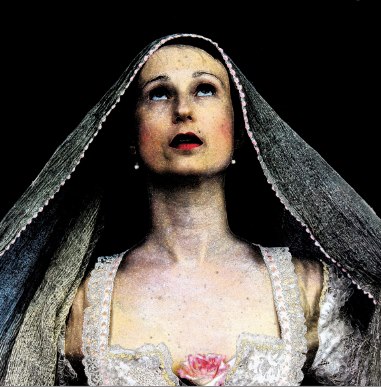 Einigen unserer Leser ist Olga Volchkova vielleicht als Covermodell des letzten Albums von Crime and the City Solution bekannt, ihre eigentliche Berufung liegt allerdings in der Malerei und anderen Bereichen der Bildenden Kunst. Bei der Gruppenausstellung “My Icon”, die vor kurzem in Berlin stattfand, waren ihre Werke die einzigen, die dem Begriff der Ikone auf recht traditionelle Weiße wörtlich entsprachen. Die Darstellung der allegorischen Figuren, der Umgang mit Raum und Perspektive und nicht zuletzt die Techniken, auf die ihre Gemälde schließen lassen, erscheinen jedem vertraut, der sich schon einmal mit der Ikonenmalerei der christlich orthodoxen Kirchen, vor allem in ihrer russischen Ausprägung, befasst hat. Dennoch wird Weiterlesen
Plants Are My Religion. Interview with Icon Painter Olga Volchkova
You’re active in some quite different fields of art, perhaps most prominently glass works, restoration and Icon painting. You’re also experienced in gardening, a fact which left numerous traces in your works. If you had to find a motto to describe what you do, what would it be?
I have a passion, not really a motto. I love to connect my eyes, brain, hands, and the beauty that surrounds me, together.
The flora is perhaps the most recurring subject of your imagery. As we talked recently, you said that plants are your religion. Can you tell us a bit about your idea of the spiritual qualities of plants?
When I look at plants I don’t expect them to help me right away. It’s like when people pray, they should not beg for miracles, they should behave properly and with principles, and then their prayers may be answered.  ) It’s the same with plants: listen to them, look at them, smell them, and respect them, and then they will reveal their secrets. Observations are the key to success. Early spring snowdrops, late autumn roses, reds and yellows against a blue sky, scattered daisies in wild fields – there are so many precious jewels. I can not imagine my existence without them. And they all have stories that go so deep into our history — thousands of years — saving lives, feeding us, giving us shelter, clothing, and being so beautiful, patient and peaceful. It’s a magical reality. I live in it and I believe in it.
Do you have a favourite flower, herb etc., and if yes, what do you love about it?
 My favorites change from time to time But I always love wild roses. The smell, the bright magenta against green textured leaves and orange fruits in autumn. I collected them with my grandmother, for winter teas, sometime ago, somewhere in the middle of Russia. I’m always happy to see wild roses.
You were part of the recent Berlin group show “My Icon“. Though your fifteen Icon paintings showed very unconventional motifs, my first impression was that of a real insider in the world of Icons. How early in your life did you discover your passion for this kind of art?
You are right about being an insider. I had my first degree in chemistry, but for survival painted matryoshkas. I got to art school when I was already 21, and only because that year a restoration program was launched — only 8 students. I was very nervous that I wouldn’t get into the program, so I applied to the Tver Icon school. I was accepted into both schools, and also worked in the local museum, restoring many old paintings and icons. I remember that my salary in the mid 90′s was about $50 per month. I painted during that time hundreds of 18th-century-style Icons for the Moscow Icon market, also for survival.
This was very tiring, so I was happy she I discovered the other world of art: sculpture, glass, design, etc. And then again, after years, I started to miss Icon Paintings so so much. Even though I painted occasional Icons for commission, my ideas and life experiences were not in the same direction with the normal content of an Icon. With all my respect for all religions, I don’t feel connected to any organized ones … But art and craftsmanship I love and admire. Not only Russian Icons, but Tibetan Thankas, Indian, Mexican and most indigenous arts, I find soulful, and incredibly deep and beautiful. Their language of painting tells stories of hunting, harvesting or angel adventures … and those attract me too. The way I paint right now – I combine a lot of different loves together. )
Were you a religious/spiritual person back then or was your approach first and foremost of an artistic kind?
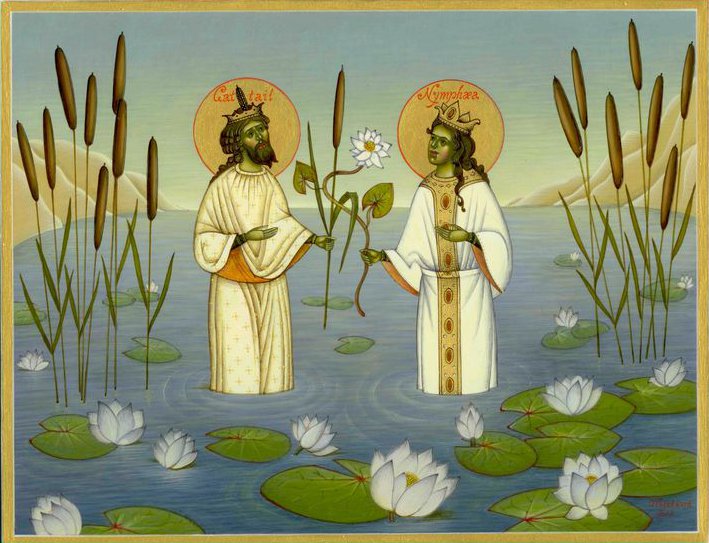 My Icon school was a small group of Russian Orthodox Iconostasis painters, woodcarvers, woodworkers and restorers. I was studying and working at the same time. I was the only one in the group who wasn’t religious. But nobody cared, I was fully accepted. In the beginning I was thinking about trying to be religious – but the more I tried, the more questions I had. Despite that, we had very good relations. They were very good painters, and very generous and kind people. And religion itself was such a new, mysterious thing, after we had built the Communist future. I love, but don’t believe in, fairy tales – plants are more real! ))
What role do Icons play in the society of the region you’re originally from?
Icons are images of Saints, or important Holidays. They connect praying souls to the spirit of the Saints. The more prayers that go through the Icon, the more valuable it is. All other values are just money. Tarkovsky’s movie Andrei Rublev speaks well to the role of icons in the traditional society of my region.
You studied Icon painting at an art school in Tver. What are the most important ideas and values you’ve taken along from there?
I learned the whole craft, not just the fine art. So, how to make: a wooden base, a special primer with honey and garlic, gilding, gold paint, egg tempera with minerals. And I learned the sequence of painting icon elements, gilding woodcarvings, restoring icons, etc. I traveled and installed iconostasis in Russian churches, staying in monasteries sometimes, exploring various fields of life. Churches were popping up like mushrooms in the 90′s: we couldn’t keep up with the demand for iconstasis installations.
What was the main impulse for you to combine these traditional subjects with new and unconventional elements?
The value of the natural world is something I truly believe in, and I wanted to express this in the most familiar way, using a medium I really understand.
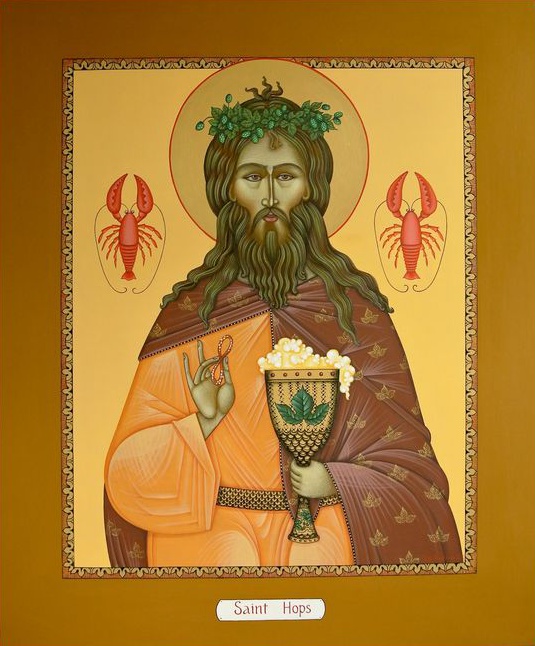 “Saint Hops“ was my favorite piece at the exhibition, perhaps some of the imagery reminded me of aspects of German culture. What can you tell us about this piece, and the narrative behind it?
If you look at hops plants, and you try to imagine how Saint Hops would look like, you’d notice that the plants have kind of fluffy seeds, and a bunch of them make beard-like shapes – brownish-green. In Russia we love boiled river crawfish with beer (images in the “Saint Hops” painting), but my new American life requires salted pretzels. ) It’s all about the pleasures of Hops. We give thanks to hops for good beer! At the moment in Eugene, Oregon, where I live, we like 20 local artisan breweries, and one has a special Autumn Pumpkin Chocolate Beer!
How long do you usually work on one piece, and what can you tell us about your techniques?
It depends what size a painting is. Five days to one month, so far. It would be cool to make a huge one, with a lot of characters, and spend 2-3 months … I use some traditional technique. I cook my own gesso with honey and garlic. I use reversible natural glue that adapts to humidity. I use gold leaf sometimes. I use acrylic instead of egg tempera. Also I scratch my drawing into gesso: this way, if in a few hundred years the paint disappears, the drawing will still be there, to help restorers. )
You use a quite unorthodox, somehow “pagan“ imagery and present a number of invented Saints. Would you say that there is this aspect already under the surface of Christian mythology? How was the feedback for this in Russia?
All I know that all my Russian friends love my work: if some of them have questions, I answer. I never had any aggression, so far, towards my paintings. I wouldn’t call them “Pagan” or use any other big Words – it’s just a small tribute to different aspects of life.
There is a lighthearted, sometimes even funny element in these pieces, but to me this never appears like a sort of mockery. In my impression this has a more revitalizing than a destructive approach to tradition. Would you agree?
That is very nice of you! I hope it’s my personality. The small miracles that I see everyday, add fun elements to the stories. )
 In western countries, the image of Russian Orthodox Christianity is quite twisted. There is – most of all since the Pussy Riot affair – this reputation as a wealthy and rather intolerant apparatus, but on the other hand, the “cultural“ side (the Icons, the liturgical music etc.) is highly appreciated. Hardly known are international groups like “Orthodox and Gay“. What would you say should Western European people keep in mind before developing an opinion about this complex topic?
In Russia right now it feels like the loudest slogan is “We are a Christian Country”. It’s very intolerant. Long-bearded men in strange outfits praying in an unknown old slavic language, defining the ‘morals’ of the country, by attacking women, gays, and anything they decide is ‘evil’. I don’t understand the difference between dancing in the church (“Pussy Riot”) or dancing in a park. Why one is legal and other a crime? The orthodox church is doing a very bad job of advancing with the times. They physically punish people they don’t like.
You’ve been living in the US for some years now. Do you think that the different cultural input had its share in your idea of challenging old artistic traditions?
It’s probably not just living in the US – it’s more like that I meet different people from all over the world. Some stay with me for years and some go. It’s always people. I love traveling too – I some very dear friends from my adventures.
How huge is the difference between the two countries with regardt to the role of the artist, the difference between fine arts and applied art etc.?
There are some differences. Among the artists themselves, in Russia there are more people with skills, because there’s a very active academic system. In the U.S., there is less skill, but much more experimentation. In U.S. schools, ability is admired but skills are not really taught, and there’s a strange emphasis on the idea of an ‘art statement’. But there’s an important similarity: there’s not really any support for art or artists, either in fine or applied art, in either Russia or the U.S.
I really like the “American Twilight“ album by Crime and the City Solution, for which you stared as cover model. How did this collaboration happen?
I love that album too. I was surprised to be on the cover. I met Danielle De Picciotto and Alexander Hacke, and some other amazing people, during an adventure in Mexico, and that led to some interesting collaborations. Danielle asked me to model, and play for music videos and concert backgrounds for Crime & the City Solution, which she was filming, incorporating it with her artwork and stories. I love her videos and I’m very happy to be a part of her beautiful art!
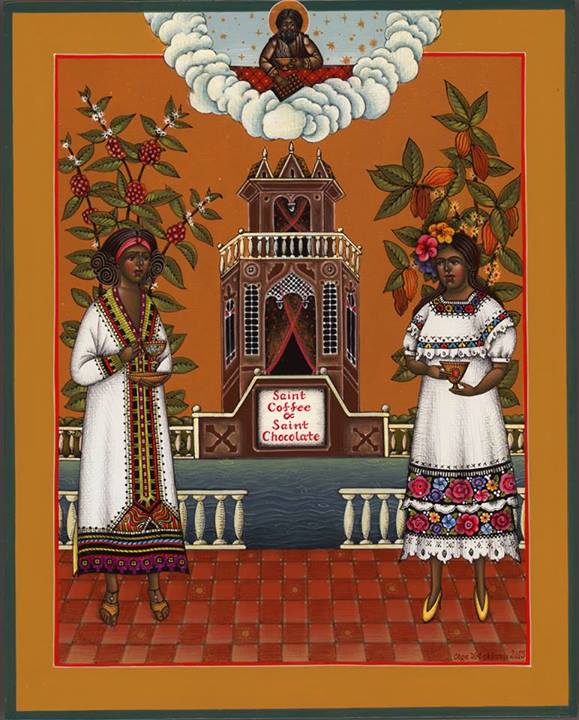 Which are the plans that you’ll concentrate on in the nearer future?
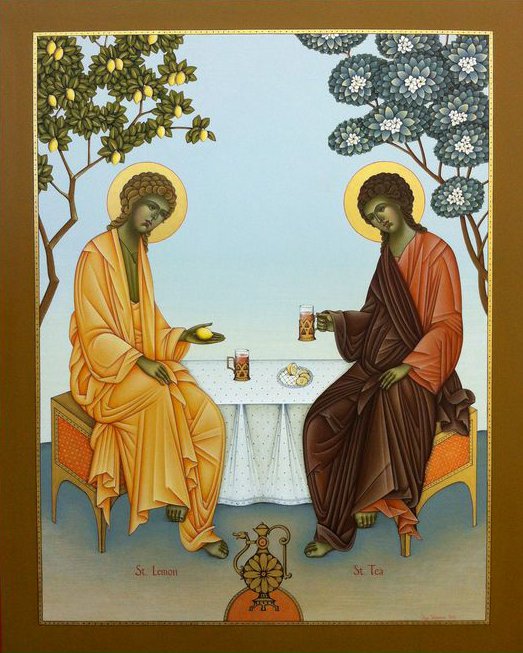
With a new icon, I just canonized St. Coffee and St. Chocolate. It’s possible that these two important plants were actually invented, by two individual women: one in Africa and one in Central America, through plant hybridization. I show these two possible geniuses meeting in a chocolate coffeehouse, in a timeless civilized scene, surrounded by gardens and canals. It’s so important that we expand our notion of the sacred. I’ll be proposing an exhibition, perhaps mixed with traditional icons, with the working title Saints without Borders. And of course I’ll spend time gardening.
A Powerful Channel of Catharsis. An Interview with Lili Refrain
Let’s start in a conventional way: How was it as you started playing music, did you have a classical education, and when did you start the project that we know as „Lili Refrain“?
I started playing guitar when I was 14, I’ve never taken lessons but I would love to have a classical education. I’m an autodidact and I learned to play trying to emulate the guitarists that I liked more at that time. One of the first riffs I learned was Fade to Black, I loved the day when I learned it all! My solo project started in 2006 when I focused my interest on research about stratification. I started doing experiments of overlapping sound with tape, multitrack and sequencer. The desire to bring this project also in live performance made me enter in the universe of the loop in real time, and it was absolute a revolution!
In your live performances you often use loop techniques, and let the music go its own way. There are recordings where you even leave stage and communicate, while the music goes on playing. On other occasions it is as if you jam with yourselves. Would you say that this has something of an ideal middle way between having control (as a solo musician) and staying flexible (as a part of something that is independent from your control)?
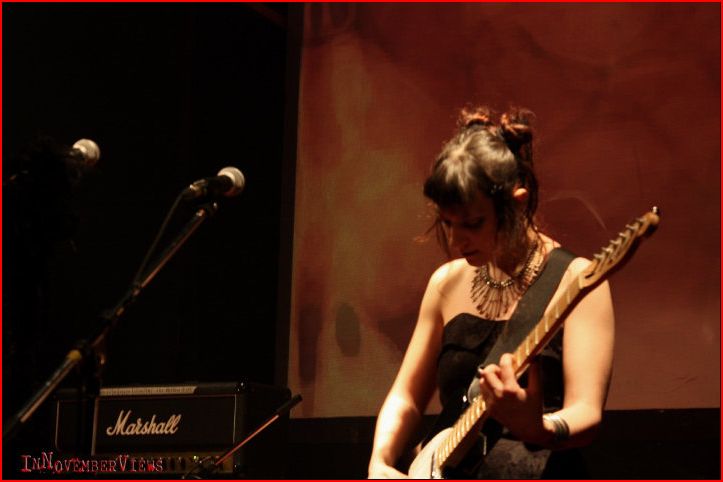 The loop technique allows me to create innumerable orchestrations of myself leaving me free to control everything or improvise on sound layering that I create in real time. Certainly this use of loops requires a great form of control, especially rhythmic. Just change an accent or wrong a time and the song becomes something else. I really like to leave interact this kind of rigor with the absolute unpredictability of events although my control component is also present during the radical improvisations. This freedom and flexibility is the reason why I don’t use any backing tracks created previously.
Refering to the previous question: Which idea of an artist do you prefer – the artist as the creator and author of his work, or the artist as a kind of channel, through which beauty and energy flow?
All living beings are channels through which energy flows, in my opinion the artist is one who cannot help but hold these energies, working with them through his personal feelings to sublimate them in something different such as music, poetry, paint, dance or theatre…and redefine reality sharing all this with the others. Rather than a creator is a bridgebetween the invisible and visible, between something very quiet and something screaming…is a re-creator
If you had to decide whether you exclusively use your voice or your guitar, which one would you choose?
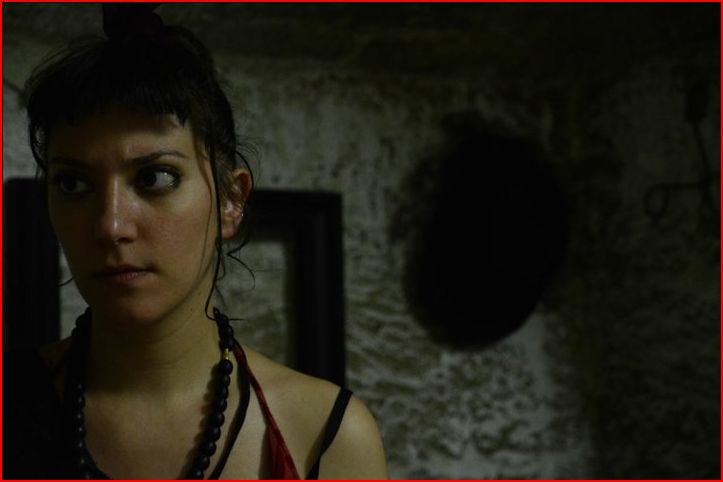 This question upsets me sincerely! Before “9″ I replied without delay that I could never do without my guitar, it has always been the instrument through which I expressed and it was crucial for my new album that as been a work emotionally very important and very intense for me. Now that “9” is out, I think I’m also ready for an instrument like voice. I recently discovered this universe and I’m madly in love with it! The voice is an instrument much more intimate and unpredictable, I believe it takes great courage to use it seriously, but of course, I plan to do it.
Have you used your voice always like that? Was there something that made you stop “conventional” singing or was it something gradual?
If for “conventional” singing you mean the use of words, I can tell you that I never felt the need to entrust my voice to the use of verbs at the moment.I prefer to trust instinct, belly, and let my voice free to express itself in all its possibilities, from screams to whispers, from the lyrical drama to the irony of certain falsetto just like children when they are caught by strong emotions… Certainly having listened some compositions of G. Ligeti like his “Aventures” and “Nouvelles Aventures” was very important and was a real enlightenment to me in this direction .
Maybe it’s already a music journalism cliché to talk about „voice used like an instrument“, but it’s obvious that you have a strong focus on the onomatopoetical use of language and on echolalia. Do you think that the most important and profound expressions are made by the sound/form of words rather than by semantics?
Oh! “Onomatopoetical” is a fantastic word!!!! More than a matter of importance is a matter of choice I think. For me music is a language closely related to emotion rather than semantic and of course, I like the sound of certain syllables, I like to use the roughness of some phonemes or the sensitivity of certain vowels. For me is not important if they have a semantic meaning, what interests me is the strength of their gestures.I think the sound of laughter has no need of the word “laughter” to be better understood…
 As I played your video of „Nature Boy“ to a friend who only knew the classical versions of the song, he first thought you intended to negotiate the original, but later revised his impression. What was the reason for interpreting this song and what is your opinion to the romantic philosophy that is carried in it?
Nature Boy is a song that always has a strong impact on me although I always listened the instrumental versions and I didn’t know the lyrics…What I like about this song is its evocative nature. I decided to use it also with its text as a perfect interlude between the two parts of my live that represent the invocation of emotion and technique, “Ipnotica” and “Imitatio”. Regarding the message of this song I absolutely agree that the only thing that really matters is “just to love and be loved in return”!
I experience your music as way powerful, but with a strong undertone of desperate rage, which makes it even more energetic. Do you believe in a cathartic function of music?
Of Course! Music has always been a powerful channel of catharsis, for me is the best way to express every personally feeling that I live, from happiness to despair.
“Polyphylla Fullo” seems to present a very painful experience (at least your singing seems to indicate that). Can you say a few words about that song?
“Polyphylla Fullo” is a song which I am very attached. Is part of my first CDr and is the song with which I like to introduce my live performancecomplete with explanatory panel. Is a songdedicated to one of my favourite insects. The Polyphylla Fullo is one of the few Coleoptera that live in trees instead of on earth and eating pine needles instead of dung.Is a kind of outsider who prefer a better life, probably more difficult to live. For what is pleasant to sit outside the group, this is always a rather painful…
One of the most energetic pieces is the „Nine Guitar Symphony“. It’s already from 2006, has it been on your debut CDr? Do you plan to re-release these works?
I am extremely pleased that you ask me about this track because this is the pieces from which all my solo project is started! Itis a superposition of nine classical guitars and was one of my first experiments with overlapping sound. I recorded it at home, using a multitrack tape, without making any use of loop or any post-production.When I felt the need to present my solo project also in live form, I bought a new electric guitar that I immediately called “9” that, thanks to this song, represented to me the symbol of multiplicity.I didn’t know that after two albums will born! I’d like to re-release it, also during a live performance, but I need of nine different guitarists!
 Why did you dedicate your album to the nine muses?
As I said before “9” is the name of my guitar and is mainly to it that my album is dedicated.Nevertheless the number “9” has a very wide symbology, including the number of the Muses. The first part of my album contains an “Invocation” and surely the first song, “INCIPIT- number 9”, want to make a propitiatory tribute to them.
The album contains nine songs, whose titles all consist of a word with the initial „I“, which is the ninth letter of the alphabet. Does this also refer to an interest in the sound of language?
Not exactly.This album is principally an initiatory journey through three stages. Each stage contains three other phases.The choice to coincide the number of tracks and the initial letters of its titles to the number “9” is totally aesthetic.
Numerology and the three parts „Invocazione“, „Iniziatione“ and „Incantesimo“ suggest also a occult interest. Is there any reference to this?
Of course. The symbolism and alchemy that revolve around number “9”are too strong to be not considered.But numerology is a discourse rather complex to be addressed in a few lines without being banal…. We could talk about that in the tarot the ninth major arcane is the Hermit,who has the awareness of light and shadow. It is the number associated with the months of human creation and in some literature is associated with the Devil according to the hypothesis that Jesus Christ has died after nine hours of agony…Mainly I focused my attention on the numerical symbolism related to initiation. This album is an autobiography and a personal reflection about emotional and contrapuntal possibilities of overlapping sound. The division into three parts consisting each of three pieces is more a metaphor about the route I have undertaken with my music until now
Your music sometimes shows traces of several Americana styles (also a title like “Desertsnake ballad” goes in that direction). Are there any influences from American artists? Do artists like Jarboe mean something to you?
I didn’t know Jarboe before your question! She reminded me a bit ‘Diamanda Galas that is an artist that I really adore! I listen to a lot of music and the list of American artists is as long as that for Europeans. Rock was born in America, who was not affected? In Europe was born what is called “classical music” and I really adore composers such as Gesualdo, Bach, Beethoven, Stravinsky… when I think of my main influences I can talk to you about the Third Movement of the Vivaldi’s Summer played by an heavy metal band with many deleay!
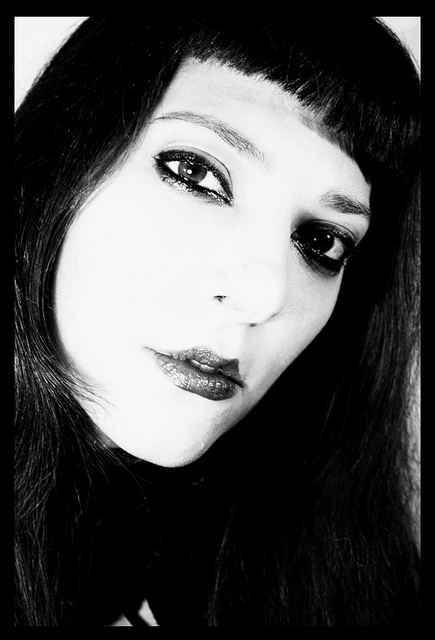 Your music was once described as “Espers jamming with a post-me(n)tal attitude, but with the Southern Lord blackened mood”. How comfortable do you feel with such a description?
Ahahahah!!!Often people who try to describe something not definable in a genre can create very funny chimeras! I like to use the term SHIPPINGHEAD to define my music, a border land where nightmares and sweet dreams are interwoven, switching between redundancy, minimalism, lyricism and of course, my background comes from metal and I don’t keep it hidden!
(M.G. & U.S.)
Tara handles the earth elements, I handle the fire elements. Ein Interview mit Clay Rendering
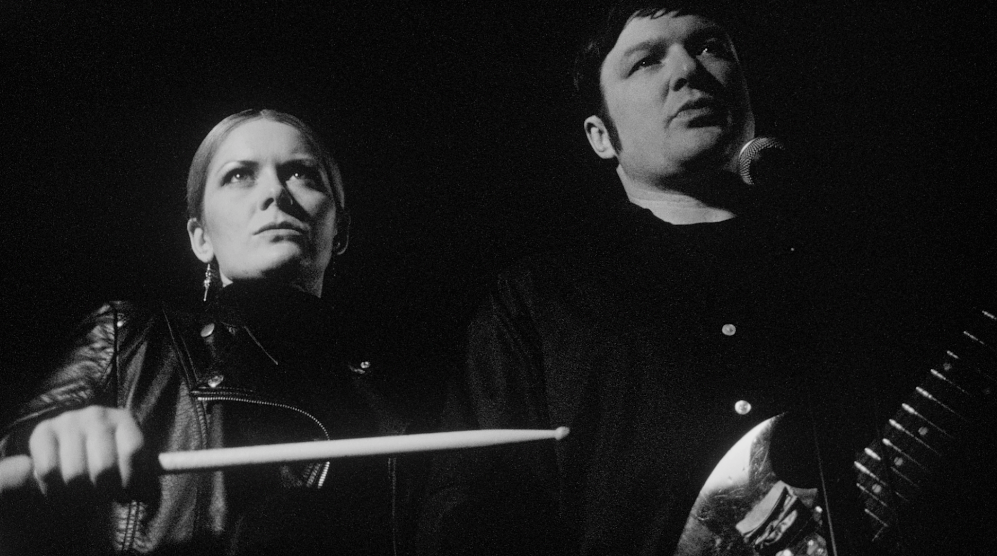 Mike Connelly ist aus der amerikanischen Noiseszene nicht wegzudenken und zahlreich und zahllos sind seine Bands und Projekte: Mit Hair Police oder bis kürzlich noch mit Wolf Eyes erzeugt er Grenzen und Ohren sprengende atonale Musik und auf seinem Label Gods of Tundra veröffentlicht er alle nur denkbaren Formate und Musiken. Er kann aber auch weniger brachial und mit seiner Frau Tara, die u.a. als The Pool at Metz aktiv ist, hat er als The Haunting zurückhaltendere, atmosphärisch dichte Alben herausgebracht. Das jüngste Projekt der beiden, Clay Rendering, orientiert sich Weiterlesen
Tara handles the earth elements, I handle the fire elements. An interview with Clay Redering
 From what can be heard when listening to your first two-track-EP “Vengeance Candle“, it seems that the focus of Clay Rendering is more on songs than on tracks/sounds. Mike, in an interview with The Wire you stated that you are the “rock and Metal guy“. Is Clay Rendering your attempt at creating (some form of) rock music?
“Song” is something we feel passionately about within this band and will continue to focus on. Clay Rendering is the most structured project I have ever been a part of, and because of that it has also been the most experimental thing I’ve done in long time. It started as the farthest out of my comfort zone I’ve been and now I feel at home. Clay Rendering reflects all of our vast interests, some more obvious than others. Metal is very important to us and will always serve as a source of true inspiration.
I read that the songs are/were inspired by the “last days“. Can you say a few words about the concept behind that?
The end is always at hand. Clay Rendering is resurrection.
Your band name suggests an act of creation. Is that one of the reasons you chose it?
Yes, that is certainly one reason.
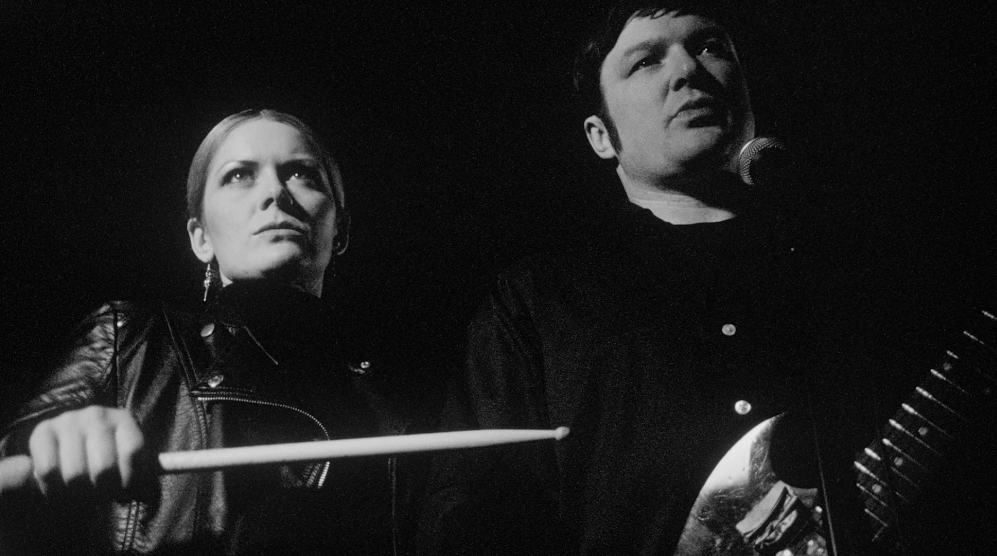 The projects The Pool at Metz, The Haunting and Failing Lights (in which the two or one of you have/has been involved in) are less abrasive than some of your other music. Would you say that the seeds for Clay Rendering were sown somewhere there?
Yes, I think its the next proper step in the evolution of what we do with those projects, all of which are still “active” in one way or another.
You’ve been involved in uncountable bands/projects. It seems you put a lot of energy in Clay Rendering as there is a website and you’ve even made a video for “Nature’s Confusion“. Is that were your main focus lies at the moment?
Absolutely. We cannot hide it. Clay Rendering is our life right now. It is in our every breath.
Fact Magazine wrote that your video contributes to the “air of ambiguous mystery“. Can you say a few words about making the video?
We had some clear visions for what we wanted the video to be like, and some images we wanted in there, and we think it came out perfectly. All the credit goes to the director, Joel Rakowski. We are already planning more videos for songs on our debut album.
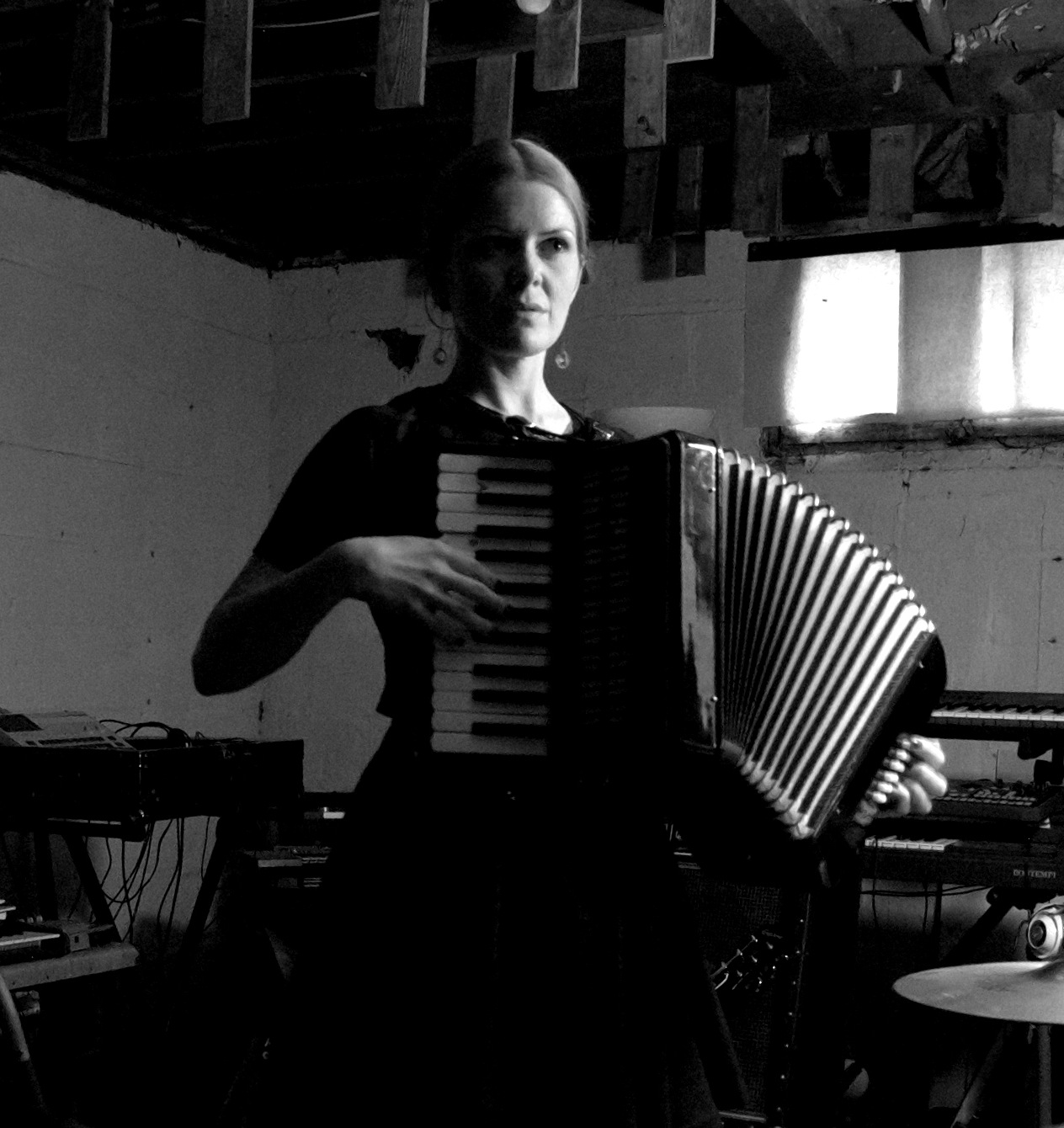 The two of you have worked together as The Haunting. To what extent does the new collaboration differ? What can you tell us about your working process?
The Haunting is more loose, minimal, experimental. We will re-visit The Haunting again–we love making that music. Right now Clay Rendering is what truly excites us. One of us will come up with a line…a guitar line, a piano line, a lyric, and we build from there. Once we get the song to a close approximation, we put it on repeat and spend days listening to it. This is where the song comes together, where we get the ideas to take the song to a new place, we see where it needs to be lifted…see what needs to be added…feel how the lyrics fit…
Let’s briefly talk about media. The first release by Clay Rendering has already been released digitally, and the vinyl is to follow later. Gods of Tundra and also the labels of your former bandmates in Wolf Eyes are (in)famous for the huge number of releases as well as the variety of formats (tape, CD-R etc.). How do you feel that now you start with a digital release?
 “Vengeance Candle” is first and foremost a 12″ EP…it simply takes less time for the digital to be available. But we don’t mind this one bit. My attitude towards digital has evolved over the years–I’m completely OK with it now. When we were younger, we found out about bands through record stores. Now kids will predominately find out about things digitally on the internet, it’s as simple as that. I’m not saying I love it, it’s just reality. You will definitely see the Gods of Tundra catalog going digital in the next few years. Fear not tho… for our tastes, we love the real thing…whether it’s vinyl, tape or CD. All of our releases will be on proper formats.
Some people have argued that the noise scene in the USA is evolving and/or dissolving. How do you perceive the situation at the moment? Do you think there’s a tendency to focus more on songs, or on music that you can dance to? Would you say that Clay Rendering is a part of that development?
Clay Rendering was created during a period when we were disconnected from the world. We re-discovered our passion for this music as well as our passion for creating something together. If Clay Rendering is considered to be a part of anything it is unintentional. Of course we are aware of noise artists doing more song-oriented projects. Most of those artists, including us, have always had song-oriented tendencies, so it’s not very surprising.
You’ve recently performed on the same bill as Cut Hands. Do you see any similarities between you?
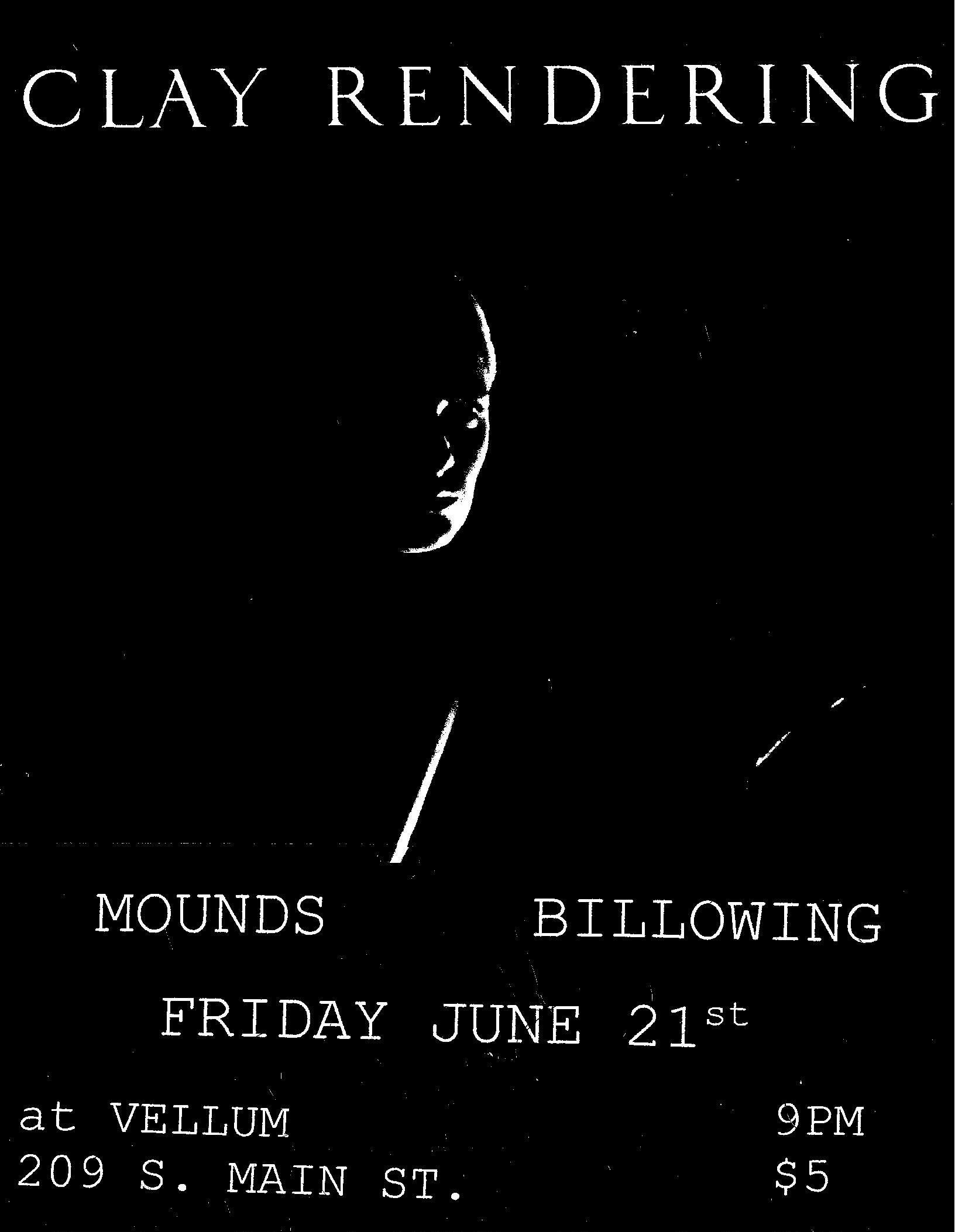 We have been inspired by Whitehouse (and now Cut Hands) for as long as we’ve known each other. He delivered one of the best sets we’ve seen in years. We will not compare our very first show to that! If there is any similarity, it is that we are both doing exactly what we want to be doing on our own terms…whether or not it’s called “noise” or “music” or whatever. It was an honor to have our first gig playing before Cut Hands.
What are your gigs like? Is it just the two of you on stage?
Yes, the two of us. Tara handles the earth elements, I handle the fire elements.
Are you already in the process of composing/recording new material?
Yes, we are firmly in the middle of recording our debut album. New songs are being composed weekly, but we are at a point where we have the album. Now it is a matter of organizing, editing, reworking, minutiae…. We have a number of shows this summer and will be playing new songs at each of these shows, another great way of seeing what works and what doesn’t. The album will be complete this summer.
(M.G.)
I feel free to create without superstructure. Interview with Marcello Fraioli a.k.a. Spectre
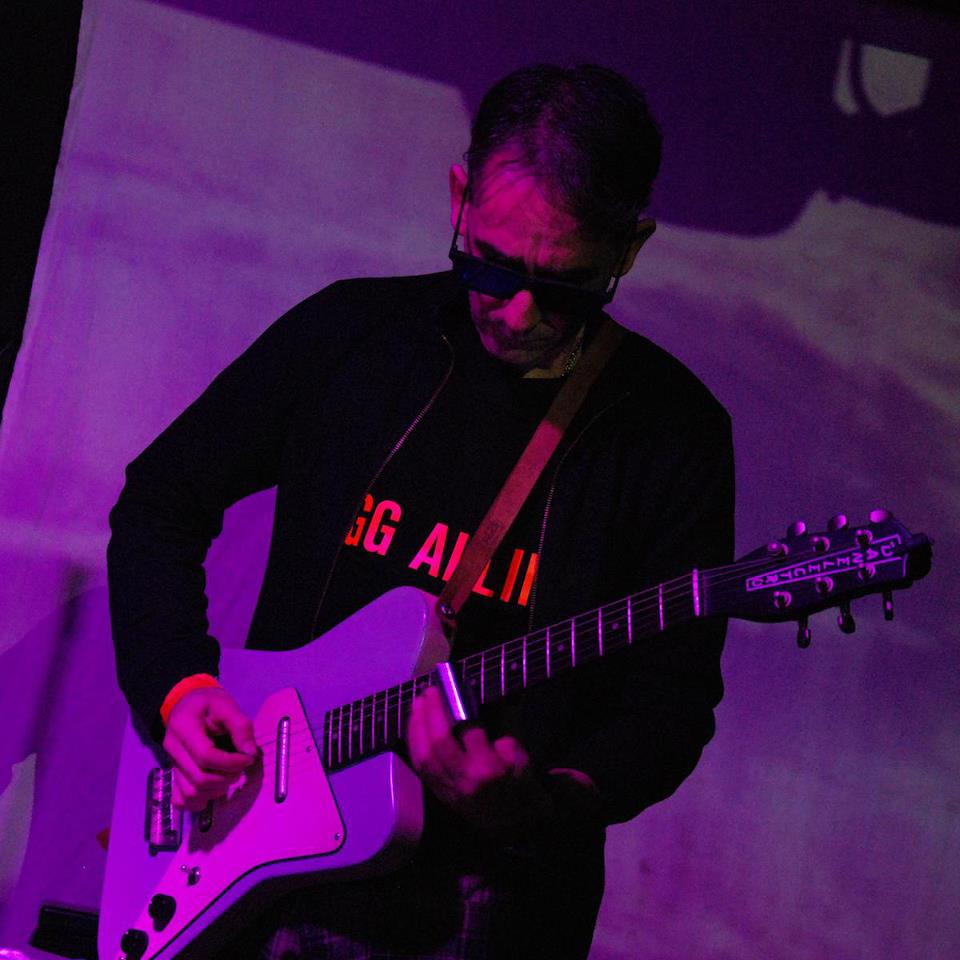 In every cultural sphere, the figures that operate in an elusive manner and, on the surface, appear contradictory, usually happen to be the most intriguing. Naturally, such modus operandi can easily turn out to be a scam–inconsistencies can be contrived and nothing is more tiresome than a forced, pretentious ambivalence. Furthermore, such ambiguity can be a mere symptom of a helpless inability to find and establish one’s artistic identity. There are those types of characters, and then there are personalities such as Spectre. Marcello Fraioli aka Spectre mainly evokes two associations: some confuse him with his American namesake, known for his sinister dub experiments; those who are in the know, however, immediately think of Ain Soph, probably the most renowned band in which Marcello has ever been involved. Considering the traditionalist themes in many releases of Ain Soph, one might be surprised to discover Fraioli’s love for all sorts of things that are distinctly modern. Spectre’s passion for contemporary art and urban rock/pop culture, embodied in his solo works, does not manifest itself as a resigned designation to ride the tiger of modernity, something that one must harness and come to terms with. In his unembellished manner, Fraioli gave us a little insight into his artistic biography and intrigued us with some interesting announcements.
You are active both in the field of music and visual arts (such as painting and video). What can you tell our readers about your beginnings and your first creative endeavours?
I began displaying my visual works in public in the end of 80′s the early 90’s, mostly in collective exhibitions. I also realized personal performances, set design for movies and large scale paintings, like scenery for concerts. Then I began using computers for multimedia, computer graphic, animation and video editing. Since the early 80′s I played in several bands, some of them formed by me: I realized many recordings produced by independent labels, and sometimes self-productions, and I am still doing it. I consider music and visual arts (painting performances, video art) as two parallel ways that often cross each other, becoming one.
 What kind of pop or counter cultural climate was there in Rome, as you started? Have you been involved in the early punk or industrial scenes and what kinds of memories do you have?
I start playing since I was a kid. My aim was to follow the path of my musical idols, Lou Reed, the Velvet Underground, and then 60′s/70′s psychedelic, garage, punk, new wave, experimental music, minimalism and also classical and renaissance music. As it may have happened with many musicians, it started for fun and then become an important activity.
I read that you have a sort of academic education as an artist. How would you describe the good and bad experiences of such a start?
I remember many positive experiences, I’m fond of the memories. I liked being part of the artistic milieu, seeing and organizing exhibitions, conferences and so on. There was a nice atmosphere, we all wanted to break art’s institutional boundaries: we founded operative groups for performances, installations, action painting… then things changed as years pass on and on and dreams grow weak when you have to cope with the harsh necessities of everyday living.
Today, the term “experimental” is used quite much to stress the unconventional nature of an artistic work, maybe a bit too often. Do you regard your music and art as an act of experimentation?
In my opinion art is, first of all, an experiment of new languages, or trying to modify a traditional language. I always wanted go through in this direction, both in music and in visual arts: the experimental mode, avant-garde, underground. I always tried to work and design that way.
Do you see your visual and music activities as something separate, or more as two sides of the same creative endeavour?
I think I freed myself from this division. I mean, of course visual and music are different because they live on different formats and use different materials, but as I said before, I don’t consider the division as absolute. I like to combine music and visuals for my concerts, video projections or live painting.
„Mantra Voluntatis“ and „10 Pezzi Facili“ are probably your major music works of recent years. As they are very song based and we don’t understand most lyrics – are there any concepts behind these albums, and what can you tell us about their background and how they developed?
These are not concept albums, but they represent my style, the choice of specific sounds and arrangements, existential lyrics or citations from other authors. Each song lives for its own, it’s like a holography of the whole album: it contains the elements that made the overall style and it concatenates itself with other songs.
What are the desires and impulses, that usually inspire you to write and to record music?
 A lot of desires and they are so different… most of them came from my deep moods and emotions, and also from external factors as well, both positive and negative, that give me creative inputs and push me to play, in studio or live. I love audience which listen and appreciate my music, and quite often I give them my cd as a gift when I go to some musical or art events.
Are there any particular works, of which you are especially proud, maybe a favourite song or something like this?
There are songs I prefer to others, the ones that came better off with composition and arrangements, or are better recorded. When a track come out as I thought it should be it gives me great personal satisfaction.
Seems you have a faible for adaptating songs and lyrics on your records. How did these songs (for instance by Edoardo de Angelis, Serge Gainsbourg or John Barry) find their way on the albums? Are they rather hommages, or is there a certain story in the albums, where they fit into?
I always liked doing covers of famous and less famous songs. I enjoy rearrange or modify songs I like or songs I listened during my childhood from records bought by my parents: I’d like to consider cover songs as a tribute to my musical idols from my childhood to present.
With „Gli Amanti Tristi“ and „Datemi Pace“ there are also former Ain Soph songs on them. Has this to do with a certain autobiographical or retrospective character of the albums, or what was the reason for reinterpreting them?
As I said before I have a lot of creative fun in reinventing songs. But it’s also a way to review and correct some songs I wrote and performed with Ain Soph (band), representing them with some variations and a kind of exercises in style.
Your „L’Avvelenata“ interpretation is one of my favourite songs, I love the adventurous mood in the song and the video. As we and many of our readers don’t understand Italian: What is the song about, and what was your personal intention by covering it?
“L’Avvelenata” is an old hit of the Italian songwriter Francesco Guccini. The lyrics represent argue against the public image of the “good” songwriter, who should respect the canons of costume and market and should not tread on the toes of politicians or middle class values. Guccini criticizes all of them: journalists, fellow musicians, priests, politicians, record labels… this song is a protest which I agree with because I experienced by myself that this is the way things are working out when an artist try to be himself.
 It seems that you enjoy a lot of rock and pop culture of earlier decades, so for instance the sixties and the seventies. What is it that fascinates you so much in this periods of the 20th century? And in that context, how enthusiastic or frustrated are you about rock and pop culture of today?
I like every kind of music. I think there are many interesting bands in several musical genres, from rock to electronic. I’m open mind to listen everything, and I like to see a lot of concerts I can admit that my favorite genre remains 60′s and 70′s beat and psychedelic, experimental rock, especially the Velvet Underground, but I also like ancient music from middle age and renaissance, as well as contemporary and minimalism.
As you are also a great Andy Warhol fan, would you agree with his statement that „all is beautiful“?
I was fascinated for a long time by Andy Wahrol. I used one of his texts to compose two tracks which included in album “ Mantra Voluntatis”. I’m intrigued by the deep superficiality that spring out by watching his works and studying his texts. “everything is beautiful” is a typical statement of his philosophy. Anyway I disagree with this statement. Not everything is beautiful. There are beautiful things and ugly things. Beauty can’t exist without ugliness and vice-versa.
Today, the pop art of Warhol, Lichtenstein and all these artists has gained a somehow nostalgic aura, and I think today’s people love this kind of art for different reasons than in the time when they were new. What do you see as the great achievements of this movement? Do you think consume and commerce of nowadays could also bring about such artists, who point out it’s beauty?
Pop art was a revolutionary art movement. The artists you named, active between the 60′s and the 80′s, were a sort of pioneers. They prophesy by painting the serial reproduction: silk screen printing will be replaced by color laser printing, 16 mm movies would become the video clips of today. They have foreseen the future. But art can always invent something new.
In our impression, your works as a solo musician have the aura of the counter cultural side of urban life. Would you agree, and do you see yourself as sort of an urban type? Could you imagine another place than Rome for you to live?
Yes, I live in the city. My work exists in a metropolitan context. Life in the city, in the streets, in the bars, in the clubs: it’s from such kind of context that the stories for my songs or the subjects for my visual works come from. I like live in Rome, but I’d like also to experience life in even larger cities as London, Berlin or New York. Nevertheless I am fond of nature, of the country. I’m fond of any kind of animal.
 Which are the achievments of modern life(style), that the person Marcello Fraioli didn’t want to be without?
I try to stay up to date with information technology and hi tech digital devices to record music or video. I often buy and trade musical instruments, guitars, synthetizers and other devices. Technology is very important to me, but as I said before living in harmony with nature and respecting the environment as much as possible it’s very important to me.
On first sight, this „rock and pop“ side of Spectre seems contradictory to many former works of your band Ain Soph, which have a traditionalist and sometimes occult attitude. Apart from the fact that Ain Soph did rock music later on, would you regard this as two sides of the same coin? Or has it more to do with different periods of your world view and aesthetics?
I feel free to create without superstructures. I firmly believe this is the right way to make art. One should not necessarily follow trends or self-label himself. I would like to point out that Ain Soph never disbanded. We re-released “Ottobre” with an unpublished track recorded in 2008. Our work is a continue research: we start from the esoteric traditionalism and we move through neofolk, then hard rock and psychedelic. At the moment we are working on a new album to be released soon with Old Europa Café.
Have you ever met people who were surprised or even irritated by the fact, that you create music that is far away from the so called ritual or traditional folk music?
I couldn’t care less about that. People who appreciate my music should be respected, and I feel free to move ahead with my research.
You had performed in London recently, with Circus Joy as well as solo. What can you tell us about the shows and your time there? Which musicians assist you on stage in the Spectre show?
London is a beautiful city. Everytime I go there to play I try to explore it as much as I can. Our concert went very well, we played on a boat moored to the port. The concert was organized by Klarita, a dear roman friend of us who lives and works in London for a long time now. We enjoyed a lot playing with many friends and fans. It was a beautiful evening and we will surely repeat it.
 You play in a number of music groups, and most of them perform or record after great intervals. Is there still a sort of „band feeling“ with regular meetings and the feeling of friendship and togetherness in Ain Soph or Circus Joy? How important are such things for you, when you cooperate with others?
First of all we are all good friends. This is important to be creative in the best conditions and to experiment together. It may happen that sometimes someone don’t get along so well with the others, or that someone split to create a new group more close to his current artistic inclinations, but this is just right and normal. Our activity is very far from the market necessities that dictates that you have to produce an album every year or two. We took all the time we need with respect to our personal evolution and research. Luckily we don’t have contractual obligations.
Were Babbo Nasale and Space Alliance rather temporary projects, or do they still exist?
Babbo Nasale were a band which played popular Christmas songs punk style. We played just for fun and only during Christmas festivities. We stopped in 2004. Space Alliance is a “spatial” music project I created with a friend of mine trumpeter dibpt. Space Alliance navigate the space continuum of musical genres: from electronic to kraut-rock, from psychedelic to minimal and surf. Our first release, some years ago, was titled “Space Alliance volume 2” because the first one was lost in space and who know if we will find it again. Anyway Space Alliance is a free project, we will work on it again for sure when we feel like it.
As to the nearer future, are you more the spontaneous person, or do you have particular plans for what comes next? Do you already think about new albums?
There are many projects. The new Ain Soph album, and the new Circus Joy one. As for Spectre, I am working on cover songs as I always wanted to play. For now I only publish them on my youtube channel and then on facebook. In 2012 I’d like to release a new album of original Spectre songs. Last year I produced Claudedi’s album “Claudedi e nemici” (Claudedi and enemies). This year I am working on the artistic production of the first album of THX, a member of Ain Soph.
(U.S.)
Translation: Polina Eliseeva, Luca Boccianti
I play the oud! I play music I love… Interview with Eliot Bates
 Eliot Bates is a widely traveled man, for whom the term musician is certainly not sufficient. In addition to practicing the oriental instrument of his choice, the Oud (a short-necked lute, which is believed to be the predecessor of the European lute that has been used since the Middle Ages), he is an expert in Anatolian music, deals with the technical side of the recording of traditional musics, teaches at various universities both in the U.S.A. and in Turkey and has published a book on Turkish music at Oxford University Press. Since “Baalstorm, Sing Omega”, Bates also supports Current 93 live and in the studio. His work for the webzine Dancecult.net should not be seen as contradictory but as complementary, true to William Blake’s dictum “Without contraries there is no progression”.
As most of our readers may not know much about the instruments you play, could you introduce them to us? The latest Current 93 booklet mentions Oud, Bendir and Erbane.
The oud is an 11-stringed fretless lute that is played through much of the Muslim world, from Morocco to Malaysia, Turkey to Kenya. We know that 4-stringed ouds were played in Baghdad in the 6th century, but the instrument has changed a bit since then. At first glance an oud looks a bit like a guitar, but the playing technique is totally different, as is the modal system (makam), rhythmic system (usul), and just about everything else!
The bendir and erbane are both frame drums. Bendirs are simply a wooden hoop with a stretched sheep or goat skin face, while the erbane, which is local to Eastern Turkey and Iran, adds hundreds of little rings on the inside of the hoop. Frame drums are one of the oldest music technologies in the world – they’ve been played through much of the world for over 10,000 years.
What can you tell us about your first encounter with Arabian/Eastern music? Did you learn about the instruments you play in school or music academy, or have you been to one of these countries in earlier years?
Growing up in Southern California I rarely heard actual music “from the East,” but did hear a lot of twentieth century classical music by Bartok, Prokofiev and other composers who used folk dance rhythms and quoted Eastern European and West Asian melodies. That was my mom’s favorite kind of music; she played it on the piano and also had these wonderful Gyorgy Sandor recordings she’d play on the old Garrard turntable. I played quite a bit of this on piano myself before I encountered non-European instruments.
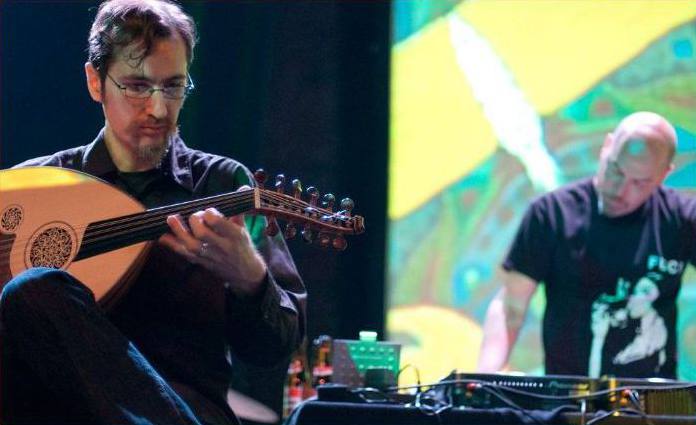 In the early 90s in California there were quite a lot of sitar and Hindustani classical music concerts, and I thought about learning that but it never quite happened. Instead, somewhat accidentally I stumbled into a new college ensemble called the UC Santa Barbara Middle Eastern Ensemble, and the director, Dr. Scott Marcus, persuaded me to pick up the oud. Everything began there, and quickly I sort of jumped in headfirst and got very involved with Arab then Turkish music. I went to Turkey in 93 to study oud with Necati Çelik and have been actively studying Ottoman art music, Anatolian folk music, the makam modal system, etc. since.
On your website you call yourself “ethnomusicologist, oud artist, audio engineer“. Are all three areas of your interest of similar importance for you? Do you see a huge difference between your academic interests and work and your performances as solo artist or with other projects?
I’ve been doing ethnomusicology, oud and audio engineering for 20 years now, and in some ways they feed into each other, but in other ways they’re very much compartmentalized. I had always tinkered with making home recordings, but after a string of disappointing experiences in California recording studios came to the conclusion that Californian rock engineers had no idea how to record oud or Middle Eastern percussion and I would need to do it myself. Once I got more into recording, I started to discover things that fed into my oud playing and creative process. My interest in recording also led me to do long-term ethnomusicological research into Istanbul’s recording studios, which I’m finishing a book about right now. I engineered a lot in Istanbul; I was a studio musician there as well, and I would not have been able to pull off the “academic/research” part of the project without that practical, hands-on experience.
But, for example, I have little interest in doing an ethnomusicological study of the oud, I’d rather just play it! I would never want to run a commercial recording studio again. When I create Kaderci recordings or do collaborations with other artists, I think of it as a form of research, but not research with the brain/mind. It’s research with the heart.
All I know about the origins of your music is that much of it derives from the tradition of arabic or other near east countries. This is, however, a large part of the world. Are you particularly interested in a certain country, or is your music influenced by several Turkish, Arabian and Persian styles?
I do listen to a lot of music from the region, but my focus has been on a few specific kinds of music from Turkey. In the 19th-20th century there was a romantic movement in Ottoman art music and numerous composers wrote stunning instrumental and vocal works – I’m thinking of Dede Efendi, Tanburi Cemil Bey, Ismail Hakkı Bey, and many others. This music works great on the oud automatically. This is the repertoire you learn if you go to a conservatory in Turkey, and most Turkish CDs of oud music are of this romantic period. I seriously studied this and continue to play it.
 More recently I’ve been more interested in rural Anatolian musics, particularly the secular songs (deyiş) of the Alevi religious order, and the bozlak song form of Central Anatolia which is really beautiful and very “deep.” Because of my research in Istanbul recording studios I also encountered a lot of what is called “arranged folk music.” Arrangement is a very creative practice in Turkey; arrangers have found ways of adapting folk songs for all kinds of ensembles, ranging from groups of folk instruments to a jazz, surf-rock or heavy metal band, and most interestingly, folk instruments on top of metal/rock. Any and all of this is stuff I might listen to (and for a few years I listened to nothing but recordings from Turkey), but how much influence this has on my own music varies from none at all, to a lot.
Do you prefer to play old songs that already exist, or rather own compositions of the basis of traditional structures?
It’s good to keep things diverse – playing old songs, creating new works, playing old C93 pieces, creating new pieces for C93. I’m creating new things all the time, including the Kaderci solo stuff, collaborative things, and I still make live sound sculptures and immersive environments from time to time.
People from western countries often find it difficult to distinguish between „classical“ and „folkloric“ music, if it comes from other parts of the world. Is such a differenciation important at all and can we draw an exact parting line between it? How much does it mean to you and do you see yourself more as a classical or a folk musician?
Part of the distinction is real and has to do with nothing other than the context in which the music is played. There were special forms of music created and performed in the Ottoman and Safavid Courts, and a lot of why we inherit the idea of Turkish or Persian “Classical Music” has to do with this. However, the term “classical” has been appropriated by music critics and record labels to include non-court music, which may have originally been 19th century popular songs from Istanbul that were most definitely not classical or courtly in any way. Likewise, “folkloric” musics are assumed to be local village traditions with the assumptions that there is no song “author” and that music hasn’t changed at all in the village. There’s been much critique of the whole folk concept, since we now know that some of this village music has very specific origins and known authors, and we’ve been able to document rapid changes to village folk musics as well.
I’m very suspicious of classical/folkloric distinctions made today, either in Turkey or elsewhere, since they tend to be noncritical attempts to either increase or decrease the perceived legitimacy of the music. One example: for whatever reasons, even though Alevi music from Central and Eastern Anatolia is composed, authored, is serious listening music and has an unbroken tradition of performance going back just as long as Ottoman court music, it’s not described as classical music but as folk music. Alevi musics are some of the only polyphonic musics from anywhere in that region and are exceedingly complex. Why is this folk rather than classical, when nightclub drinking songs from the 19th century are classical but not folk? It’s nonsensical!
Western listeners have a hard time differentiating musics for a number of reasons. Many people today encounter the music of Turkey via “world music” programming or record labels, and there’s a long history of exoticism and Orientalism that has skewed perceptions and provided a lot of misinformation. But this is not just in the West – in Turkey, there is a long history of “self-orientialization” and a lot of romanticization of Eastern Anatolian musics by urbanites who have no idea what the musics are or what they mean.
In terms of what I do, I play the oud! I play music I love…
 I found fotos from a performance you gave in an Istanbul bar. Have you played often in countries of the orient? What can you tell about the reactions of the people towards a “western” musician, who performs „eastern“ music?
I have a repertoire of some 500-600 works from Turkey/Egypt, and have done over 1000 performances of this, both solo and in small groups. When I was living in Istanbul and working in the studios I played out twice a week, one night at a meyhane (restaurant that serves alcohol), one night at a bar. It was a great experience, and I really like performing folk/light art music for Turkish audiences since they’re so passionately into it, dancing for hours, then crying and singing along when we’d sing melancholic songs. It’s totally different playing for American audiences; people listen silently and politely clap at the end of pieces. At least for this music, I prefer the Turkish way!
In terms of reactions, of course there’s the novelty factor of an American singing Turkish music, we were on TV, in newspapers, etc. That eventually wears off, and some people who regularly attended our Istanbul shows would start to actively comment on, criticize and correct our performances. They’d take my lyrics book in the middle of the show and cross off lines they thought were inaccurate and put other lyrics in there, and even debate with each other about precisely how to best correct a wrong verse. I loved this – it was an amazing learning experience. A couple of fans would make us compilation CDs with every known recording of a particular song we played, so we could better “copy” the “correct” recordings. People realized we genuinely loved the music and had respect for it, so there was a certain degree of respect for us based on that. This is what we experienced and what we overheard, but you’d have to ask Savaş, Ergül, Cevdet, Mehmet, Tülay, Mustafa and the many others who regularly came to our shows, they might tell you something different…
In recent years the orient has often been associated with violence and instability. You took part in a talk about “Music of Conflict and Reconciliation: The War in Iraq/Post-9/11 World“. What can you tell us about your experiences there?
The most disturbing thing that emerged in this symposium was the extent to which music has been used as a weapon of war or torture, mainly by US military forces, in both the first and second Iraq wars.
Would you say your music is (also) an attempt to reconcile orient and occident?
Not at all! If anything, my oud playing is an attempt to reconcile my left hand and right hand, my composing is an attempt to reconcile my atria and ventricles, and my engineering reconciles right and left brain… but you asked about orient/occident, and for me I wouldn’t know how to divide things that way. I think of it this way: Istanbul is a cosmopolitan and modern European city; it has its quirks, but so do Rome, Paris, Berlin, London, etc. It has always been connected to the rest of Europe to some extent, so when I was living there, I didn’t really have the sense that I was in a world that was radically different. I mean, of course, there are differences – the language is really different and quite tough to learn – but North Germanic languages and Mediterranean romance languages are similarly different.
In some of your works, jazz and break beat elements are included. Are these just several elements that you admire, or is there a particular „crossover“ concept behind it? When you make use of computers to create loops, do you feel that traditional instruments and modern technology can complement one another in a very fertile way?
 I hear songs, textures, timbres, and orchestrations in my head. I always have. It’s a matter of being able to take what’s in my head and turn it into actual sound. Nothing arises from any preconceived concept – I’ve tried that out and it never sounds good. So I have these abstract sonic ideas/feelings/soundings, and try to find resonances – something I can play on the oud or percussion, on my analog synths, field recordings of desert landscapes or construction sites, or digital signal processing applied to something from the archive of sound recordings I’ve made in the past. Sometimes a solo oud recording emerges, sometimes it’s a harsh industrial texture, sometimes something else.
One question is more or less obligatory: How did you came in contact with David Tibet from Current 93, who was it that discovered the other? Can you tell our readers a bit about your first meeting?
I’ve enjoyed Current and many other former World Serpent/Rough Trade artists since the late 80s. David and I “met” on myspace, actually – David had been listening to quite a bit of Coptic Christian oud music from Egypt, I had been listening to Current, after a couple brief exchanges I mentioned I’d be happy to contribute oud to Current or other projects, and an hour later David had emailed me 20 mp3s of Baby Dee piano/organ parts!
David Tibet and his music is popular in various underground scenes from Industrial to Folk to Psychedelic, although he may not see himself as a part of that. How much can you as a classical musician identify with such counter cultural phenomena? Did you also have a sort of teenage punk rock period or the like?
I played in a couple industrial bands in California in the 90s, the heavily-amplified-found-objects-with-screaming-vocals kind of industrial, that is. All the music I’m interested is intense in some way, although intense acoustic folk music and intense industrial noise obviously involve different techniques. One thing I love about Current is the way that it has changed over the years while keeping the same core intensity. Of course, most of that has to do with David, who is such a superb lyricist, performer and visionary, and attracts such interesting collaborators.
What are for you the main rewards when working within a band context?
Well, I don’t like performing solo, I got into oud playing and recording in a very social way, and find collaborations to be the most rewarding thing. Music is a form of communication. It’s not a language, but it’s communication, and there is simply nothing in the world like what happens when good musicians get together and interact, communicate. It’s really fulfilling for audiences, too, it fills a void that nothing else does, and I think that’s why in this “digital” age there is such a thriving economy for live bands. Such as Current…
What can you say about your experiences during Current 93′s “gentlemen“-tour (as Andrew Liles put it)?
Ha, the “gentlemen’s tour”! It went really well, the audiences were wonderful and yet quite different from each other. We played mainly material from the new albums (Honeysuckle Aeons, Baalstorm) and the Aleph/Black Ships trilogy, and I think that made for a really powerful and dynamic set. The local promoters in Athens, John and Anna at CTS Productions, are at the center of the local black metal scene, were gracious and did a great job reaching out to the community. The tour also saw the first Current show in Denmark, and that one went so well that there’s talk of a Scandinavian Current tour soon. We could call that one “the son of the gentleman’s tour”..
Thanks for the interview and all the best for your future endeavors.
Thank you!
(M.G./U.S.)
Fotos: Ladi Dell’aira & David Bauwens
We are an army of two and we take no prisoners. Interview with Mueran Humanos
 In his preface to Jeanette Leech’s book “Seasons They Change”, folk singer Greg Weeks wrote that many new developments in music are of a purely regenerative nature and ultimately lead to an inedible infusion of once exciting innovations. In our recent review on the debut of Mueran Humanos, the two Berlin-Argentinians, we noted how fresh and original this album is – how much their 80s inspired music in the tension between post punk and Suicide brings an actually consumed and exhausted style to breath new life. Carmen Burguess and Tomás Nochteff are not trying to be clones who try to reanimate the music of a certain temporal context without any refractions and new ideas. Or as they say below: “We are not in the revival business.” In the following interview, the two give an insight into the band’s history, their conceptual ideas and a variety of other projects, which illustrate that the interests of the two go far beyond music.
We don’t know much about your band’s history – only that you’re from Argentina and have lived in Barcelona before. Can you tell us a bit about how you met and decided to form Mueran Humanos?
Carmen: We were lovers in Buenos Aires since we meet in 2004, but we never played together, because each of us had an own band and we perceived ourselves almost as enemies. At some point I lost everything, my band, my family, everything – I even had no place to live. Somebody gave me an apartment to look for and I locked myself inside. Tomás was the only person who visited me. So I abandoned Buenos Aires before leaving it physically, and in that loneliness he was the only person allowed to enter. The things had radically changed since then in a positive way. Tomás left the country and I stayed for a while trying to fix the mess my life was, and after some time I left too. Tomás was waiting for me at the airport in Spain and we’ve been together ever since. We tried to play together and Mueran Humanos happened. I was a triumphal accident. Nothing was planned.
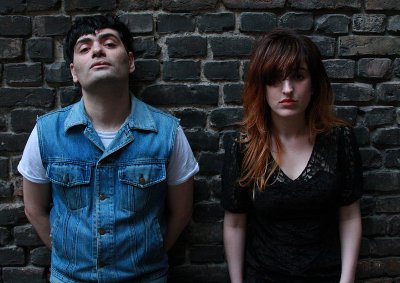 Tomás: We started to live together in an empty house, we only went out for strict necessity. We lived a couple of years in that way, no furniture, no Internet, TV, or radio, we didn’t buy magazines, newspapers neither books, we didn’t go to the cinema, gigs, nothing, we completely disconnected ourselves from the outside world, like it didn’t exists anymore for us. In that way we developed everything that is MH now, artwork, videos, music, lyrics. We made our first apparence in an art gallery with a live installation involving video, music and a corpse. The music in that time was much more abstract than now, we didnt make songs for a while. We were trying different things all the time, one night a song appeared and we start to make songs together and start to play live more, we still do a lot of different things. We decide what to show and what not, you see a rock band but there are other things behind it.
What can you tell us about the alternative/underground music scene in your country? In what sort of groups did you play earlier? Is there an element in your music that you would see as typically Argentinian?
C: Mujercitas Terror is the only band I’ve ever belong to, I couldnt really play any instrument but they put me in the band anyway. I’m still their most loyal fan. I don’t think that there is anything typical Argentinian in our music. The things I love from Argentina are too unpopular to called them “typicals”. In a way we are originators of a new scene, wich is really small, and with MH we continue that path. Tomás used to play in a cult band called Dios.
T: There’s good bands in Argentina but the best ones never make it. There’s no money whatsoever in underground or experimental music, even when there’s plenty of audience for these things, but there is no structure, so people tend to give up and its difficult to make records. The best thing about it is that people keep doing it against all odds. Anyway we are outsiders by nature and election, so we are not representative of mainstream culture, Argentinian or any other. We played in bands before and we are closely related to a small group of people, bands like Travesti or Mujercitas Terror, these people are the most important influence in our life… but it is too small and individualistic to call it a movement or style.
 I always thought that the geographical isolation of our country and our culture give us a freedom for developing our own thing. I was always well aware that the majority of the music and youth counterculture is anglosaxon and I am not, therefore even if I draw inspiration of it I feel the need to develope my own thing, so I disconnect myself from it from the begining. But this is a highly alien concept in Argentina, most bands are just clones of English or American bands and they conform with it, just like everywhere else. So yes, being from Buenos Aires is a big influence in what I do but at the same time we are not the typical Argentinian band.
Many people bring you in context with the so called post punk genre. As musicians with a wider range of influences, are you comfortable with such a label, if it’s not used as a narrow minded category?
C: Well, “Post punk” is ok if you want, although I don´t agree that it explains the music we make. There are other labels that exist for the sake of selling tickets for venues like “electronic noise pop” or “industrial dance” or “space punk, synth wave, post wave, witch house, kraut punk, or even worst “indie noise”… I don`t really care.
T: To be honest I hate being labeled, I am not comfortable with any label. Besides I don’t believe in post punk as a genre, for me they were just a bunch of punk bands trying to do something original, some of them we like and others not, at least the original ones. Contemporary post punk is people trying to copy some music and style of that era and that’s something we definetly not doing. We are not in the revival business. Mark Stewart from the Pop Group came to see us and helped us with the album because he said that we remind him of that whole era in the way we approach things, he said that for him we are like this original punks trying to push things forward, not copying but doing our own thing. Is not that we decided to do a style of music, what we do is just inevitable, we can’t do anything else really. We work with what we have: a bass, a cheap synth and old drum machines, we use tapes because we don’t own a sampler or a proper computer, all this can make our sound remind you of old records because its old equipment, we don’t try to sound like it’s 1978… if we could buy expensive synth and big samplers and 6 thousand euro computers and sound bigger than anyone else, we will.
The name Mueran Humanos sounds like an antihumanist statement. How would you describe your interest for the morbid side of human nature?
 T: We are interested in double, multiple meanings and mystery. We use collage, cut-up, improvisation, altered states of mind and esoterism to create what we create. There is not a single linear thing in Mueran Humanos. Starting with the name, that doesn’t really sound gramatically correct in Spanish and can be interpreted in many ways.
I made a fanzine of cut-up newspapers for years, anonimously, called Mueran Humanos. When we started the band, Carmen liked the name and proposed me to use it. We feel it related to the beauty of the forces of nature, glaciars, tsunamies, earthquakes, tigers, elephants, black holes. I liked also the fact that it sounded totally unfashionable in that time. People seem fascinated with the deepness and importance of superficial things, it’s like a way to look intelligent. They seem to despise romanticism and artistic ambition, being superficial and normal and meaningless is considered cool, innovation and personality is declared dead, passe, pretentious, childish, fake. It-s OK to be revival, it-s OK to be meaningless and superficial. We go for the oposite, we care. So the name is the result of taking our attitude to the ridiculous extreme, making fun of the whole cultural landscape, is a provocation to show that we are not afraid of being ridiculous or unfashionable. Our name is confusing, evocates many things at once. Its like a sign in the door saying “inside here nothing is what it seems to be”.
C: I like the unPC of our name, and I like the exaggeration in it. Too many times I had to restrain exaggerated emotions or reactions in order to not distub the standards. We are excessive, we like excessive people and everything that is taked to the extreme. I like everything that attacks the fake morality. I hate empty pictures and “nice” things without content. I hate the decadent and horrible photographer who tried to make me look awful in the passport photo this morning. Beauty has many enemies. But he children are like us. Mueran Humanos is the door, through which enemies cannot cross.
Do you feel any affinity to that loose group of people that are called “antinatalists” and who believe it would be better not to have been born?
T: I don’t know about these people, but if its that what they think, why say it? Why don’t they simply kill themselves? I don’t know about them but as you present them they sound like posers. I don’t mind about cheap misantrophy. Nothing to do with us… the way we live, the kind of people we are and the place we came from… we would have died many years ago if we wouldn’t love life.
In that context I wanted to ask if you are familiar with the writings of the American author Thomas Ligotti. His pessimistic philosophy and the fact puppets sometimes occur in his work made me wonder if you have heard about him or read any of his works?
T: No. I know his name for his connection with Current 93, what I know about him is really interesting, I should check him out.
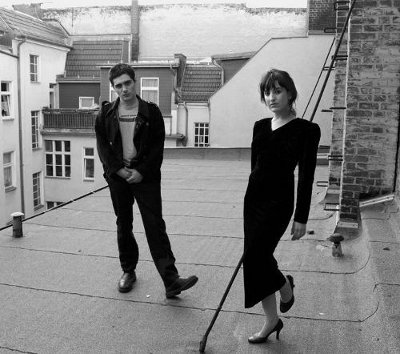 As probably not many of our readers understand Spanish, let’s talk a bit about some particular songs from your debut album. “Leones en China” seems to be inspired by political events (at least according to the background projection during live shows). What is it about?
C: Not consciusly, but is true that it allows that interpretation, because it mentions airplanes and bullets and a general apocalyptic scenario. I realized this much later.
“In China we children live in caves/In China the buildings are upside down/In China the sea has bones/And all airplanes are black/In China there are lots of horses hiding/And the moon is a painting/In China flowers are invisible/And the trees are made of worms/In China stones live in houses/And people’s teeth are nails/ In China Death wears white/And in China’s gardens bullets bloom”
There is nothing political about “Leones En China”, and its not even about China, at least not in a linear way. Again, we like to play with meanings, we like to fuck around with symbols, clash things, juxtapoze, twist, pervert. That’s how we make lyrics, images, music, but you are free to interpret what you like, you can use it the way you want to, as a gift from our world to your world, a gift and maybe a virus too. You can be free inside Mueran Humanos, that’s what it’s all about really.
In our opinion, “Corazon Doble” is the most powerful song on the album…
T: It’s one with more straighforward lyrics, is about that moment in the peak of ecstasy, when you see your future inevitable decay and you see it in a calm, melancholic way. But also you see there is an afterlife and make plans about it. Is a sad/happy song about pure love. We took the name from a Marcel Schowb book that we liked a lot. He uses it in the meaning of dualism, being one thing and the contrary at the same time, is a very gnostic concept if you like and I can relate to that, but in the context of the song it can also be interpreted in a romantic way, two hearts became one double heart, like our band.
C: For me this song has a very clear meaning and shows that a really strong union is more powerful than death. One of the lyrics that made the strongest impact on me was “Sara” by the german band Sand. It’s a very mysterious song, the singer asks “is that you Sara?”, and an almost imperceptible voice answers “no, its the storm”. Our song said : “When a strange morning shatters our windows/When you leave/Wait for me on the other side of the storm”.
“Festival de las Luces” seems “friendlier” in it’s outfit and implies something positively religious, but the video with the burned dolls seems to contrast this. What kind of sacrifice ritual do you act out on these mannequin’s heads?
 C: This song is a celebration of strange events and it’s interesting that without understanding the lyrics you catch the “religious” element, because it is about three nuns, part of the lyrics say: “…Party’s over/It came to an end/I’m walking happily/On my way home/ When I see them/Right over there In the light/They’re looking at me/ and In a car/They’re taking him away…/It’s raining houses/It’s raining cars/It’s raining letters/It’s raining blood…”
T: The video was made in a single night, we were drinking at a bar after a gig in Spain and a friend told us “I have this mannequin heads and I am saving them for you”, so we went to his place to check it, and when we saw them, we dislike them, so we said “let’s burn them”, so we go to the roof and we set them on fire and he filmed it and that’s it, we were all drunk and it was just natural and fun and the Police didn’t show up.
What were the main reasons for you to move to Germany? Seems you have yet a trusty audience in the capitol’s area.
C: Yes, we are happy with that, there is people who sing along our songs and they don’t even speak Spanish, it’s really nice.
T: Yes we have a lovely audience here. We were living in Barcelona in 2008, we never connected really with the city, when we came here for three weeks we found a much more friendly place for the kind of things we do and the kind of people we are, so we stayed and we are very happy with it. Also, I was always felt attracted to many things of German culture, like Grosz, Nico, Neubauten, Kraftwerk, DAF, Cluster, Sand, Murnau, Herzog, etc. so it just made sense to me in a strange way. I like Berlin. I don’t mind there is no sun, I never liked sun anyway.
We just watched your video of your “Monstruo” performance at Teufelsberg, Berlin. Would you say that the acoustic of that location and the history of the building were of equal importance when you chose to perform there?
T: Yes, it’s a place in wich many of the currrents of history cross with each other, a spiritual crossroad: the nazis, the CIA, the Soviet Union. Also the architecture, the acoustics, the nature around it, everything is fascinating, even the name of the place, the fact that it’s the highest point in all Berlin area, the fact that it’s a wood that grew on the litter of the war, etc. We aproached it as a psycophonic recording session, we wanted to be mediums and let whatever is there to express itself, that’s why the perfomance is so naked and improvised, we played with the place, not only in the place. We used it like an instrument and let the place use us like instruments.
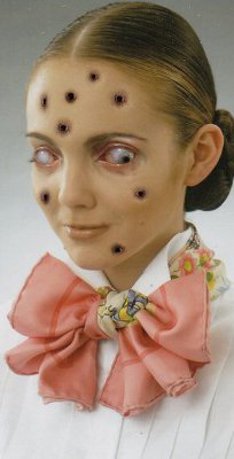 You stress the simplicity of this performance and that no effects were added afterwards. Was that also to show that music that has an electronic basis can be very effective without too many gadgets?
T: It was important for us to leave the place express itself, so thats why we kept equipment and performance to the minimum, it was an extraordinary oportunity to apply ideas that we have about silence in music, resonance, acoustic and psychic phenomena, in a way much more straighforward that we usually do. It would be a waste of time to go there and just make a wall of noise, you can get all the reverb you want for a 50 euro pedal, what’s the point to go there for that. But if you want to catch a ghost you just try to be still and quiet and open yourself to it. That’s what we did.
Carmen, you are also an illustrator and visual artist. Could you tell our readers how you work and what you regard as core elements of your art? Would you say that the artwork plays an equal role besides the music in Mueran Humanos?
C: I use the collage technique to draw and paint concret images. In the process, the colour and the drawing are operating although I use the collage techniques to create the forms, digitally or with paper I use the same technique of superposing layers. Sometimes I do it with dolls too. For me music and images and lyrics have all the same importance. We become a band wich make songs but we started doing soundscapes integrated in full installations with video, objects, etc. I would like to do more of this with Mueran Humanos, I like to rock but I missed the other part. For me the visuals we use on stage and the artwork are as much a part of Mueran Humanos as any of us.
You said about one of your works of art that “there’s a girl on fire, standing in a closed space, she’s burning alive but I can’t tell if she’s suffering or having a good time.” This ambivalence seems to be a characteristic of a lot of your work. I’m sometimes not sure if the disfigured figures are simply victims or just about to inflict pain (on others). Would you agree to that?
C: Yes. Ambivalence itself is a mystery and fascinates me. For instance Vampires are victims of a process, but I am not interested in the moment of pain or the family they left behind when they lost the human condition. I am only interested in the part in wich one reconciliates himself with what they are. In the case of this piece, her gesture shows something considered impossible: to feel pleasure while she is consumed by flames. In the case of the Seventeen girls, they are in peace with what they are. Only one of them is not and she’s the only one that communicates pain to me. I found the others just fun, they make me laugh.
You illustrated a special Christmas issue of a magazine called “Quimera”. One of the articles is entitled “Deconstruir la Navidad”. What can you tell us about this issue, and does your visual contribution also convey a personal statement on religion?
C: They offered me to illustrate all the short stories in the dossier. It’s a selection of short stories which happens at Christmas, and they all have an “anti-angelic” character. I have just read the stories and made a free interpretation for each one of them. One of the stories is pornographic and in general the content is very adult. I think that my collages bring esoterism and humour to it.
Recently the model Isabel Caro died of anorexia. At the moment there are discussions in the USA as even 17-year-old kids go to the doctor’s to get an injection of Botox. Are your artwork and the other “seventeen”-pictures a reaction to developments like this?
 C: I can understand that a girl can decompose herself so fast in the fashion world, which is frivolous and yet aesthetically fascinating. I can understand that this world can swallow you. If you allow yourself to be filled with stupidity like a duck is filled with filthy food until the limb explodes to make paté, I think that you were born lacking something. Its difficult for women to move freely in a business for which they are just bait.
Your album just came out via Old Europa Café, which is on of the most notorious labels of the „industrial“ scene. How did you come in touch, and do you have any relation to the industrial scene in particular?
C: We are very proud and happy to be on OEC. We are indirectly related to the Industrial scene, last year we played at the finissage of a Genesis P. Orridge exhibition in Berlin, which was a great pleasure for us since we are his fans, and this year we will play in the festival Congresso Post Industriale organized by OEC in Venetia. Blind Prophet Records is also related to post industrial music. Anyway, we play in different scenes, we go where they invite us to go, from art galleries to noise events like Dienstbar or Salon Bruit and then punk squats like Köpi or Subversive and then the Almighty Wire thing and then Endorcism wich is a witch-house night… we don’t really belong to any scene but we are open to play… and anyway the moment we hit the stage, it’s ours and we are the ones in control.
T: Yeah it’s like guerrilla tactics, maybe we got it from our South American culture. We enjoy playing to an audience which is expecting something different. We are kind of crossover in a way. Rudolph heard us on myspace and was kind enough to contact us and offered us to release something, our album was just finished, so we sent it to him and he liked it and released it. OEC is a label which is on it purely for the love of music and who is not afraid of taking chances, we like many of the artists on the label, especially the ones that are more on the dark ambient, Spectre but also MB, Folkstorm and many others. We are not an Industrial band but Industrial culture was important to me always. TG, Coil, Cabaret Voltaire, TOPY, SPK and all that. I like to think that we have a similar spirit of exploration to this early bands, although (or maybe precisely because of that) the results are totally different. Maybe Rudolph saw that connection… who knows?
Tomas, besides a couple of collaboration you also do a solo project called “Nochteff” which is more based on soundscapes. As I first listened to songs like “Congregación de Alejos” I thought of some desperate urban wasteland folklore.. Do you “run” this project completely alone, and how would you describe it’s core elements?
T: Yes, I use my own surname for making different projects, I have an album of songs from 2004 called “Le Beat Juste” released in Buenos Aires. But then Mueran Humanos started doing songs, so now I make almost only more conceptual or experimental things. I put an album called “Pascua Pagana” (Pagan Easter), which I made in three days during Easter 2006 in London with only a bass with 3 strings, 3 channels, 3 effects and 3 tapes. First I put it out in cassete but now it’s for free download on the German label Alarm Platten. Also I am working in a psychogeographical DVD on the city of Buenos Aires with a filmmaker. I choose some trips througth the city that I feel important or powerful, by train or car, he do the trip and film it, and I am doing the music to go with it. Also I have an eternal album going on in wich all the lyrics are cut-ups made from newspapers, it’s mostly voice, electronic feedback, tapes and bass, I work on it from time to time for the last four years. I also just put out a book of cut-ups in a small experimental poetry publishing house of Buenos Aires, called Bases Para el Turismo del Futuro (Foundations for the Tourism of The Future). There’s lot of things, but Mueran Humanos is more important to me, so the other things go slow.
 You also did a hommage to the late Jhonn Balance. What did his music (e.g. with Coil) mean to you? I could only imagine that the passing of Balance’ former partner Sleazy shifted the work’s meaning once again..
Coil is one of my favourite bands ever, I especially like the “Musick to Play in The Dark” series and “Horse Rotorvator”. But besides that there is something very special about Balance, something personal, when I hear his voice I feel it very close, it only happens something similar to me with Nico and Captain Beefheart. I know other people who feel the same about him, he had a sort of strange power, a very fragile person but yet very strong. I made this song one night I was alone in the dark in our house in Barcelona thinking about Balance and how he said he loves Barcelona, I felt that a spirit enter my room through the window and sit beside me, I took the keyboard and “we” made the song together. At the moment I was convinced that the ghost, if any, was Balance himself. I am not asking you or anybody to believe it, I don’t know even if I believe it myself, I am just telling you what I felt at that moment and in wich mood I made the song, most probably it was only an hallucination. I used to see spirits and weird things a lot at that time. It was the same house in which Mueran Humanos started. It was a weird place, the people who lived there before blinded all windows with black painting and there were crosses and some magical symbols painted on the walls and everything was in a general state of decay and in top of that we started to live there doing sigil rituals, experiments with magic and other things, it was an hallucinatory enviroment to say the least so who knows… Anyway, the song is there now and I see it like an hommage to an artist that means very much to me and others.
The last question is trivial and obligatory: How definite is the nearer future of Mueran Humanos? Do you plan to stay in Berlin, and are you already writing new songs? Thanks for the interview and all the best!
T: Yes we plan to stay in Berlin for a while, it’s our second home now. Now the album will be released by Blind Prophet Records on vinyl in New York in early February. We’ll be touring the USA in February. After that we will comeback and do a European tour. We would love to do a South American tour as well. We have a lot of new songs, hopefully we can make another record this year, also we want to make an EP with four versions of a song, in Italian, German, English and Spanish, many ideas… we will never stop, we are an army of two and we take no prisoners.
C: Thank you for the interview, cheers!
(M.G. & U.S.)
At the core of Cut Hands there is darkness and there are rhythms, beyond that anything’s really possible. Interview mit William Bennett
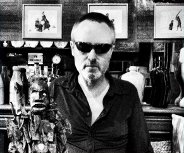 Seit William Bennett Whitehouse auf unbestimmte Zeit auf Eis gelegt hat und mit seinem Projekt Cut Hands sein Interesse an Afrika – das latent schon seit Ende der 90er bei dem in Edinburgh ansässigen Bennett da war und auf den letzten Veröffentlichungen von Whitehouse (durch Artwork, Titel und Einsatz von Perkussion) immer virulenter wurde – (weitgehend) instrumental auslebt, scheint das ehemalige Enfant terrible auf gewisse Weise salonfähig geworden zu sein, sein Schmuddelimage zumindest partiell verloren zu haben. Cut Hands teilen die Bühne inzwischen mit so unterschiedlichen Künstlern wie Weiterlesen
At the core of Cut Hands there is darkness and there are rhythms, beyond that anything’s really possible. Interview with William Bennett
It’s often said that it’s the second album of a band or artist, that really shows the direction and proves its enduring quality. I think “Black Mamba“ has finally shown that Cut Hands is not just a “project“. Which constant elements and changes do you see as most important, when you compare the beginning of Cut Hands to the new album?
Thank you! You know, it’s difficult to identify components that have special value, my tendency has always been to use a different set of rules for any single piece of music, often destroying the guide notes or even the technology used as a means to ensure that the creative process doesn’t get tempted towards simple reiterations of the same thing – at the core of Cut Hands there is darkness and there are rhythms, beyond that anything’s really possible.
Some reviewers have argued that “Black Mamba“ is less abrasive than its predecessor. Would you say that the noise part of/in your music is slowly diminishing and vanishing?
 Abrasive noise or sounds have the potential for great emotional expression and is something I’ve always utilized, and probably always will – for me, changing the dynamics of noise can make that even more powerful and enjoyable, certainly it doesn’t have to be in someone’s face all the time, I’m still continuing to learn different ways to deploy it.
On “Black Mamba“ three tracks have been used for soundtracks. Were these specifically commissioned and is that a direction you want to pursue further in the future?
Yes, I think it’s now as many as 4 or 5 of the songs have been used (“54 Needles” is also in “Bub & Friendz”, premiering at this year’s TriBeCa Festival). Although these tracks were specifically commissioned, they weren’t musically directed beyond vague associations and are integrally Cut Hands pieces.
Snoop Dogg (or his reincarnation Snoop Lion) is not an artist that is immediately associated with the work you’ve been doing for the past decades. What does an artist like Snoop signify for you? Would you say that the idea of transformation from Dogg to Lion appealed to you?
Early 90s Death Row and Dre as a producer (making Snoop Dogg’s best work) had a major influence; you can appreciate in the film the purity of Snoop’s intent and respect during his stays in Jamaica, despite some of the inevitable later claims of marketing exploitation; the potential of personal transformation in general is something that I’ve always been deeply involved with.
 How was your interest in “Krokodil” and its devastating (side-)effects aroused?
A piece was commissioned for the film “Krokodil Tears”, which dealt specifically with this, I was very moved by the shocking images of those suffering from the devastating side-effects of the drug juxtaposed with the enormous panoramic beauty of the Siberian wilderness.
The first track contains material that was originally used for your installation at Tate Modern. The lyrics played an increasingly important role in the last couple of Whitehouse-releases whereas Cut Hands is primarily instrumental. What is for you the relationship between sound and word(s) in general and in Cut Hands in particular?
Yes, there’ll be more of these extralinguistic sequencing tracks. At its heart, I guess my expertise is really as a dirty words specialist and just as there is less noise in the music, there are also fewer words: This was one of the reasons for incorporating special texts for each song on “Black Mamba” in the accompanying booklet, it’s still really important.
How did it feel to be part of the art world with ”Extralinguistic Sequencing“ – at least temporarily?
Actually, without its ever being a deliberate strategy, I do so much all over the place within the mainstream artworld now, it almost seems like a familiar home.
 I remember that when you played in Cologne at least a couple of people seemed to be irritated and agitated by the film that was shown in the background. Have you experienced people accusing you (there or somewhere else) of using such images just for the sake of cheap thrills or that this is an exploitation of indigenous culture(s) by somebody from the west (I’m asking because I also remember a letter in the Wire about a similar topic)?
The thing is these aren’t mondo films! The images are either from Jean Rouch in the Congo or Maya Deren’s “The Divine Horsemen” of vaudou rituals and carnivals in Haiti; these kinds of reactions aren’t uncommon and I’m happy that they’re occurring because anybody that feels like that upon watching people celebrating and having an important meaningful time should take a cold hard look into their own conscience and wonder what the real cause of their agitation is. It’s not exploitation, it’s an important part of my inspiration to which I’m paying homage and which are also of great beauty.
Same comments apply to The Wire’s editor who, with seemingly no trace of irony in his unseemly haste to take a gratuitous potshot at me, managed to simultaneously justify naked piracy of original African music to Western audiences – just because you use the term ‘ethnographic’ music, doesn’t make the expropriation any less culpable.
As far as I know, you haven’t visited Africa so far. Do you think that the geographical distance and the lack of direct experience is a main source of creativity? I mean, it requires a stronger stimulation of fancy…
Yes, that’s right. Creativity comes from the imagination, stimulation is good to stoke its flames – and yet even in an empty windowless room, it would be and is capable of amazing things.
 Do you plan to go there one day, and if yes, which places and things would you love to see?
The sunsets, the wildlife, the sounds of life, the smells, surely it must all be incredible. it’s a dream, I hope that will be realized one day.
What do you think are the most valuable things that anyone can learn and adapt from African music and aesthetics?
The best book I ever read on the subject is the wonderful ‘African Rhythm And African Sensibility’; one of the chapters is essentially a philosophical monologue by master drummer Alhaji Ibrahim Abdulai; even to begin to come to terms with African music, one has to give up so many fixed preconceived notions about our music and what it represents and does for us – that process in itself is transformational, and hugely rewarding.
I guess that from a European or Western perspective, no continent is so much tied to stereotypes as Africa is. The cliché of warlords and hut barracks contrasts the cliché of archaic masks and pittoresque landscapes. Whilst some people complain about the absence of skyscrapers over there and want to help the people due to our own standards, others stress the vast difference between our cultures and their ones. I often think that we tend to forget to ask the Africans first, how they see themselves. How do you think about this?
 Totally agree with you. I have no issue with the romanticisation, that’s natural and happens everywhere, how people around the world feel about London, New York, Paris, Berlin, Bangkok, Tokyo are all essentially heavily romanticised images, for better or worse; where Africa suffers is from European maternalistic condescension, guilt complexes, patronizing saviourism, capitalist aggression, evangelizing, and so on – it’s as if it was not enough to be punished once by colonialism.
You’ve said in an earlier interview, that you are not really interested in religious belief systems, I think chiefly because of the group aspects. Would you say, that your music with Cut Hands has or can have something like a spiritual dimension for the listener/dancer nontheless?
I hesitate to use the word ‘spiritual’ because it’s so commonly associated with the language of religion; however, the experiences often elicited by religion and other social phenomena are natural and could be experienced through music for example. Elements of this are alluded to in the aforementioned book, and indeed in Maya Deren’s accompanying “Divine Horsemen” book, she experiences this first hand in Haiti – Keith Johnston explores this in his drama experiments with masks in “Improv”.
When you include elements from cults like Voudou, Santeria etc. into Cut Hands, do you keep an awareness for the world view behind this, or do you regard your musical reference more as a decontextualisation of ”occult“ sounds?
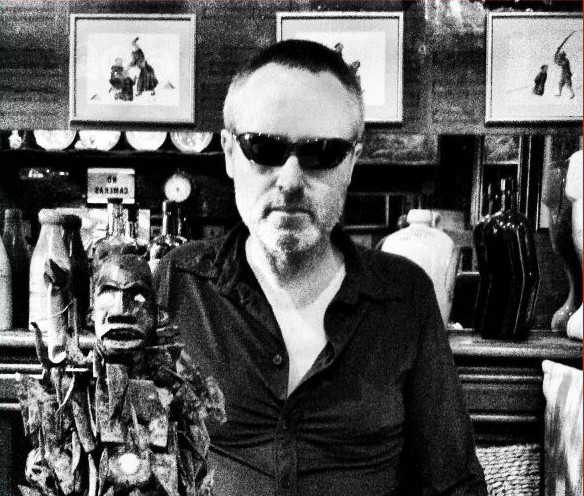 What many people fail to understand is how open Voudou and Santeria are, especially compared to the default religious monoliths – they encourage new participation and free artistic expression within their traditions, they are friendly; embracing these traditions is participating is celebrating, it’s all the same thing. Just as you can’t laugh or kiss someone or talk aloud in a church, we are so used to walking on tiptoes around ‘religion’ so as not to offend, it’s easy to forget that in other syncretised traditions, things just aren’t the same.
The DJ Benetti sets are still part of your event schedule.. At the heyday of Italo Disco you were very much involved in the noise music scene, so how and when did you discover this sort of music and what makes it so outstanding for you?
Funnily enough, and it’s because I’m old enough, it was right at the same time it happened; I moved to live in Barcelona in 1984/85 and became addicted to it there, where you’d hear Italo all the time in clubs and on the radio! Probably more even than if you lived in Italy.
You once said, that a main problem of contemporary music is its tendency to conformity and its slavish obedience to rules. Are there still exceptions, some contemporary music that you follow with interest?
As much new music as I can with interest and, despite my comments, there’s actually hell of a lot of great stuff going on nowadays; by the overwhelming volume of choice that we now have access to, I’ve learnt that you just have to curate your musical environment a bit better and work a little bit harder to find things; the rewards make that worthwhile.
To end on a lighter note…You’ve just collected all “Uncle William” episodes. Do you think you may write new ones?
The world’s probably had more than enough Uncle William already…
(M.G. & U.S.)
Zeichnungen: Mimsy DeBlois, Konzertfoto: Jimmy Mould
Personal loss is an important literary theme and one that I return to quite often: Interview mit Joel Lane
 Unter den Autoren, die in der jüngeren Vergangenheit originelle Beiträge zur unheimlichen Literatur beigesteuert haben, sticht der in Birmingham lebende Brite Joel Lane aus verschiedenen Gründen hervor. Sein Output ist weder auf ein Genre noch auf eine Gattung festgelegt: So lassen sich seine bisher veröffentlichten zwei Romane From Blue to Black und The Blue Mask tendenziell eher dem Mainstream zuordnen, seine vier Sammlungen mit Kurzgeschichten (The Earth Wire wurde 1994 mit dem British Fantasy Award ausgezeichnet) gehören dagegen zur unheimlichen Literatur; außerdem hat er noch mehrere Lyrikbände veröffentlicht. Weiterlesen